National Data Centre No.1 Strengthens Foundation for Việtnam’s Digital Transformation, Says Party Chief
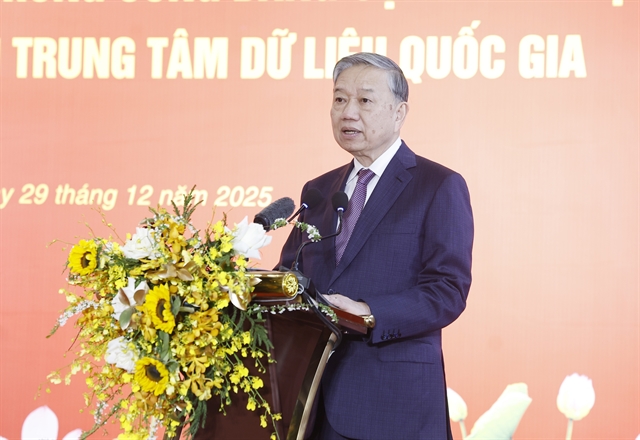
Hanoi, The Gulf Observer: The completion and commissioning of National Data Centre No.1 have laid a crucial foundation for Việtnam’s data infrastructure and will make a significant contribution to accelerating national digital transformation in the coming period, Party General Secretary Tô Lâm said on Monday.
During a working visit to the facility at Hoà Lạc Hi-Tech Park in Hànội, the Party leader was briefed on the centre’s operations and strategic role. The centre, the first specialised unit directly under the Ministry of Public Security tasked with state management and coordination of data, was officially launched on February 25 and inaugurated on August 18.
Positioned as a core and pivotal facility, the centre is expected to serve as the “brain” and “heart” of the country’s digital transformation process. It has synchronously consolidated a large volume of data into an integrated repository, including 157 million datasets drawn from 16 national and sectoral databases.
According to reports at the meeting, the centre has coordinated with the Government Office to restructure procedures for 82 groups of administrative services. It has also deployed a modern ten-layer physical security system alongside a 24/7 cyber security monitoring system (SOC/SIEM) to safeguard national digital data sovereignty.
In addition, an innovation centre for data exploitation and research into strategic platforms has been launched, with preparations under way for the rollout from 2026 of initiatives such as the national data exchange, blockchain applications and a national virtual assistant.
Addressing officials and experts, General Secretary Lâm stressed that to realise the country’s two centennial development goals, there is no alternative but to accelerate progress, achieve strong breakthroughs and pursue sustainable development driven primarily by science, technology, innovation and digital transformation.
“In this new development model, data has become a strategic resource and a new type of asset, of particularly important significance to national governance capacity, the competitiveness of the economy and the quality of life of the people,” he said.
He emphasised that building infrastructure and collecting and storing data are only necessary conditions. More importantly, data must be effectively utilised, analysed and transformed into value—turning data into knowledge, into sound policy decisions, and into concrete products and services that deliver practical benefits to society.
The Party leader also identified three major challenges that need to be addressed: data quality has yet to meet requirements; a comprehensive data-driven innovation ecosystem has not been fully developed; and autonomy in core technologies, along with the availability of high-quality human resources, remains limited.
Building on the achievements of National Data Centre No.1, General Secretary Lâm called for the continued implementation of subsequent centres as planned in order to complete the national trusted data infrastructure network. He underscored that this task is of national importance and requires the shared responsibility of the entire political system, rather than any single agency.
The Ministry of Public Security has been assigned responsibility for state management of data and for assisting the Government in managing and operating the centre. The Party chief directed that the national integrated database be established in the first quarter of 2026, connecting relevant data repositories nationwide.
He also urged accelerated efforts to utilise data and generate value from it, while ensuring that 100 per cent of eligible fully online public services are implemented to maximise convenience for citizens and businesses.
In addition, the national data exchange should be urgently put into operation in the second quarter of next year. Priority should be given to mastering core and strategic technologies, particularly cloud computing, artificial intelligence, blockchain and shared data platforms, to gradually enhance technological self-reliance, reduce dependence on foreign providers and safeguard national digital sovereignty.
General Secretary Lâm further stressed that data security and safety must be ensured at the highest level, highlighting the importance of human factors. He called for special mechanisms and policies to attract and retain high-quality personnel, especially in key roles such as chief engineers and chief architects.
He also urged stronger international cooperation and collaboration with major corporations to facilitate the transfer of core technologies and the development of comprehensive training programmes for data and digital transformation personnel.