Hànội Approves Capital Master Plan with 100-Year Vision
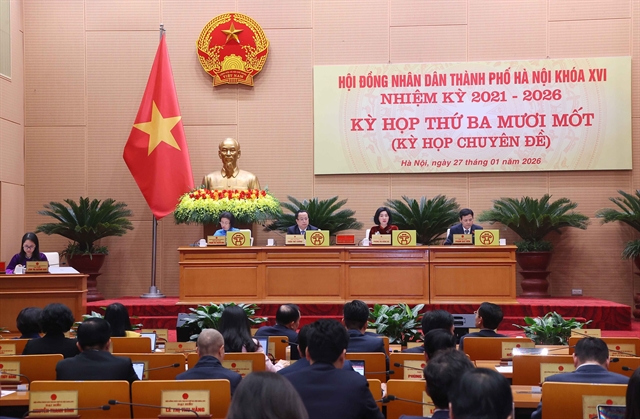
Hanoi, The Gulf Observer: The People’s Council of Hànội on Tuesday approved a resolution endorsing the core contents of the capital’s Master Plan at its 31st session, setting out a long-term development vision extending 100 years and beyond.
Described as a historic policy decision, the master plan is expected to shape Hànội’s future as a capital of culture, identity and creativity. It introduces a multi-polar, multi-centre and multi-layered urban development model aimed at restructuring the city in a sustainable and resilient manner.
The plan targets the development of a cultured, civilised and modern capital, featuring bright, green, clean and beautiful urban spaces that are resilient to climate change.
Permanent Deputy Chairman of the Hànội People’s Committee Dương Đức Tuấn said the new master plan seeks to position Hànội not only as Việtnam’s political and administrative centre, but also as a major national growth pole capable of generating development space and momentum, with an ambition of achieving double-digit economic growth over the long term.
He noted that the plan reflects a strategic vision aligned with the goal of building Hà Nội as the capital of a high-income country with a socialist orientation, while serving as a driving force for development across the Red River Delta, the capital region, the northern key economic zone and the country as a whole.
The adjustments under the master plan are designed to ensure consistency with organisational restructuring, administrative boundary changes, the implementation of a two-tier local government model, and alignment with the National Master Plan, the Red River Delta regional plan, inter-provincial connectivity strategies, and sectoral and thematic planning frameworks.
Strategically, the plan shifts from a previous outlook to 2065 toward a long-term orientation extending beyond 2100, effectively establishing a 100-year vision. Development scenarios will be mapped across key milestones, including 2030, 2035, 2045, 2050, 2065, 2085 and 2100, with the objective of shaping a capital defined by culture, identity and creativity.
Under an open population scenario that manages growth in line with infrastructure carrying capacity rather than rigid controls, Hà Nội’s population is forecast to reach approximately 15–16 million by 2045 and 17–19 million by 2065. The longer-term outlook from 2065 to 2100 envisages continued population growth accompanied by workforce rejuvenation and modernisation.
In terms of spatial and urban infrastructure development, the master plan identifies nine growth poles. These include the central urban area on the right bank of the Red River, encompassing the historic core and expansion zones, which will function as the cultural, historical and political hub of the capital alongside an Olympic urban area.
The northern growth pole covering Đông Anh, Mê Linh and Sóc Sơn is positioned as an integration-driven engine featuring international services, trade, finance and logistics linked to Nội Bài International Airport, as well as high-tech industrial centres.
To the east, the Gia Lâm–Long Biên area is planned as a gateway and trade and service growth pole, hosting large regional commercial complexes, inland container depots and modern logistics hubs connected to National Highway 5 and the Hà Nội–Hải Phòng Expressway.
The southern central urban pole in the Thường Tín–Phú Xuyên area is designated as an industrial and logistics engine, incorporating high-tech industry, high-tech agriculture, inter-regional services and multimodal transport hubs associated with Hà Nội’s second airport in the south, high-speed rail and river ports.
Another southern pole centred on Vân Đình and Đại Nghĩa is planned as an ecological landscape city along river corridors, integrating heritage and spiritual spaces linked to the second airport.
The southwestern pole in the Xuân Mai–Chương Mỹ area will focus on education, training and health care, combined with eco-resort development. To the west, Hòa Lạc is designated as a science, technology, innovation and education urban area anchored by the Hòa Lạc Hi-Tech Park and Việt Nam National University, Hà Nội, with development corridors linking western provinces.
The northwestern pole around Sơn Tây and Ba Vì is set to develop as a cultural, historical and resort tourism region, combined with national defence and security functions. The Red River corridor itself is identified as a special landscape space integrating finance, commercial services and tourism.
Economically, the plan sets an average gross regional domestic product (GRDP) growth rate of over 11 per cent per year from 2026 to 2030, with per capita GRDP projected to exceed US$12,000 by 2030. By 2045, average growth is expected to remain above 11 per cent annually, with per capita GRDP reaching around $45,000. By 2065, growth is forecast to moderate to about 5 per cent per year, while per capita GRDP is projected at approximately $100,000.
Social development goals include the near elimination of poverty under national standards by 2030. The Human Development Index is expected to reach around 0.92 by 2045 and 0.95 by 2065, while the happiness index is targeted to reach 9.5 out of 10 by 2045. Average life expectancy is projected to reach about 80 years by 2045.
By 2030, the city aims to have fundamentally addressed major environmental bottlenecks. The resolution also outlines breakthrough tasks to tackle longstanding challenges such as flooding, traffic congestion, environmental pollution and the improvement of urban order as part of Hànội’s broader urban development agenda.