HCM City Launches Four Major Infrastructure Projects Worth VNĐ239 Trillion Ahead of 14th Party Congress
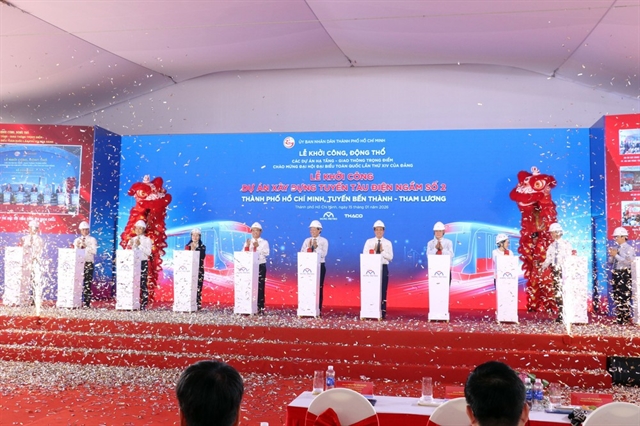
HCM City, The Gulf Observer: Ahead of the 14th National Congress of the Communist Party of Việtnam, HCM City on Thursday officially launched and broke ground on four major infrastructure projects with a combined investment of VNĐ239 trillion (US$9.7 billion), marking a significant milestone in the city’s long-term urban and economic development strategy.
Covering transport and sports infrastructure, the projects are expected to generate strong momentum for economic growth while reshaping the city’s urban landscape for decades to come.
The largest of the four is the Rạch Chiếc National Sports Complex, located in Bình Trưng Ward in the former Thủ Đức City. With a total investment of more than VNĐ145.6 trillion (US$5.9 billion), the 186-hectare complex is designed as a modern, international-standard sports and cultural hub.
At its centre will be a stadium with a capacity of 65,000–75,000 seats, capable of hosting major regional and continental sporting events. The complex will also feature an 18,000-seat indoor arena, aquatic sports facilities, tennis courts, indoor sports venues and supporting infrastructure, including a central plaza, public service areas, a sports hospital and an exhibition centre.
Implemented under a build-transfer (BT) model, the project will see investors reimbursed through land funds rather than direct State budget spending. Đặng Minh Trường, Chairman of Sun Group, the project’s investor, said the modern design and advanced equipment would enable the stadium to host international sporting events as well as large-scale music concerts and major regional and global entertainment programmes.
The multi-purpose complex is expected to accommodate up to 90 per cent of Olympic sports disciplines, with highlights including a 10-hectare indoor arena seating 18,000 people and a convention centre with a capacity of 10,000 seats.
“This is one of Sun Group’s key projects in HCM City, reflecting our responsibility as a strategic investor committed to long-term development and to working alongside the city to create sustainable value for future generations,” Trường said.
Meanwhile, construction of Metro Line No. 2 linking Bến Thành and Tham Lương officially commenced, marking the only project among the four fully funded by the State budget. With a total investment of about VNĐ57 trillion (US$2.3 billion), the 11.27-kilometre line will pass through 14 wards and include 10 underground stations and one elevated station.
Considered a key north–south urban transit corridor, Metro Line No. 2 is expected to ease congestion along the Cách Mạng Tháng Tám–Trường Chinh axis and strengthen the city’s mass public transport network. Site clearance has been completed, and the line is scheduled to begin operations by the end of 2030.
Nguyễn Lộc Hà, Standing Vice Chairman of the HCM City People’s Committee, said the project would help reduce traffic congestion, improve public transport capacity and guide urban development in a more sustainable direction. He noted that the metro line is being implemented under special mechanisms approved by the National Assembly, reflecting a significant shift in the management and execution of large-scale infrastructure projects.
Another strategic project is the Cần Giờ Bridge, with a total investment of around VNĐ13.2 trillion (US$540 million), implemented under a public-private partnership and BT contract. Spanning approximately 6.3 kilometres, including a nearly three-kilometre cable-stayed section over the Soài Rạp River, the bridge will replace the Bình Khánh ferry and eliminate a long-standing transport bottleneck to the coastal district. The project is scheduled for completion in 2029.
The fourth project, Phú Mỹ 2 Bridge, has an estimated investment of VNĐ23.2 trillion (US$940 million). It will connect Nguyễn Hữu Thọ Street in the city’s southern area with Liên Cảng Road in Đồng Nai Province, easing pressure on the existing Phú Mỹ Bridge and providing a direct transport link to Long Thành International Airport. The bridge is also expected to be completed in 2029.
Hà said the Phú Mỹ 2 and Cần Giờ bridge projects play a crucial role in completing the city’s inter-regional transport network, expanding urban development space and easing pressure on existing routes. Together, they will strengthen connectivity between the city centre and southern and eastern areas, as well as the southern key economic region, in line with HCM City’s multi-centre development model that places transport infrastructure at the heart of growth.
He added that the Rạch Chiếc National Sports Complex is the first project to implement the Politburo’s Resolution No. 80 on the development of Vietnamese culture and aligns closely with the city’s strategy to develop cultural industries.
“With culture as a foundation, communication as a catalyst, sports reaching higher standards and tourism making breakthroughs, the city aims to turn cultural industries into a key economic sector contributing more significantly to GRDP growth, while enhancing HCM City’s identity and international appeal,” Hà said.
The simultaneous rollout of public investment and public–private partnership projects reflects the city’s renewed development mindset, in line with the Politburo’s Resolution No. 68 on private economic development, and reaffirms HCM City’s commitment to supporting investors and promptly addressing challenges during project implementation.