Lebanese President Joseph Aoun Visits Key Cultural and Historical Landmarks in Oman
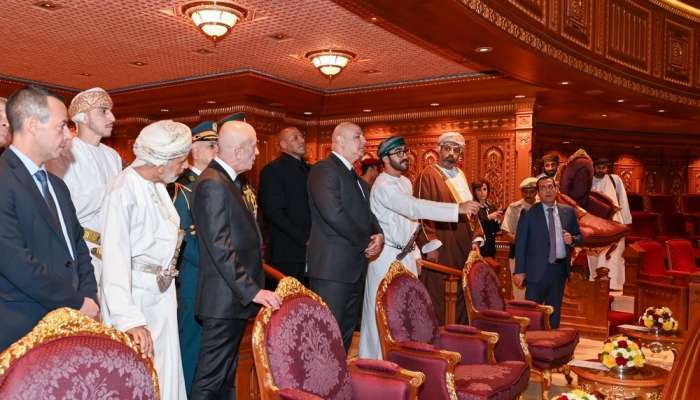
Muscat, The Gulf Observer: President General Joseph Aoun of the Lebanese Republic, accompanied by his delegation, visited several major cultural and historical sites in the Sultanate of Oman on Wednesday as part of his official visit.
The Lebanese President was welcomed at the National Museum by Jamal bin Hassan Al Moosawi, Secretary General of the museum. He toured its various galleries and received detailed briefings on exhibits showcasing the depth of Oman’s history and civilisation.
President Aoun began his visit at the Maritime History Gallery, where he viewed a model of the armed Muscat Baghlah, the largest and one of the most elaborately decorated traditional Arab commercial vessels in the Arabian Gulf. He then continued to the Land of Frankincense Gallery, exploring Omani incense burners and Armenian incense burners loaned by the History Museum of Armenia, highlighting the shared cultural heritage of frankincense.
In the Prehistory and Ancient Times Gallery, the President viewed the oldest known incense burner, dating back nearly two millennia BC and considered a masterpiece of the ancient Magan civilisation.
The visit also included the Splendours of Islam Gallery, where President Aoun examined the second edition of the Holy Bible printed in 1960 by the Paulist Printing Press in Harissa, Lebanon. The copy had been gifted to the late Sultan Qaboos bin Said in 2006 by Patriarch Gregory III of the Melkite Greek Catholic Church.
At the Oman and the World Gallery, he was briefed on the historic Omani–East African relationship, including the Sultanate of Zanzibar. He viewed Qamoos al-Shari‘a, the largest encyclopaedia of Ibadi jurisprudence and the first publication of the Royal Press in Zanzibar.
The President later visited the Renaissance Gallery, where he examined the original “Will Letter No. 1” issued by the late Sultan Qaboos to the Royal Family Council through the Defense Council.
In the Land and the People Gallery, he reviewed artefacts reflecting the historic ties between Oman and Lebanon, including letters exchanged between Lebanese dignitaries and the Sultans of Zanzibar, a box of commemorative coins gifted by former Lebanese President Émile Lahoud, and Lebanese educational books from the 1960s.
At the conclusion of the museum tour, President Aoun signed the VIP Guest Book, emphasizing the importance of enhancing cultural cooperation and deepening the longstanding friendship between the two nations.
The Lebanese President also visited the Royal Opera House Muscat (ROHM), where he toured the facility and learned about its architectural features, performance programmes, and advanced technical capabilities. He praised ROHM’s cultural significance and commended its blend of Omani and international architectural traditions before signing the VIP Guest Book.
President Aoun further toured the Sultan Qaboos Grand Mosque, receiving a detailed explanation of its construction, Omani and Islamic architectural styles, and facilities including the library and lecture hall. He expressed his admiration for the mosque’s design, noting its exemplary representation of Islamic architecture and its contribution to promoting Islamic studies.
President General Joseph Aoun was accompanied during his visits by Dr. Mahad bin Said Ba’owain, Minister of Labour and Head of the Mission of Honour.