Morocco Showcases “Irreversible Path” Toward Gender Equality at Feminist Diplomacy Conference in Paris
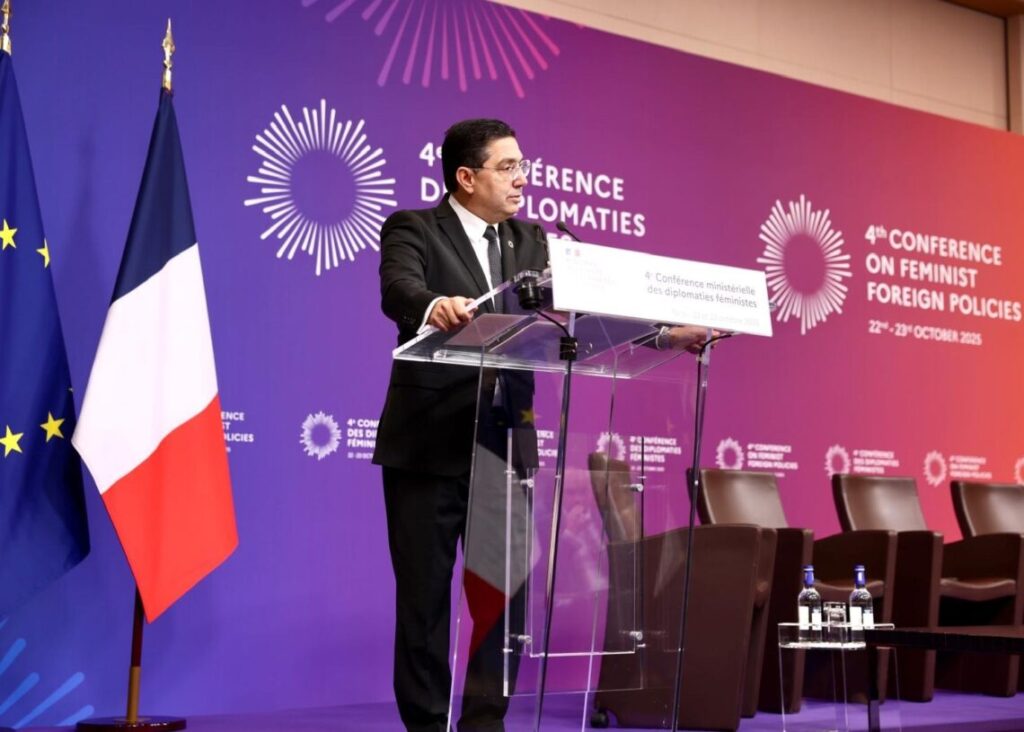
Rabat, The Gulf Observer: Morocco has been advancing on an “irreversible path” toward gender equality over the past 25 years under the leadership of King Mohammed VI, Foreign Minister Nasser Bourita affirmed on Wednesday during the opening of the 4th Conference on Feminist Diplomacies in Paris.
Addressing foreign ministers and representatives from around 50 countries, Bourita highlighted that Morocco’s reforms under the reign of King Mohammed VI have transcended legislative changes to fundamentally reshape societal perceptions of equity and modernity.
“Our confidence stems from the choice made by His Majesty King Mohammed VI to make women’s rights and equality priorities of His Reign,” the minister said at the gathering, which brought together nearly 450 participants, including France’s Jean-Noël Barrot and Spain’s José Manuel Albares.
From Domestic Reform to Global Leadership
Bourita noted that Morocco’s commitment to gender equality has evolved from a domestic reform agenda into a cornerstone of its foreign policy. As a member of the Feminist Foreign Policy Group (FFP+), Morocco cooperates with nations that place equality and inclusiveness at the heart of their diplomatic action.
“Our feminist diplomacy is, above all, a diplomacy in the service of peace,” he declared, underscoring Morocco’s adoption of its first National Action Plan in March 2022 to implement UN Security Council Resolution 1325 on Women, Peace, and Security. The plan, extended through 2026, strengthens women’s participation in conflict prevention, mediation, and post-conflict reconstruction.
Morocco ranks as the world’s ninth-largest contributor to UN peacekeeping operations, deploying 3,400 personnel — including 120 women, a number the government aims to increase.
Empowering Women as Agents of Peace
The minister also underscored Morocco’s initiatives to train women mediators at the community level, enabling them to prevent conflict and rebuild social cohesion. “Empowering them gives peace a human face,” Bourita remarked.
Through its partnership with the African Union, Morocco has trained hundreds of election observers between 2022 and 2025 — with women comprising 175 out of 300 trainees.
In the religious sphere, Bourita highlighted the significant role of morchidates (female religious guides) as “powerful agents for preventing violent extremism,” contributing to the country’s holistic approach to peace and equality.
Morocco’s migration policy also embodies feminist diplomacy principles. Women constitute nearly half of Morocco’s regular migrant population, benefiting from the landmark regularization campaigns of 2014 and 2017 that ensured their protection and dignity.
Pioneering Feminist Diplomacy at the United Nations
In April, Morocco introduced a historic resolution at the UN Human Rights Council in Geneva titled “Women, Diplomacy and Human Rights.” The resolution reinforces the observance of the International Day of Women in Diplomacy, calls for greater representation of women in international diplomacy, and urges states to ensure equal access and eliminate discrimination in foreign service.
Bourita also noted that Morocco’s feminist diplomacy is reflected in its bilateral relations — with equality forming a core pillar of partnerships with France and Spain, and cooperation with Japan and Latin American countries on the Women, Peace, and Security agenda.
The Strategic Case for Equality
Presenting global data, Bourita pointed out that women’s participation in peace negotiations increases by 20% the likelihood of an agreement lasting at least two years, and by 35% the chance of it enduring for 15 years.
Economically, he cited World Bank data indicating that closing the gender gap could expand global GDP by more than 20%. He also noted research showing that societies with higher gender equality are less susceptible to radicalization, and that investing in gender equality could reduce global greenhouse gas emissions by up to 15% by 2050.
Walking the Talk at Home
“Because feminist diplomacy cannot thrive externally without internal coherence,” Bourita said, Morocco has also advanced equality within its diplomatic corps. Women now represent 43% of Foreign Ministry staff, 47% of central leadership, and lead 45 out of 155 diplomatic and consular missions, including 21 embassies and 24 consulates.
The proportion of women serving as Consul Generals has risen from 3% in 2004 to 40% in 2024, while women now account for 21% of ambassadors, up from just 4% two decades ago.
“It is neither about compensating through favoritism nor balancing by numbers, but about doing justice through excellence,” Bourita emphasized. “Women have never fallen short.”
A Southern Voice in Feminist Diplomacy
Acknowledging that feminist diplomacy originated in the Global North, Bourita stressed that it is not exclusive to any region. “Feminist diplomacy gains its strength from diversity of experience and perspective,” he said.
He proposed three measures to reinforce the FFP+ network: expanding inclusivity while maintaining focus, implementing measurable actions with accountability mechanisms, and building partnerships that connect feminist diplomacy with global challenges.
Bourita also suggested launching a joint training program on feminist diplomacy and the Women, Peace, and Security Agenda, creating exchange platforms for women diplomats, and developing bilateral and triangular partnerships to share best practices.
“Feminist diplomacy is not a model to export, but an experience to share,” he concluded.
The Paris conference follows previous editions held in Germany (2022), the Netherlands (2023), and Mexico (2024). According to France’s Foreign Ministry, the event serves as a platform for participating states to reaffirm their collective commitment to women’s rights, equality, and justice — and to resist any regression in these universal values.