Pakistan, Saudi Arabia Initiate Talks on Local Vaccine Production to Boost Health Security
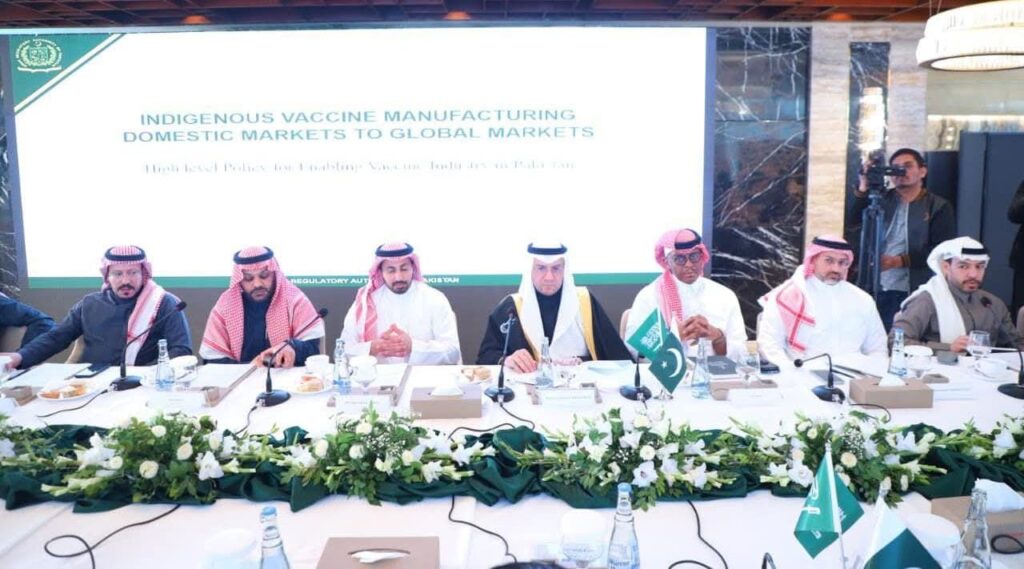
Islamabad, The Gulf Observer: Pakistan on Tuesday commenced high-level discussions with a Saudi delegation aimed at establishing local vaccine manufacturing, a strategic move to reduce import dependence and prepare for the eventual phase-out of international funding for the country’s national immunization program.
The initiative forms part of Islamabad’s broader strategy to enhance health security and expand domestic industrial capacity. Currently, Pakistan, with a population exceeding 240 million, relies entirely on imported vaccines for its immunization campaigns, with significant financial support from international partners.
Officials emphasized that local vaccine production would not only strengthen health security but also conserve foreign exchange, support long-term economic stability, and advance Pakistan’s goal of developing a competitive, export-oriented pharmaceutical sector.
The eleven-member Saudi delegation, led by Nizar Al-Hariri, senior adviser to Saudi Arabia’s Minister of Industry, arrived in Islamabad to explore cooperation in health, pharmaceutical manufacturing, and industrial development.
“Practical progress is being made toward the local production of vaccines for 13 diseases in Pakistan,” the Ministry of National Health Services stated, quoting Federal Health Minister Syed Mustafa Kamal, who met with the delegation.
During the meetings, Pakistani officials provided detailed briefings on current vaccine demand, existing infrastructure, and potential production capacity. “Collaboration between Pakistan and Saudi Arabia in the health sector will set an example for the entire region,” the ministry added.
Highlighting the country’s demographic challenge, Kamal noted that Pakistan is the world’s fifth most populous nation, with approximately 6.2 million children born annually—roughly equivalent to New Zealand’s population. He pointed out that while the government provides vaccines for 13 diseases free of cost, none are currently produced domestically, resulting in an annual import bill of around $400 million.
Currently, international partners cover nearly 49 percent of vaccine costs, with the remainder borne by the government. Kamal warned that external funding is expected to end by 2031. “If vaccines are not manufactured locally, the annual cost could surge to $1.2 billion by 2031, placing a heavy burden on the national economy,” he said.
Pakistan conducts nationwide immunization campaigns against diseases including polio, measles, rubella, and hepatitis. This week, the country launched a seven-day polio vaccination drive aimed at inoculating over 45 million children.
The ongoing talks with Saudi Arabia represent a significant step toward reducing Pakistan’s reliance on imports while simultaneously strengthening the nation’s public health infrastructure and industrial base.