President Mirziyoyev Sets Ambitious Development Targets for Karakalpakstan
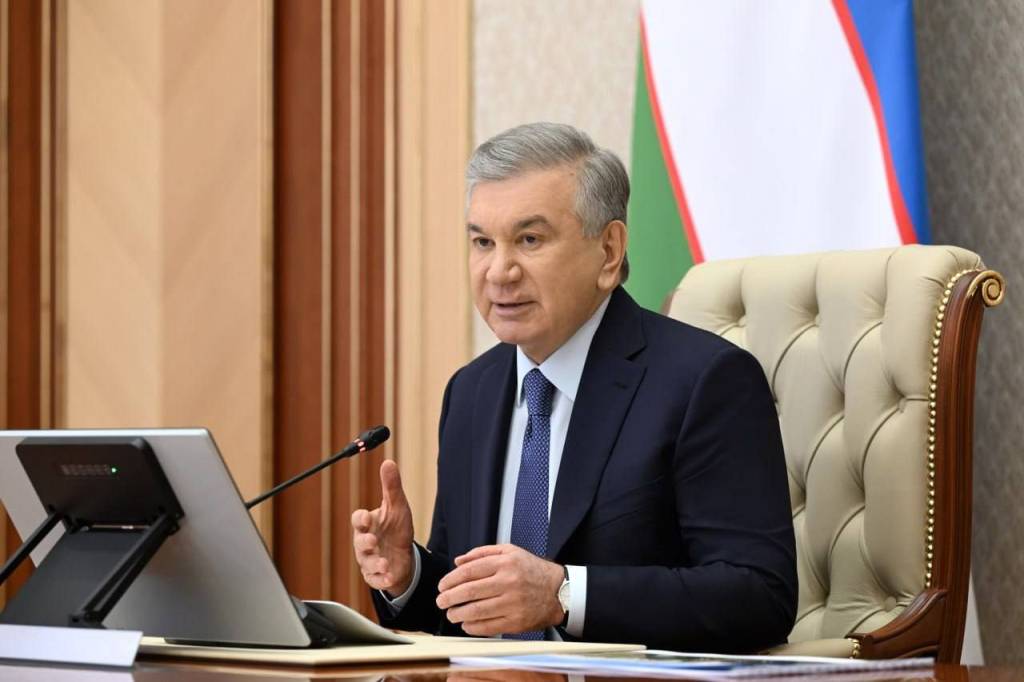
Tashkent, The Gulf Observer: Upon returning from a working visit to Washington, President Shavkat Mirziyoyev chaired a high-level meeting to review the effectiveness of ongoing reforms and outline priority tasks for the socio-economic development of the Republic of Karakalpakstan.
The meeting highlighted Karakalpakstan’s vast economic and investment potential, underpinned by significant mineral reserves, including 270 million tons of cement, 200 million tons of lime, 6.9 million tons of glass, and other key construction materials. Despite its large territory and resource base, the President emphasized the need for precise planning and the effective use of regional comparative advantages, particularly given the considerable distances between settlements.
Officials reported notable economic progress in recent years. Eight years ago, Karakalpakstan ranked last in per capita economic performance; it now stands seventh nationwide. The share of industrial output destined for export has increased from 4 percent to 30 percent, while total exports have grown 3.5 times compared to 2016, reaching $2.1 billion.
Over the next five years, the region’s economy is projected to expand to 102.5 trillion UZS, with per capita output rising to 51 million UZS. Authorities plan to implement $7.2 billion worth of projects in industry and services, while increasing exports to $900 million. By year-end, the unemployment rate is expected to fall to 4.2 percent and the poverty rate to 3.2 percent, with targeted measures to eliminate unemployment and poverty in key districts and mahallas.
The President supported a proposal to extend existing investment incentives aimed at stimulating entrepreneurship and attracting capital. A target has been set to increase foreign direct investment by 2.5 times, reaching $2.5 billion in 2025.
Major investment initiatives include the establishment of a modular intelligent computing center in Takhiatash district for the artificial intelligence sector, the creation of an automotive components technology cluster, basalt fiber production, waste-to-energy power generation in Nukus, gold extraction from coal in Karauzyak district, and textile and yarn production facilities in Takhtakupir and Chimbay districts.
In agriculture, attention was drawn to the underutilization of land resources, with only 2.5 percent of available land currently cultivated. Tasks were set to expand cultivation of drought- and salt-resistant medicinal plants, introduce artificial intelligence-based monitoring systems, restore 10,000 hectares of pastureland, and implement water-saving technologies. A modern agro-complex with an annual capacity of 36,000 tons of animal and fish feed will be commissioned in Beruni district.
Tourism was identified as a strategic growth driver. Plans include the development of a tourist and recreational zone near the Barsakelmes salt deposit, glamping facilities in the Aral Sea region and on the Ustyurt Plateau, and modernization of the Aral Sea History Museum. The region aims to attract 500,000 foreign and 3 million domestic tourists this year.
Additionally, a new support system for intellectual projects and start-ups will be introduced, including the establishment of an IT university and a technopark. Authorities intend to attract $5 billion in foreign investment for artificial intelligence development and significantly expand data processing and cloud infrastructure.
Infrastructure improvements are also underway, with 150 billion UZS allocated for regional projects and 2.2 trillion UZS directed toward centralized water supply enhancements. A further $200 million will be mobilized for drinking water, sewage, treatment facilities, and road construction. An Aral Logistics Center with “dry port” status is scheduled for completion in Kungrad by the end of 2027.
Concluding the meeting, President Mirziyoyev instructed officials to ensure targeted, calculation-based planning at the district and mahalla levels to achieve measurable improvements in living standards and fully realize Karakalpakstan’s economic potential.