UAE Reaffirms Commitment to Global Clean Energy Transition at G20 Ministerial Meeting in South Africa
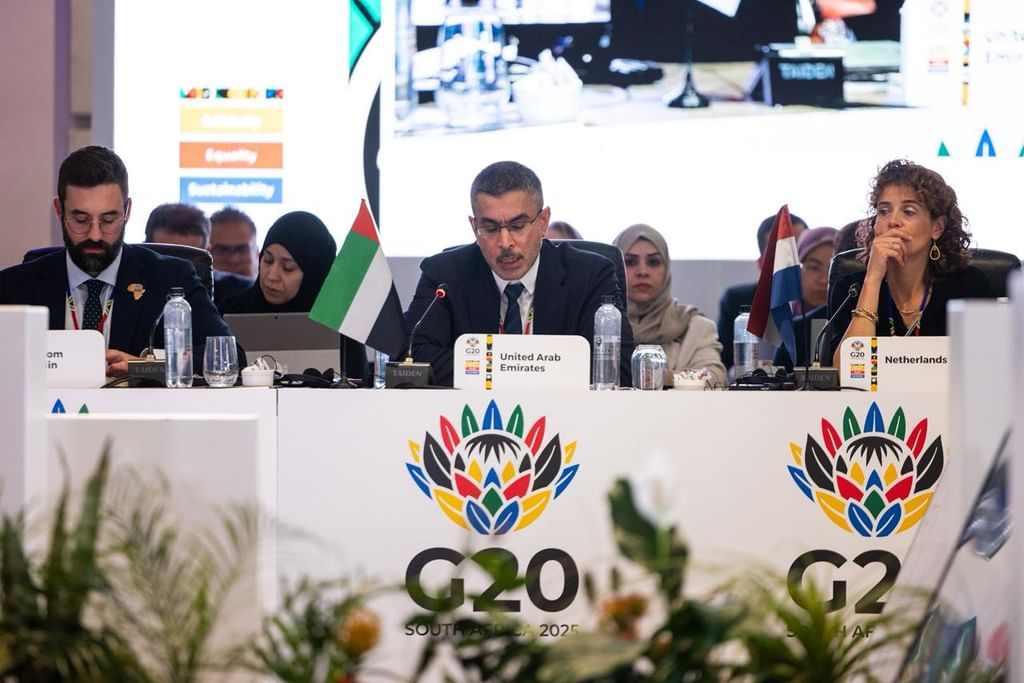
Cape Town, The Gulf Observer: The United Arab Emirates (UAE), represented by the Ministry of Energy and Infrastructure (MoEI), participated in the G20 Energy Transitions Ministerial Meeting held in South Africa, underscoring its continued commitment to advancing a safe, inclusive, and sustainable global energy transition.
Eng. Sharif Al Olama, Undersecretary for Energy and Petroleum Affairs at MoEI, led the UAE delegation to the high-level meeting. In his remarks, Al Olama reaffirmed the UAE’s support for the G20 Presidency’s priorities, emphasizing the need for coordinated global action to achieve energy security and accelerate the shift toward clean, resilient energy systems.
“Energy security is the foundation of global stability and prosperity. In the UAE, we regard it not just as diversification but as resilience, based on innovation, coordinated planning, and inclusivity,” he said.
Highlighting the UAE’s achievements in sustainable energy access, Al Olama noted that through extensive investments in smart grids, electrification, and decentralized systems, the country has achieved 100 percent electricity access under Sustainable Development Goal 7 and ranks first globally in access to clean cooking.
He further pointed to the Barakah Nuclear Energy Plant, which now supplies up to 25 percent of the UAE’s electricity, as a model for the role of peaceful nuclear energy in enhancing energy security and reducing emissions.
“Similarly, the water-energy nexus is at the core of climate resilience,” Al Olama added. “The Mohamed bin Zayed Water Initiative reflects our belief that cross-sector innovation is essential for securing water and energy futures. In this spirit, I warmly invite all partners to join us at the UN Water Conference, co-hosted by the UAE and Senegal in 2026, to promote collective, solutions-oriented action.”
Al Olama welcomed the G20 High-Level Voluntary Principles for Sustainable Industrialisation Hubs, praising the Presidency’s focus on hydrogen and its derivatives as key enablers of low-carbon growth. He highlighted the UAE National Hydrogen Strategy 2050, which seeks to position the country as a leading global producer and exporter of low-emission hydrogen and ammonia through innovation, robust financing, and resilient supply chains.
“Energy transition must also be efficient, not just clean,” he emphasized. “That is why we established the Global Energy Efficiency Alliance (GEEA) — a government-backed, implementation-driven coalition aimed at turning pledges into tangible progress.”
Through GEEA, the UAE aims to support at least 15 countries by 2030, mobilize US$75 million in energy efficiency financing, and help deliver measurable reductions in energy intensity, recognizing efficiency as the most cost-effective approach to expanding access, cutting emissions, and driving sustainable growth.
Al Olama also expressed the UAE’s strong support for the Presidency’s vision of African energy interconnectivity, noting that regional cooperation is essential for a resilient energy future.
“Drawing on our GCC interconnection experience and global initiatives such as the India-Middle East-Europe Economic Corridor (IMEC), the UAE is dedicated to sharing technical expertise, innovative financing, and clean infrastructure investment to help build resilient energy networks across Africa,” he concluded.
The UAE’s participation in the G20 Energy Transitions Ministerial Meeting reaffirms its leadership role in promoting global collaboration, innovation, and inclusivity in advancing the clean energy transformation.