95 Years of Progress: Honoring King Abdulaziz’s Pioneering Leadership in Saudi Arabia
Riyadh, The Gulf Observer: As Saudi Arabia marks its 95th National Day, the legacy of King Abdulaziz Al Saud, founder of the modern Kingdom, is remembered as a period defined by historic firsts that shaped the nation’s future.
King Abdulaziz, who unified the Kingdom in 1932, devoted his reign to establishing the foundations of a modern state, introducing institutions, infrastructure, and agreements that would influence Saudi Arabia for decades.
The First Budget
In 1932, the Kingdom issued its first budget, amounting to 14 million riyals. Though modest by contemporary standards, this budget represented a critical step in institutionalizing financial management across the newly unified nation, laying the groundwork for Saudi Arabia’s evolution into one of the world’s largest economies.
The First Ministries
State-building under King Abdulaziz included the creation of key ministries. The Ministry of Foreign Affairs, established in 1930 under Prince Faisal, was the first modern ministry in the Arabian Peninsula. The Ministry of Finance, later led by Abdullah bin Suleiman Al-Hamdan, managed the Kingdom’s revenues and expenditures, providing the administrative framework necessary for economic development and international diplomacy.
The First Oil Concession and Discovery
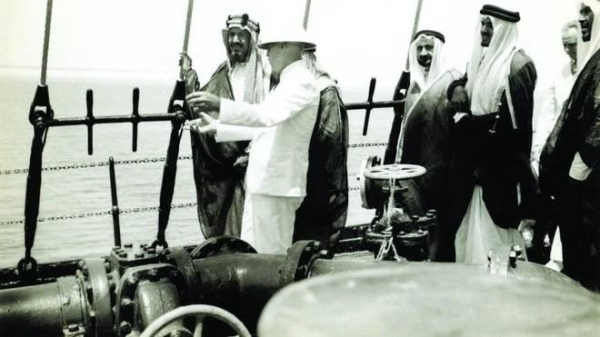
King Abdulaziz signed the first oil concession with Standard Oil of California in 1933, paving the way for exploration. Commercial quantities of oil were discovered in 1938 at Dammam Well No. 7. In 1939, the King personally inaugurated the first shipment of Saudi crude from Ras Tanura, marking a defining moment in the Kingdom’s economic history.
The First Railway and Airports
Recognizing the importance of connectivity, King Abdulaziz initiated transport infrastructure projects, including the first railway linking Riyadh to Dammam. Early airports also emerged, facilitating communication and travel across the Kingdom.
The First Schools and Hospitals
Education and healthcare were key priorities. King Abdulaziz oversaw the establishment of schools, hospitals, and clinics in Riyadh, Taif, and Jeddah, laying the foundations for nationwide systems that would expand in subsequent decades.
The First International Agreements
King Abdulaziz placed Saudi Arabia on the global stage, forging diplomatic ties, hosting foreign envoys, and participating in international institutions. His attendance at the 1945 founding of the United Nations marked the Kingdom’s first formal engagement with the global community.
A Legacy of Beginnings
Each of these “firsts” — from budgets and ministries to oil concessions and international agreements — symbolized more than administrative milestones. They were foundational steps in transforming Saudi Arabia into a modern, thriving state.
As the Kingdom celebrates 95 years of unity, the vision and resilience of King Abdulaziz remain central to its enduring legacy.