HCM City Unveils Ambitious Plan to Establish Low-Emission Zones and Phase Out Polluting Vehicles by 2036
HCM City, The Gulf Observer: In a decisive move to combat worsening air pollution, Ho Chi Minh City has announced plans to introduce low-emission zones (LEZs) and gradually phase out high-polluting vehicles over the next decade.
The initiative was unveiled at a seminar on Tuesday by the city’s Department of Construction, which presented findings from a comprehensive emission-control study and a detailed roadmap for implementing cleaner transport strategies. These include creating LEZs, transitioning vehicles to cleaner energy, and offering financial support to both businesses and citizens.
Under the proposal, the first LEZ will cover the central urban area—bounded by 15 bridges and 20 main roads—and the Rừng Sác Road. Within these areas, trucks and motorbikes below emission standard Level 2 and cars below Level 4 will face restrictions or bans, while electric and “green” vehicles, as well as emergency and priority services, will continue to operate.
Starting in 2026, gasoline- and diesel-powered ride-hailing and transport vehicles that fail to meet emission standards will be restricted, with a pilot ban along Rừng Sác Road between Bình Khánh Ferry and Duyên Hải Street. From 2027 to 2030, the city plans to launch widespread emissions testing for motorbikes and gradually restrict non-compliant vehicles from entering the city centre.
By 2031, the LEZ will expand outward to Ring Road 1, encompassing major roads such as Phạm Văn Đồng, Nguyễn Thái Sơn, Bảy Hiền, Hương Lộ 2, and Nguyễn Văn Linh Streets. From 2032 onward, all vehicles entering the zone must meet the city’s highest emission standards.
To ensure enforcement, authorities plan to install 58 license-plate recognition cameras throughout the central area and nine along Rừng Sác Road. These will automatically identify and fine vehicles that do not meet emission requirements. The city has also proposed that the Ministry of Construction include “Low-Emission Zone” traffic signs in national regulations to help drivers easily identify restricted areas.
The LEZ initiative is built on three key pillars: vehicle electrification, emission zoning, and supportive infrastructure and policy. Ho Chi Minh City intends to prioritize the conversion of buses, taxis, ride-hailing vehicles, and trucks to cleaner energy. By 2030, it plans to launch 78 new bus routes using clean fuels, adding nearly 2,850 vehicles connected to networks of public bicycles and electric motorbikes.
To encourage adoption, the city will offer various incentives, including full registration-fee waivers for electric transport vehicles, a 50% reduction in road maintenance and license renewal fees for electric cars, and direct cash support worth up to US$190 (10% of the value) for purchasing new motorbikes. Those scrapping old vehicles could receive compensation equal to 70% of their residual value, with full or partial support for low-income households.
Deputy Director of the Department of Construction, Bùi Hòa An, emphasized that the LEZ initiative remains in an “encouragement phase,” not a strict ban. “Vehicles that meet acceptable emission levels will still be allowed to circulate within the low-emission zone. It’s not only electric vehicles that can enter,” he said.
He added that with a roadmap extending to 2029, businesses will have sufficient time to adapt, supported by loan programmes, interest-rate subsidies, and other financial mechanisms. The project will be submitted to the City People’s Council and is expected to roll out in early 2026.
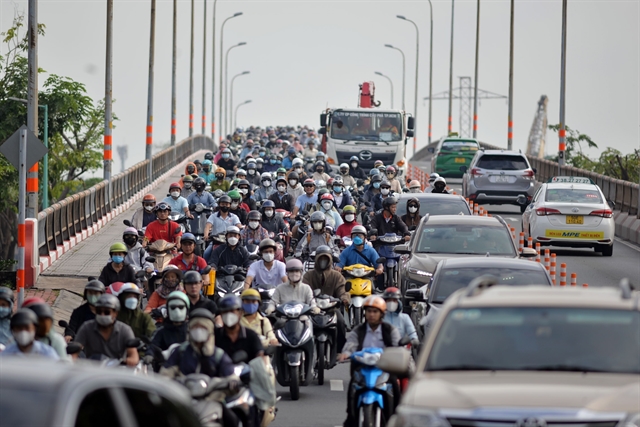
Following its recent administrative merger, Ho Chi Minh City’s population has surpassed 14 million, heightening challenges related to traffic congestion and pollution. The study revealed that the city’s one million cars and 7.3 million motorbikes account for 88% of nitrogen oxide (NOx), 99% of carbon monoxide (CO), 79% of sulfur dioxide (SO₂), and 88% of particulate emissions from transport.
Average fine dust (PM2.5) concentrations in the city reach 31 micrograms per cubic metre—six times higher than the World Health Organisation’s recommended safe level. The resulting health and productivity losses are estimated at VNĐ3 trillion (approximately US$114 million) per year, equivalent to 0.25% of the city’s gross regional domestic product (GRDP).
If implemented as planned, the low-emission zone strategy could represent a landmark shift for Việt Nam’s largest metropolis—paving the way toward cleaner air, smarter mobility, and a more sustainable urban future for millions of residents.