President Mirziyoyev Reviews Comprehensive Measures to Develop Uzbekistan’s Silk Industry
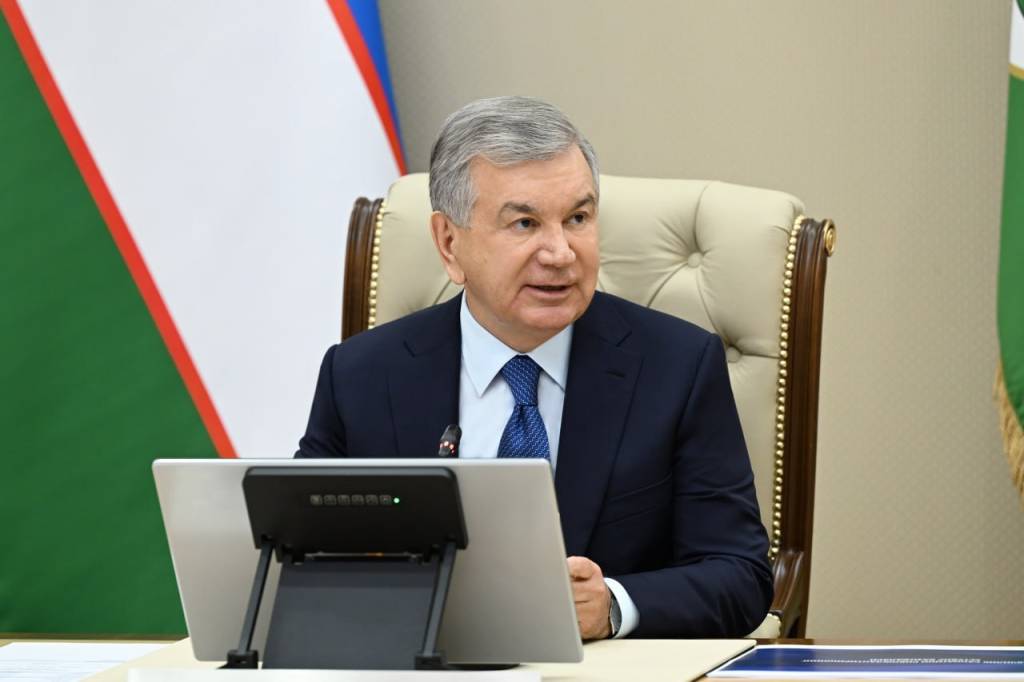
Tashkent, The Gulf Observer: Shavkat Mirziyoyev chaired a presentation outlining wide-ranging measures aimed at modernizing and expanding Uzbekistan’s sericulture sector, with a focus on strengthening the feed base, boosting domestic silkworm egg production, increasing exports, and introducing digital technologies.
Sericulture and the procurement of silkworm cocoons play a vital role in generating rural employment, providing household incomes, and enhancing the country’s export potential. However, accumulated challenges across the value chain—from feed supply to cocoon processing—have limited the sector’s full potential.
Expanding Domestic Silkworm Egg Production
It was noted that a significant portion of silkworm eggs is currently imported. By 2030, the share of domestically produced eggs is projected to reach 75 percent. To achieve this, operations at specialized breeding stations will be restored.
Plans include establishing breeding silkworm egg stations in Fergana and Khorezm regions to produce elite varieties. Additionally, two new silkworm egg production enterprises will be launched this year in Bukhara and Namangan, complementing the existing 10 facilities. Between 2027 and 2029, four more enterprises are set to open in Tashkent, Jizzakh, Samarkand, and Surkhandarya regions.
To support these enterprises, proposals were presented to cover 50 percent of expenses for attracting qualified foreign specialists and paying seasonal workers. It was also suggested that their activities be exempt from personal income and social taxes.
Strengthening the Feed Base
Enhancing the feed base was identified as critical to improving cocoon quality. Between 2026 and 2030, the government plans a phased expansion, including:
- Establishing new mulberry plantations on 8,000 hectares
- Organizing single-row mulberry plantings on 41,500 hectares
- Restoring 15,000 hectares of mulberry plantations
By 2030, approximately 200 million mulberry saplings are expected to be planted, increasing the feed base by 30 percent.
Based on feed base analysis, cocoon production is forecast to reach 30,000 tonnes in 2026 and 36,000 tonnes by 2030.
New System of Sector Management
Under a new organizational framework, the Uzbekipaksanoat Association, regional and district branches of Agropilla, and sericulture clusters will operate in coordination. They will support farmers, home-based workers, and cocoon producers at every stage—from establishing mulberry plantations to purchasing harvested cocoons.
Special attention will be given to involving low-income families and individuals listed in the social register. Beginning this year, through the “mahalla of seven” initiative, producers will receive subsidies covering 35 percent of the cost of one kilogram of procured cocoons. Loans of up to 20 million UZS will also be provided for purchasing silkworm cultivation equipment.
Promoting Industrial Production and Exports
The expansion of industrial cocoon production was highlighted as a priority. Currently, most cocoons are procured at the household level. Establishing specialized sericulture farms is expected to enhance production stability and quality. Such farms will be exempt from land and property taxes until January 1, 2029.
Increasing value addition and exports was also emphasized. The share of high-quality raw silk produced from locally sourced cocoons remains limited. Through quality improvement and expanded deep processing, export revenues could reach $250 million.
By 2030, 21 investment projects worth $200 million are planned, raising raw silk processing levels to 75 percent and increasing output to 3,000 tonnes. This would enable the production of 18.5 million linear meters of silk fabric.
Measures have also been outlined to expand finished product exports, access new markets, and develop and promote national brands.
Digital Transformation of the Sector
The President underscored the importance of introducing digital technologies across the industry. A unified information system will be developed to manage feed base accounting, maintain an enterprise registry, enable electronic reporting and settlements, and provide real-time monitoring of silkworm egg volumes, cocoon harvests, and collection points.
After approving the proposed measures, President Mirziyoyev instructed relevant authorities to accelerate efforts to strengthen the feed base, expand domestic egg production, introduce industrial methods, and increase the share of finished products in exports, aiming to unlock the full potential of Uzbekistan’s silk industry.