Israel and US Launch Coordinated Strikes on Iran, Triggering Widespread Regional Escalation
Tehran, The Gulf Observer: Israel and the United States launched coordinated military strikes against Iran on Saturday, sharply escalating tensions in the Middle East and casting fresh uncertainty over diplomatic efforts aimed at resolving the long-running dispute over Tehran’s nuclear programme.
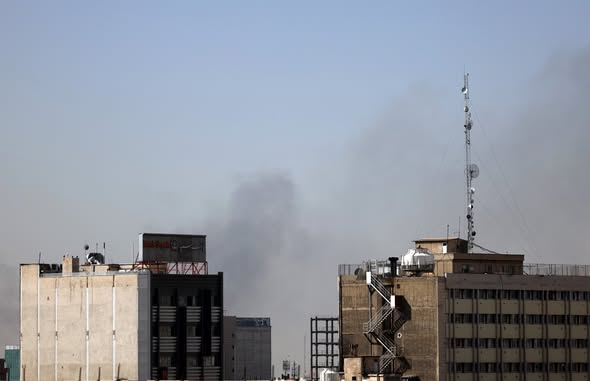
According to Iran’s Fars news agency, explosions were reported in Isfahan, Qom, Karaj, Kermanshah and Tabriz. Iranian state media also confirmed that the southern port city of Bushehr was targeted, though it remains unclear whether the Bushehr nuclear power plant sustained damage.
A source cited by Reuters said Iranian officials were the primary targets of the first wave of US-Israeli strikes. A US official told the agency that operations were being conducted by air and sea and were expected to continue for several days, stressing that the strikes were directed “only at military targets.”
In response, Iran’s Islamic Revolutionary Guard Corps (IRGC), as reported by Tasnim news agency, announced the launch of a first wave of missile and drone attacks against Israel. The Israeli military confirmed that multiple missile barrages were fired from Iran toward Israeli territory, with air defence systems activated to intercept incoming projectiles. Sirens sounded across Israel around 08:15 local time as part of what the military described as a proactive alert.
Bahrain’s state news agency reported that a service centre of the US Fifth Fleet came under missile attack, while witnesses in Abu Dhabi described hearing loud explosions. Smoke was reportedly seen rising from Bahrain’s Juffair housing area near a US Navy base.
Iranian officials told Reuters that several ministries in southern Tehran were targeted. Tasnim reported that seven missiles struck areas near the presidential palace and the compound of Supreme Leader Ayatollah Ali Khamenei. Iranian authorities later stated that Ayatollah Khamenei had been moved to a secure location outside Tehran, while Mehr news agency reported that the country’s president was safe.
The Iranian health ministry placed hospitals nationwide on high alert. Iranian state media also reported disruptions to mobile phone services in parts of Tehran and weakened internet connectivity. International internet monitor NetBlocks said network data indicated that Iran was experiencing a near-total communications blackout.
The US State Department advised American citizens in Iran to shelter in place “until further notice” after President Donald Trump ordered what he described as “major combat operations.” In a televised address, Trump said the objective was to eliminate “immediate threats” from the Iranian regime and reiterated that Iran “can never have a nuclear weapon.” He warned that the US would destroy Iran’s missile capabilities and naval assets if necessary and urged members of the IRGC to lay down their arms.
Israeli Defence Minister Israel Katz described the action as a pre-emptive operation to remove threats to Israel. Prime Minister Benjamin Netanyahu said the operation aimed to eliminate what he called an “existential threat” posed by Iran.
Israel closed its airspace to civilian flights, suspended non-essential activities, and shut schools and workplaces except for critical sectors. Authorities urged the public to avoid airports, while the military stated that forces were deployed across all fronts and that air operations would continue as required.
The latest escalation follows a 12-day air conflict in June, during which the US joined Israeli strikes on Iranian nuclear facilities — the most direct American military action ever taken against the Islamic Republic. Tehran retaliated at the time by launching missiles toward the US Al Udeid air base in Qatar, the largest American base in the Middle East.
Diplomatic efforts had resumed in February between Washington and Tehran to address the decades-old dispute over Iran’s nuclear activities. Israel has insisted that any agreement must dismantle Iran’s nuclear infrastructure and impose limits on its missile programme. Iran has consistently denied seeking nuclear weapons and has said it is willing to negotiate limits on its nuclear activities in exchange for sanctions relief, while rejecting linkage to its missile capabilities.
Pakistani and International Reactions
In Pakistan, air traffic control authorities were directed to closely monitor national airspace, particularly near the Iran-Afghanistan region. The Ministry of Foreign Affairs issued a travel advisory advising Pakistani nationals against non-essential travel to Iran, and Pakistani airlines were instructed to avoid Iranian airspace.
Political and religious leaders, including Pakistan Peoples Party Chairman Bilawal Bhutto Zardari and Jamaat-e-Islami chief Hafiz Naeemur Rehman, condemned the strikes, warning that the escalation could destabilise the entire region.
Britain reiterated that Iran must never be allowed to develop nuclear weapons and reaffirmed support for a negotiated solution. Iraq closed its airspace, while Lufthansa suspended flights to Tel Aviv and Beirut. The US embassies in Jerusalem, Qatar and the UAE implemented shelter-in-place protocols for personnel.
Deputy Chairman of Russia’s Security Council Dmitry Medvedev criticised the US action, questioning Washington’s commitment to diplomacy and warning of long-term consequences.
As military operations continue, regional capitals remain on heightened alert, with analysts warning that the confrontation risks widening into a broader conflict with far-reaching geopolitical and economic repercussions.