Madrid Talks: From Tariff Wars to Structured Cooperation
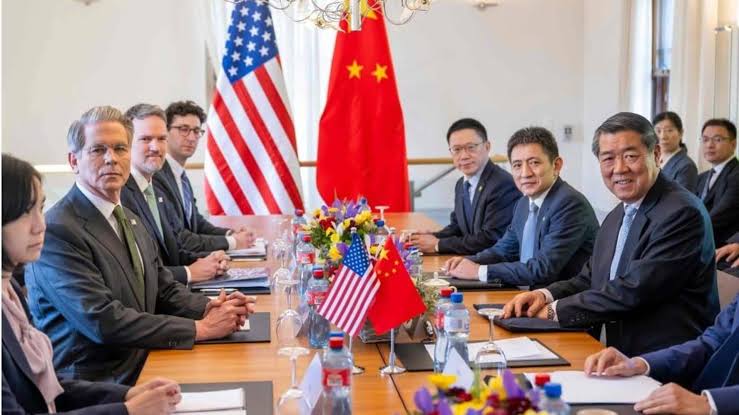

The latest round of U.S.–China economic and trade talks in Madrid has largely concluded, and the outcome is already clear from the tone of the press briefings. What emerges is not merely another episode in a long series of tactical skirmishes, but a sharper definition of the contours of interaction between the two sides.
The era when tariffs alone dominated the agenda appears to be giving way to a broader, more structured set of negotiations that include investment flows, technology governance, and cooperative arrangements on sensitive issues.
The Madrid session focused centrally on three interlinked themes: addressing the TikTok dispute through cooperative formulas, lowering barriers to investment, and advancing broader economic cooperation. A preliminary framework agreement has been reached on this basis. Taken together, these shifts reveal not just an adjustment in tactics but a deeper recognition of changed realities in bilateral bargaining.
The pathway to Madrid deserves attention. On April 2, President Donald Trump announced a so-called “Liberation Day,” threatening sweeping “reciprocal tariffs.” China was immediately hit with a 34 percent tariff rate—summarized as “10 plus 24.” When Beijing responded in kind, Washington dramatically raised its tariff level to 145 percent. Weeks of deadlock followed, until it was the U.S. side that called Beijing to request talks. From there, a structured consultation mechanism took shape, moving from Geneva to London and Stockholm, before arriving in Madrid.
Earlier phases of negotiation had been dominated almost entirely by tariff formulas. The discussions revolved around whether to “keep 10 percent, suspend 24 percent, and cancel the rest,” with reciprocal concessions on non-tariff barriers. That phase, however, has largely run its course. Madrid marks a new stage in which Washington has been unable to escalate further. Instead of leveraging tariffs endlessly, the agenda is moving toward specific fronts of cooperation.
For China, the first concrete outcome has been to resist permanent tariff escalation. The 10 percent reciprocal tariff remains, while the larger 24 percent tranche has been suspended, not conceded. Crucially, other potential measures floated earlier—such as duties on fentanyl precursors—have faded from discussion and are unlikely to reappear in the technical documents that will follow. This is a significant achievement, indicating that tariff escalation as a permanent strategy has been checked.
Technology issues inevitably surfaced, with TikTok at the center. Beijing reiterated its longstanding stance: technology must not be politicized or weaponized, and China will not sacrifice its core principles, corporate interests, or international norms for the sake of a deal. The principle advanced is to balance national interests, company rights, and fairness. Technology exports can be considered, but only under strict regulatory supervision and subject to code review. Chinese companies may negotiate voluntarily, but ultimate approval rests with the state.
The U.S. side acknowledged progress toward what it called a “basic consensus.” This framework envisions delegated management of American user data and content security, along with licensed rather than transferred use of algorithms and intellectual property. The model recalls the earlier “Project Texas” arrangement, in which Oracle would oversee TikTok’s U.S. servers in Texas. Importantly, algorithm rights would be licensed, preserving commercial secrecy while protecting Chinese user data.
Both sides were careful to stress that what has been achieved is a consensus, not a binding agreement. Technical details remain under discussion. Yet the overall direction is unmistakable. A complete ban on TikTok is no longer realistic: the technical hurdles are prohibitive, and the platform’s entrenched social and political presence in the United States makes such a step politically unfeasible. Negotiated formulas are thus the only path forward.
Commentary on the outcome has sometimes tried to frame the talks in terms of “winners and losers.” Yet such language overlooks the reality of international economic negotiations, where outcomes are rarely zero-sum. Both sides stand to gain from preventing escalation, and both recognize the costs of allowing disputes to spiral out of control.
Madrid is better understood as a window into how U.S.–China strategic competition has evolved since Trump’s first term. The dynamic now is one of strict reciprocity. Pressure is applied to generate dialogue; competition is leveraged to encourage cooperation; and China’s strengthened industrial and economic base has become an undeniable source of bargaining power.
Tariffs, once the centerpiece of Washington’s approach, are no longer the sole instrument. Their overuse has blunted their impact, forcing the U.S. to move toward negotiation on specific issues where it lacks unilateral leverage.
This new dynamic of reciprocity is emerging as the grammar of great-power bargaining. Each side signals its intentions not by unilateral diktat but by matching actions step-for-step. If tariffs are raised, counter-tariffs follow; if suspensions are offered, reciprocal suspensions are considered. The resulting pattern is less dramatic than the turbulence of earlier trade wars, but it is also more sustainable. Structured reciprocity ensures that neither side gains unchecked advantage, but both secure stability by acknowledging the other’s capacity to respond.
The implications of this shift extend well beyond the bilateral. For global markets, the move away from tariff escalation toward cooperative fronts of negotiation provides breathing space. Supply chains, which had grown fragile under the weight of uncertainty, benefit from greater predictability. Investors and manufacturers now have clearer signals that dialogue remains the default mechanism, not rupture. For smaller economies and third countries, the message is equally important: they need not choose sides in a tariff war that might upend global flows, because the leading powers themselves are showing restraint.
Domestically, the Madrid outcome offers advantages on both sides. For Washington, it demonstrates that national security concerns around data and technology can be addressed through regulatory formulas rather than outright bans. This avoids political backlash from millions of American users while reassuring Congress that action is being taken. For Beijing, it shows that China can hold its line on core interests without abandoning negotiation. By preventing further tariff escalation, Beijing signals strength not only externally but also internally, reinforcing the idea that it can protect national dignity and corporate interests under pressure.
The world cannot ignore the symbolic failure of tariffs as the central U.S. strategy. Madrid has confirmed that unilateral escalation cannot be sustained indefinitely, especially when met with equal resolve. Instead, the focus is shifting to specific areas of cooperation—data governance, investment rules, and market access—where the two powers can hammer out frameworks without destabilizing the global economy.
The Madrid round may not have produced a final settlement, but it has produced something equally consequential: clarity. Clarity that tariff escalation has reached its limit. Clarity that technology issues will be negotiated, not dictated. And clarity that the future of U.S.–China relations will be defined less by unchecked escalation than by structured reciprocity.