Mr. Khalid Taimur Akram Participated as a Speaker at the “Phewa Dialogue 2026”
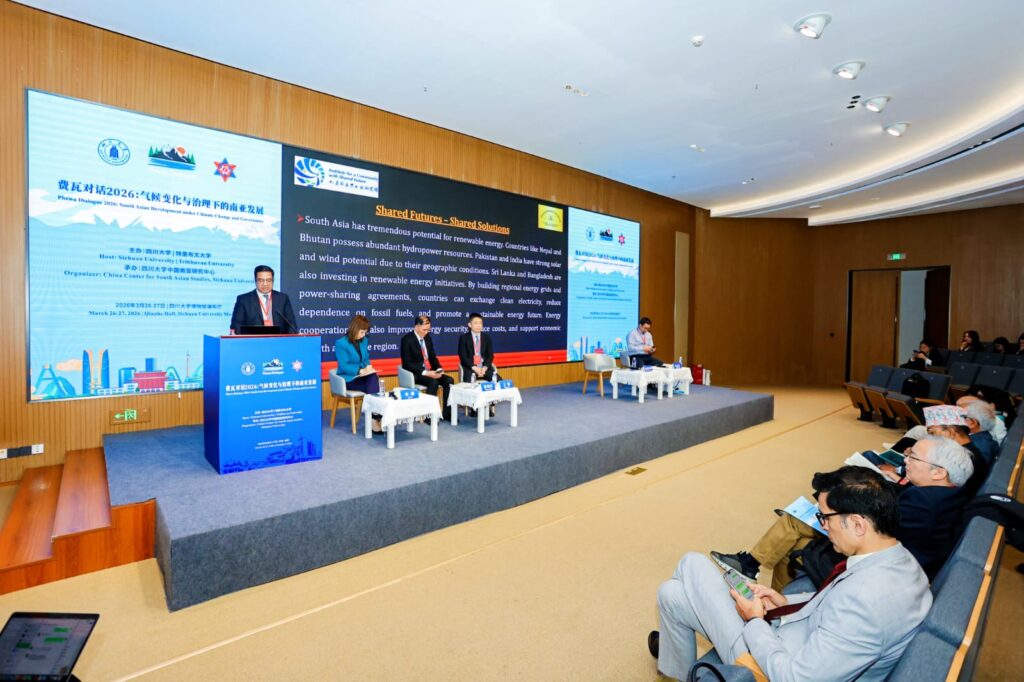
Chengdu, The Gulf Observer: On March 26–27, 2026, Mr. Khalid Taimur Akram, Executive Director of the Pakistan Research Center for a Community with Shared Future (PRCCSF), participated as a distinguished speaker at the “Phewa Dialogue 2026” held at Chengdu, China. The Phewa Dialogue is a pioneering initiative of China aimed at fostering dialogue and cooperation among South Asian countries. The inaugural Phewa Dialogue was held in 2024 in Pokhara, Nepal, marking the beginning of this important regional platform.
This was the second edition of the Phewa Dialogue, convened under the theme “South Asian Development under Climate Change and Governance,” and jointly organized by the China Center for South Asia Studies (CCSAS) at Sichuan University and Tribhuvan University of Nepal. It aimed to bring together leading scholars, experts, and policy practitioners to pool intellectual resources, foster mutual understanding, and promote sustainable development in South Asia in the context of evolving global and environmental challenges.
The Phewa Dialogue 2026 was structured into three thematic forums, each focusing on key regional priorities:
Theme 1: Cooperating to Meet Challenges—Advancing Regional Economic Integration in South Asia
Discussions under this theme explored how South Asian countries can strengthen economic cooperation, enhance regional connectivity, and improve policy coordination to build a more resilient and integrated regional economy, particularly in the face of climate change.
Theme 2: Green Empowerment for Development—Clean Energy, New Energy, and New Industrial Chains
This session focused on the transition towards renewable energy, the promotion of green technologies, and the development of sustainable industrial value chains to support long-term economic growth.
Theme 3: Achieving Sustainable Development—Transforming Traditional Lifestyles
This forum emphasized the importance of encouraging environmentally responsible behaviors, promoting low-carbon lifestyles, and integrating sustainability into social and cultural
practices.
Mr. Khalid Taimur Akram delivered a keynote speech under Theme 1, titled “Cooperating to Meet Challenges—Advancing Regional Economic Integration in South Asia.” In his address, he highlighted that climate change is a shared and pressing challenge for South Asia, affecting economies, livelihoods, and ecosystems across the region. He emphasized that since climate challenges transcend national borders, their solutions must also be rooted in regional cooperation.
He further underscored the importance of building a climate-resilient regional economy through joint efforts in key areas such as climate-resilient infrastructure, renewable energy cooperation, sustainable agriculture, and regional trade integration. He also stressed the need for policy harmonization, knowledge sharing, and the establishment of coordinated disaster management mechanisms to effectively respond to environmental challenges.
Additionally, Mr. Akram highlighted the role of academic institutions, businesses, civil society, and youth in advancing sustainable development and fostering innovation across South Asia. He noted that enhanced regional collaboration can transform shared challenges into opportunities for green growth, economic stability, and long-term resilience.
The Dialogue featured several prominent speakers, including:
1. Prof. Yao Leye, Vice Chairman of Sichuan University Council and Former Vice President of Sichuan University, China
2. Prof. Liu Chao, Vice President of Sichuan University, China
3. Prof. Khadga K.C., Rector of Tribhuvan University, Nepal
4. H.E. Mr. Zhang Maoming, Ambassador of the People’s Republic of China to Nepal
5. H.E. Mr. Leela Mani Paudyal, Former Ambassador of Nepal to China
6. Counselor Chen Wei, Department of Asian Affairs, Ministry of Foreign Affairs of China
7. H.E. Dhana Raj Acharya, Mayor of Pokhara Metropolitan City, Nepal
Approximately 27 speakers from across South Asia, including Pakistan, Nepal, Bhutan, India, Maldives, and Sri Lanka, participated in the Dialogue.
The Phewa Dialogue 2026 provided a high-level platform for meaningful engagement, academic exchange, and policy-oriented discussions. It made a significant contribution toward shaping a shared vision for a sustainable, cooperative, and resilient future for South Asia.