President Tokayev Addresses Ashgabat Forum on Peace, Trust and Neutrality
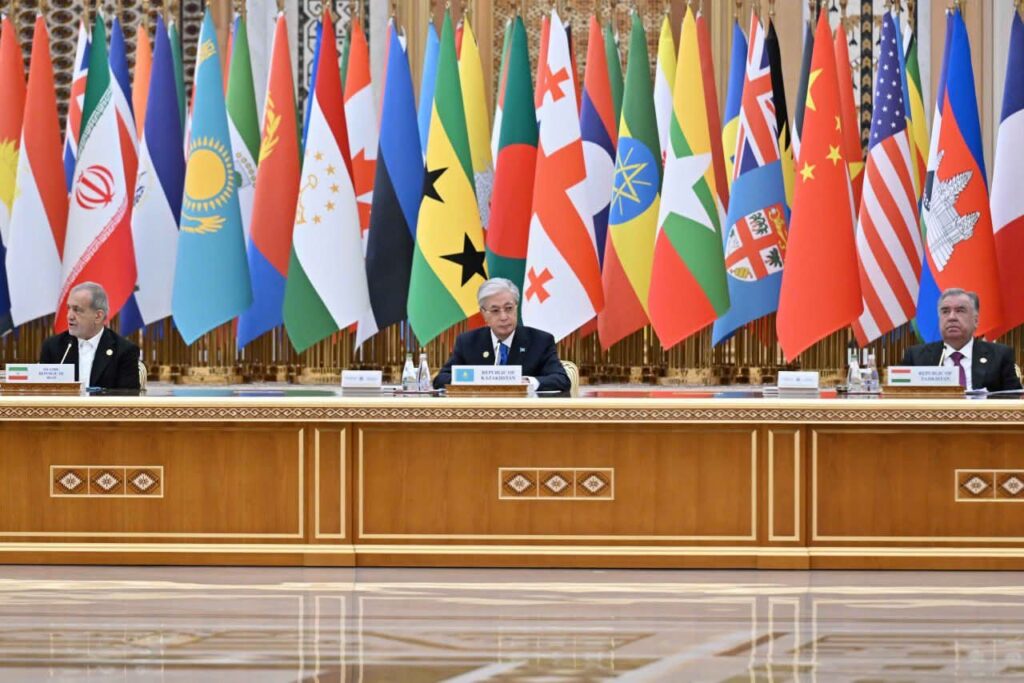
Your Excellencies,
Distinguished Heads of State and Government,
Esteemed Participants,
Ladies and Gentlemen,
It is a great honor for me to take part in this important Forum dedicated to the International Year of Peace and Trust, the International Day of Neutrality, and the 30th anniversary of the permanent neutrality of Turkmenistan.
At the outset, I would like to extend my sincere congratulations to the National Leader of the Turkmen people, Hero of Turkmenistan Gurbanguly Berdimuhamedov, and to President of Turkmenistan, His Excellency Mr. Serdar Berdimuhamedov, on this historic milestone. The policy of permanent neutrality pursued by Turkmenistan has made a significant contribution to stability, security, and sustainable development across the vast Eurasian continent.
The initiatives and proposals voiced at this Forum convincingly demonstrate the enduring and positive significance of neutrality in the 21st century. Turkmenistan’s policy of positive neutrality is deeply rooted in the centuries-old cultural traditions and spiritual values of the Turkmen people.
As the founder of Turkmen classical literature and an outstanding thinker, Magtymguly Fragi once said: “Where there is peace, the state grows stronger; where there is justice, trust grows.” The ideas of this great humanist represent a unique worldview whose relevance in today’s complex international realities is beyond doubt.
I would like to highlight the special importance of Ashgabat’s initiative to proclaim the International Year of Peace and Trust, which was supported by the United Nations General Assembly. Kazakhstan joined this resolution, as peace and trust form the foundation of our country’s foreign policy strategy.
Despite progress in resolving certain conflicts, the overall global situation remains extremely tense. There is an evident shortage of mutual trust, tolerance, and understanding of the critical importance of peace and cooperation for sustainable development. We also regret the erosion of international law, its replacement by certain “rules,” and the declining authority and effectiveness of multilateral institutions, primarily the United Nations.
Without restoring strategic balance and building a just world order, international stability and security may remain nothing more than words in resolutions and declarations. Therefore, Kazakhstan consistently advocates reform of the United Nations, including the expansion of the Security Council’s membership and the strengthening of the role of the General Assembly. During the 80th session of the UN General Assembly, I proposed the creation of a group of like-minded states to prepare concrete proposals for reforming the UN system.
Kazakhstan believes it is essential for major powers to demonstrate political will and encourage UN member states to engage in inclusive and meaningful dialogue. In this context, we welcome the intensification of negotiations on the Ukrainian conflict. Following the meeting between the Presidents of Russia and the United States, active discussions on key provisions of a peace agreement indicate the emergence of an opportunity to achieve long-awaited peace.
Kazakhstan also welcomes steps aimed at resolving conflicts in other regions. Our decision to join the Abraham Accords is driven by the desire to make a practical contribution to stabilizing the situation in the Middle East. At the same time, we support the establishment of a sovereign Palestinian state as a key factor in resolving this protracted crisis. We also attach historic significance to the Joint Declaration on Peace between Azerbaijan and Armenia and hope for the early conclusion of a comprehensive peace treaty guaranteeing stability in the South Caucasus.
We believe it is necessary to continue providing assistance to Afghanistan. An important platform for coordinating such efforts is the UN Regional Centre for Sustainable Development Goals for Central Asia and Afghanistan, established in Almaty. The Conference on Interaction and Confidence-Building Measures in Asia has also demonstrated its political relevance, and we are grateful for the support aimed at transforming it into a full-fledged international institution.
Kazakhstan pays special attention to strengthening interfaith, interethnic, and intercultural dialogue. For more than two decades, our country has hosted the Congress of Leaders of World and Traditional Religions. At the recent 8th Congress in Astana, we put forward the “Movement for Peace” initiative, which is essentially a call to end military violence and seek peaceful solutions in the spirit of collective responsibility to future generations.
Sustainable socio-economic development remains a key condition for global stability. Despite global challenges, Central Asia continues to demonstrate confident economic growth. Kazakhstan’s economy is expected to grow by more than six percent this year, with GDP exceeding USD 300 billion and per capita GDP surpassing USD 15,000.
Central Asian countries are actively enhancing their transit and transport potential to strengthen connectivity between East and West, and North and South. Kazakhstan attaches great importance to the development of the Trans-Caspian International Transport Route and is modernizing its railway, port, and road infrastructure to create a seamless transport system.
Ensuring water security also requires urgent attention. Issues of transboundary water use and the environmental condition of the Aral and Caspian Seas demand coordinated action. Kazakhstan has initiated the development of an intergovernmental program to prevent further degradation of the Caspian Sea ecosystem and calls on the international community to support these efforts.
In this regard, Kazakhstan proposes the establishment of an International Water Organization within the UN system. Transforming the UN-Water mechanism into a specialized agency would consolidate existing mandates and contribute to achieving the Sustainable Development Goals. Next April, Astana will host a Regional Environmental Summit, during which we intend to launch international consultations on this initiative.
In conclusion, I am confident that the Ashgabat Forum will make a meaningful contribution to strengthening constructive partnerships among states and will provide a strong impetus to international efforts aimed at building a just world order based on mutual trust, peace, and cooperation.
Thank you for your attention.