President Tokayev Outlines Political Reforms, Foreign Policy Priorities, and Digital Transformation at National Kurultai
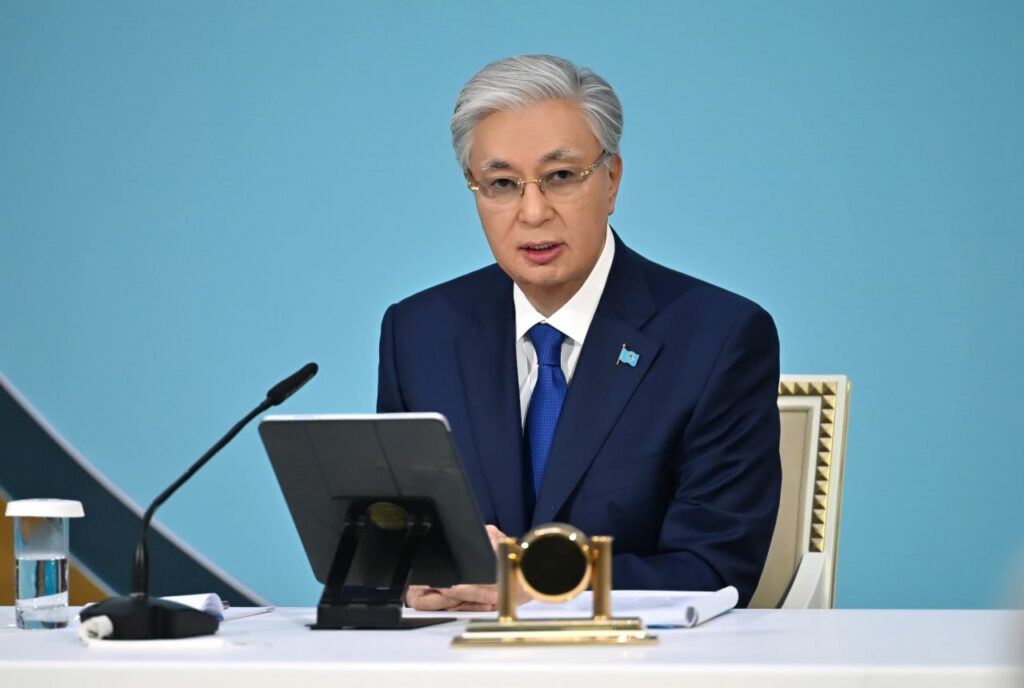
Astana, The Gulf Observer: President Kassym-Jomart Tokayev of Kazakhstan on Tuesday presented a comprehensive overview of the country’s ongoing political reforms, foreign policy priorities, and digital transformation agenda during the National Kurultai (Congress) in Kyzylorda, emphasizing the importance of national unity amid global uncertainty.
Constitutional Reform and Referendum
Tokayev highlighted that the reforms initiated in 2022, along with upcoming proposals to be submitted to a national referendum, mark a transition from the 1995 constitutional model to a fundamentally new system. He stressed that public support for these reforms would renew Kazakhstan’s political framework and strengthen long-term stability.
The proposed changes include a shift to a unicameral Parliament, to be named Quryltai; the establishment of the Khalyk Kenesi (People’s Council); and the creation of the office of Vice President, according to an official statement from Akorda.
People’s Council (Khalyk Kenesi)
The President explained that the People’s Council would assume key functions of the Assembly of the People of Kazakhstan, focusing on interethnic and interfaith harmony, domestic policy development, and promoting state ideology. The Council would also have the right of legislative initiative and organize the Congress of Leaders of World and Traditional Religions.
Presidential Succession and Vice Presidency
Tokayev underscored the importance of clearly regulating presidential succession in the Constitution. He affirmed that in the event of early termination of a president’s term, new elections must be held within two months, ensuring that the head of state assumes office exclusively through elections.
As part of the reforms, the President proposed creating the office of Vice President, appointed by the President with parliamentary approval. The Vice President would represent Kazakhstan internationally, coordinate with Parliament, engage with domestic and foreign organizations, and carry out duties assigned by the President. Tokayev emphasized that these amendments would clarify governance structures and stabilize the state system without weakening presidential authority.
The reforms also include the abolition of certain administrative bodies supporting the current Parliament and the post of State Counselor, alongside adjustments to the Presidential Administration to meet practical governance needs.
Economic Integration and National Interests
Turning to economic policy, Tokayev affirmed Kazakhstan’s support for economic integration while emphasizing the protection of national interests amid global tensions. As chair of the Eurasian Economic Union (EAEU) this year, Kazakhstan will focus on removing trade barriers, combating unjustified protectionism, and expanding the use of artificial intelligence to enhance integration efficiency.
The President expressed concern over subsidized imports affecting Kazakhstan’s agricultural processing sector, highlighting food security and urging decisive measures to protect domestic producers.
Foreign Policy in a Changing World
Tokayev noted that global relations are evolving, characterized by declining trust, erosion of international law, and rising militarization. In this context, he stressed that Kazakhstan’s foreign policy must remain balanced and prioritize national interests, with diplomatic decisions taken professionally and cautiously, emphasizing compromise over confrontation.
Digitalization and Artificial Intelligence
Highlighting the transformative impact of digitalization and artificial intelligence, Tokayev said that these technologies reduce the significance of population size and reward countries that adapt quickly and strategically. Kazakhstan has committed to accelerated digitalization and AI adoption across all sectors.
He cautioned, however, that technology alone cannot solve poor governance and stressed the need for modern management practices, streamlined processes, and improved organizational culture in the public sector. Tokayev also called for robust infrastructure to support a digital and energy-intensive economy, including early designation of high-capacity data center zones with reliable power, cooling, and security systems.