President Tokayev Reviews Financial Sector Performance, Sets Priorities for Stability and Growth
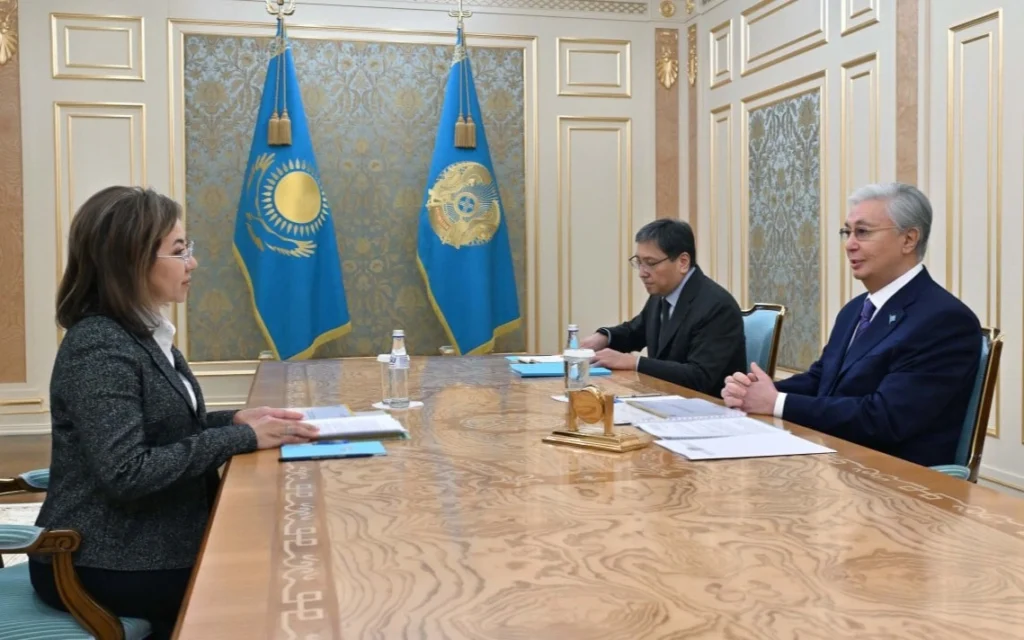
Astana, The Gulf Observer: President Kassym-Jomart Tokayev on Thursday met with Madina Abylkassymova, Chairperson of the Agency for Financial Market Regulation and Development, to review the results of Kazakhstan’s financial sector development in 2025 and outline strategic objectives for the coming period, the Akorda press service reported.
During the meeting, the Head of State was informed that the banking sector maintained resilience over the past year and successfully completed its annual supervisory assessment cycle. Total banking assets grew by 11 percent to reach 68.3 trillion tenge, while the capital adequacy ratio stood at 20.7 percent, indicating a stable and well-capitalised system.
Abylkassymova briefed the President on legislative initiatives, including a newly drafted Law on Banks, as well as updated legislation regulating investment funds and credit rating activities, aimed at further strengthening the institutional framework of the financial market.
On the lending side, credit to the real economy demonstrated strong momentum. Lending to the business sector increased by 17.9 percent as of November 2025 to reach KZT 14.8 trillion. Over the year, banks issued KZT 17.5 trillion in new business loans and are currently co-financing eight large syndicated projects with a total value of KZT 2.3 trillion.
To enhance access to finance for small and medium-sized enterprises, a dedicated SME Loan Guarantee Fund was established within the Damu Fund in June 2025. Since its launch, the fund has provided credit guarantees amounting to KZT 505 billion.
The President was also briefed on measures to curb excessive household borrowing. Consumer lending growth slowed by 50 percent compared to 2024 following the introduction of stricter regulations, including a ban on loans exceeding five years for borrowers with existing arrears, tighter limits on high-risk lending, and new restrictions on loans with maturities of three to five years. A new aggregate debt-to-income ratio has also been introduced.
As part of efforts to reduce household over-indebtedness, banks and microfinance organisations restructured debts and provided partial forgiveness to 703,000 borrowers. Under the individual bankruptcy mechanism, financial institutions wrote off KZT 209.7 billion in debt for 56,000 citizens. In addition, the Mortgage Loan Refinancing Programme provided support to 1,200 borrowers.
To counter financial fraud, a legally mandated “cooling-off period” for loan issuance has been introduced, alongside a requirement for mandatory in-person attendance when obtaining an initial loan. The grounds for both judicial and out-of-court debt cancellation have also been expanded in cases involving fraudulent activity.
Abylkassymova reported that the Agency significantly intensified its supervisory work, carrying out 49 on-site and documentary inspections of banks, 47 of insurance market participants, 54 in the securities market, and 260 inspections of microfinance organisations and collection agencies. These actions resulted in 628 supervisory measures and fines totaling KZT 641.3 million.
In the microfinance and collection agency segments, 58 entities had their licences revoked, including 23 through involuntary termination, while the licences of nine other entities were suspended.
Concluding the meeting, President Tokayev issued a number of directives aimed at ensuring continued financial stability, expanding credit to the real economy, and further strengthening the protection of consumers of financial services.