Seventy-Five Years of Pakistan–China Relations: From Roads to Renewables – A New Horizon
The relationship between Pakistan and China has been marked by numerous times of being referred to as “all-weather friendship”, which has been said so many times that it can be simply translated as a slogan. Nevertheless, seventy-five years since the establishment of the first diplomatic ties between Islamic Republic of Pakistan and the Peoples Republic of China in 1951, the relationship has been among the most durable and flexible in the contemporary international relations. What started out as tentative diplomatic arm handshake has developed into a complex alliance which includes defense, infrastructure, trade and over time more like in renewable energy, digital innovation, and industrial collaboration. This development indicates a shift in priorities of both countries in the process of managing globalization and sustainability and technological disruption.
From Early Diplomacy to the CPEC Era:
The initial days between the Pakistan-China relations were characterized by trust-building and strategic convergence. Pakistan was one of the first states to enter into diplomatic relations with Beijing, which predetermined the decades of collaboration. The country of Pakistan played a key role in enabling China and the United States to rebuild their relations in 1970s, which is a period that was known as the bridge between the East and the West. This foreign policy game raised the significance of Pakistan in the foreign policy of China and established its image as a trusted partner. Later on in the twentieth century, the relation had gotten to military cooperation, as military drills, weapon transfers, intelligence information were shared. To Pakistan, China was an equivalent of the Indian regional superiority whereas to China, Pakistan provided a reliable partner in South Asia.
The most radical one of the relationships was in 2013, when the China-Pakistan Economic Corridor (CPEC) which is a flagship project of the Belt and Road Initiative (BRI) was launched. CPEC had assured investments to a tune of more than 60 billion, which was to go on road, railway, power projects and development of Gwadar Port. These projects were efforts to deal with the long historical infrastructure deficit in Pakistan which has lessened the electricity crises and enhanced connections within provinces. Gwadar Port was regarded as a strategic point of Pakistan, which gave China an easy way of getting into the Arabian Sea and reduced its reliance on the Malacca Strait to trade in energy. CPEC was a lifeline to Pakistan since it provided jobs, growth and modernization. To China, it was a strategic route connecting western China to the world markets.
Although CPEC brought tangible improvements, it also triggered the doubts. The issues were raised on sustainability of debts, transparency, and unbalanced growth of different regions. According to critics, infrastructure would not be sufficient to assure long-term prosperity. Furthermore, the changes in the world to digital economies and renewable energy also pointed to the necessity of diversification. Pakistan has a fragile economy, which relies on conventional industries and is prone to external shocks and needs to seek new ways to develop. Even China was rebranding itself as the afterlife of green technologies and digital innovations. All of these elements brought the partnership to a new stage.
A New Age: New Sector and Sustainability:
Over the recent years, Pakistan and China also increased their collaboration towards the renewable energy. China is aiding Pakistan in the development of solar and wind power especially the Sindh and Punjab. The initiatives play a pivotal role in energy transition in Pakistan and will minimize the reliance on fossil fuels and will support the global climate objectives. The studies by Pakistan Institutes of Development Economics (PIDE) and MDPI journals have noted that CPEC is becoming a platform of green energy, which is a transition to the old type of coal-based projects and the alternative of sustainable ones. The move is indicative of the realization that the future of these two nations is in clean energy and environmental resilience.
Another frontier is the Digital Innovation. Artificial intelligence, fintech, and e-commerce cooperation is increasingly growing, as a result of the young population and increased internet penetration in Pakistan. Pakistan is being viewed as a promising market by Chinese technology companies and China has experience in the global digital infrastructure and innovation. This diversification assists Pakistan to depend less on conventional industries, and it artificially creates new prospects of employment and entrepreneurship. The digital economy is no longer about apps and platforms, but rather about the redesign of the ways in which Pakistan is engaged in the global trading and knowledge networks.
There is also the cooperation between industries. Through the 2025-2029 Action Plan, Pakistan and China are collaborating to increase industrial relations with particular attention given to Special Economic Zones (SEZs) that invite investment and employment. Such areas are aimed at getting Pakistan deeper into the global supply chains, but they will also help China deepen its Belt and Road vision. The industrial cooperation is even more significant to Pakistan which has been facing the problem of weak manufacturing capacity and insufficient exportation over a long period. With the collaboration with China, Pakistan is in the hope that its industries can be modern and become more competitive.
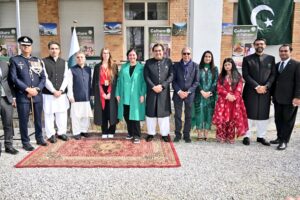
The relationship is also strengthened by cultural and social interactions. The softer side of cooperation is reflected with joint documentaries, conferences, as well as students exchange programs. Such efforts make sure that the partnership is not confined to the economic field only, but it is based on mutual understanding and respect. The example of the co-production of a documentary commemorating seventy-five years of relations depicts how both nations are working on accounts praising their friendship. Seminars like the China at 75, which was organized by the Pakistan China institute give them a platform upon which they can discuss future collaboration in the new industries.
Opportunities and Challenges:
The importance of such development cannot be overestimated. In the case of Pakistan, diversification into renewable energy and digital industries would bring about resilience to the external shocks and help eliminate susceptibility to the global fuel price fluctuations. Pakistan is considered by China to be one of the pillars of its Belt and Road Initiative which is offering it the strategic depth as well as a new market. The two nations are forming a more progressive, sustainable and all-inclusive bond.
Of course, challenges remain. The political unpredictability of Pakistan, and a lax regulatory system have the capacity to slack acceleration, as economists are still concerned with the debt issue incurred in previous CPEC projects. The international understanding between China and the West has also placed Pakistan in a tricky situation where diplomacy should take care and not to provoke the relationships. The partnership will require transparency, accountability and inclusive growth in order to provide long term benefits.
With seventy-five years of relations between Pakistan and China, the friendship is embarking on a new era. It is not only about road construction and ports anymore, but about future construction as well. The philosophy of all-weather friendship needs to be transformed into the actual one now that uses the ‘third idea’ that is innovation, sustainability, and mutual prosperity. Through proper management, this alliance can be a prototype of how developing countries and emerging powers can collaborate to overcome the twenty-first century.