St. Petersburg: Mystery and Majesty
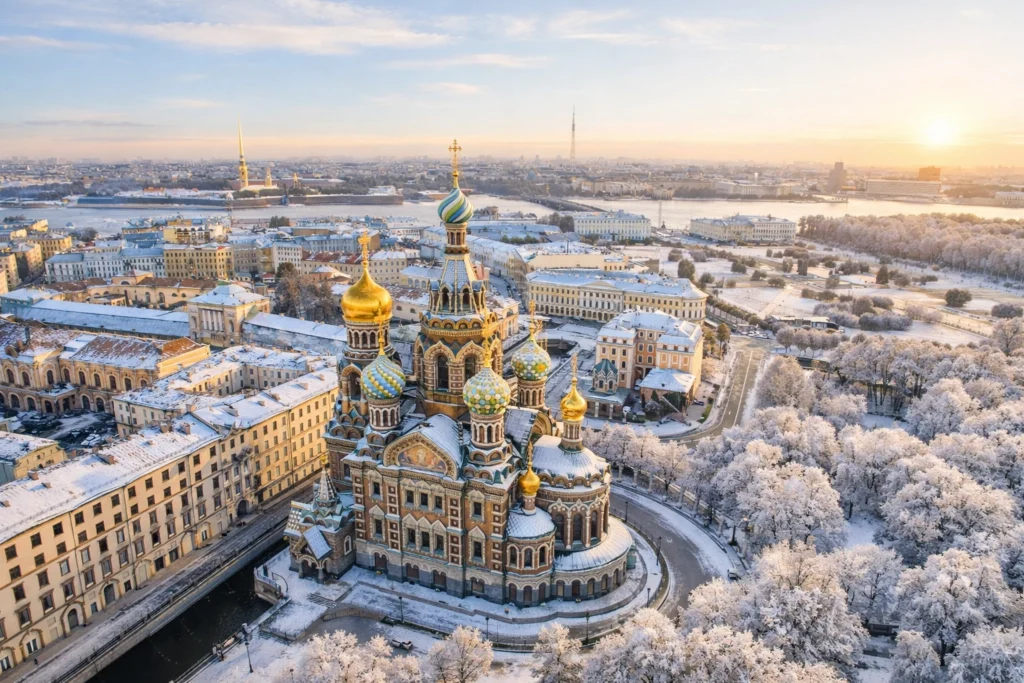

Cities are those that are impressive and those that are enchanting. St. Petersburg is a part and piece of the latter. Covered with mist, and smeared with silver-grey skies, the city is filled with the air of poetry and silent mystery, very often softened with rain. It is one of the most fascinating and mysterious places in Russia, whose foggy evenings and secret legends keep people intrigued and eager to visit it.
The secret societies used to hold a meeting here once upon a time. Such influential citizens investigated black magic, optimism to live immortally, and they were searching more about themselves and the world. With or without fact, such stories have created a web of myths that still captivates visitors and scholars of all kinds. St. Petersburg is not a place just existing, but one that can be speculated upon, imagined, and wondered over.
A City Born of Vision
St. Petersburg was the capital of Imperial Russia that was founded in 1703 by the Tsar Peter the Great and it was planned as the window of Russia into Europe. Its construction in a sophisticated European architectural design was in contrast to other traditional Russian cities which were constructed using a traditional design. It is now the second-largest city in Russia and is a vital port, located in the banks of the river Neva and on the border of the Gulf of Finland and the Baltic Sea.
Its medieval core, which was awarded a UNESCO world heritage site in 1991, is another monument to its incredible cultural and architectural heritage. The skyline of the city is created as a perfect harmony of the Baroque grandeur and neo-Classic magnificence. One of its jewels is the world-renowned Hermitage Museum, a monument of art and one of the biggest and most significant art museums in the world- full of the rich Russian artistic tradition.
The Rotunda, Gorokhovaya Street
The Rotunda at Gorokhovaya Street is one of the most intriguing places that can be taken as a symbol of St. Petersburg mystics world. The L-shaped house was constructed by Savva Iakovlev, a prosperous merchant and philanthropist, in the end of the 18th century, and inside it, there is a rare circular vestibule, which rests on six columns and topped with a twisting staircase. The example of such a rotunda in a building so shaped is unique, and is bound to cause speculation.
It is said that Grigori Rasputin who is one of the most mysterious figures of Russia came here. Some feel that the spiral staircase is a point in entry into the other world. The most enigmatic however is the hatch in the centre of the rotunda where a hidden Masonic initiation chamber is said to be located. It is observed that newcomers, who had come in, could get lost in labyrinths and come out years later.
There is also another myth that Count Andrei Zubov who stayed in the mid of 19th century there founded a Masonic lodge inside the building. They even say that the rotunda turned into a zero meridian which gave rise to six other rotundas which constituted an inverted star on the map of the city.
The Dante Alighieri inscription that was so vivid in the 1990s on the vault read: “All hope abandon ye who enter here.” This added to the legend and attracted streams of inquisitive people.
The Northern Venice
St. Petersburg is often referred to as the “Northern Venice” because it is distributed throughout the delta of the river Neva which flows into smaller rivers creating dozens of islands, connected by hundreds of bridges. Many bridges close to the city rise gracefully each night to give way to passing ships between Lake Ladoga and the Gulf of Finland – a spectacular view that makes up for the short days of winter in the city.
The most magical effect of summer is probably the so called White Nights. Darkness hardly descends upon weeks. After midnight the sky glows gently and envelops the city with the dreamy light. The streets are filled with festivals, concerts and outdoor celebrations.
A Living Cultural Heart
Nevertheless, St. Petersburg was never anything but, at heart, Russian, even though it is European. Standing next to theaters, concert halls, museums, and galleries, there are Orthodox churches and majestic cathedrals. It is a place of ballet and literature, classical music and full-blooded students.
This is where students constitute a vibrant and visible presence in the streets, filling them with juvenile dynamism. Winter snow sports, summer boating, grand Russian ballet shows and vibrant public celebrations are only but a few opportunities that one can explore when immersing into the cultural experience. St. Petersburg equally has both urban liveliness and academic standards unlike smaller university towns.
This city was established as a multi-national and multi-confessional centre and its people are still friendly, tolerant and welcoming. The winter snows are so fierce; they can never take away its beauty.
Concluding Remarks
I studied that, International visitors visit St. Petersburg and can hardly ever go away without being impressed. The only question that is unanimously raised is that one can never have enough time to see it all. One can get a glimpse by a quick visit; spend decades here and he can belong.
St. Petersburg is not just the destination, it is a historical, artistic, mysterious, and tough experience. It has gold in its grey clouds. It’s wet streets are centuries old. Its bridges do not only unite islands, but time and thoughts.
When you walk through St. Petersburg you enter into a city, which talks in a low voice asking you to find out on your own.