Survivors of deadly Maui wildfires returning to ruins, death toll likely to rise
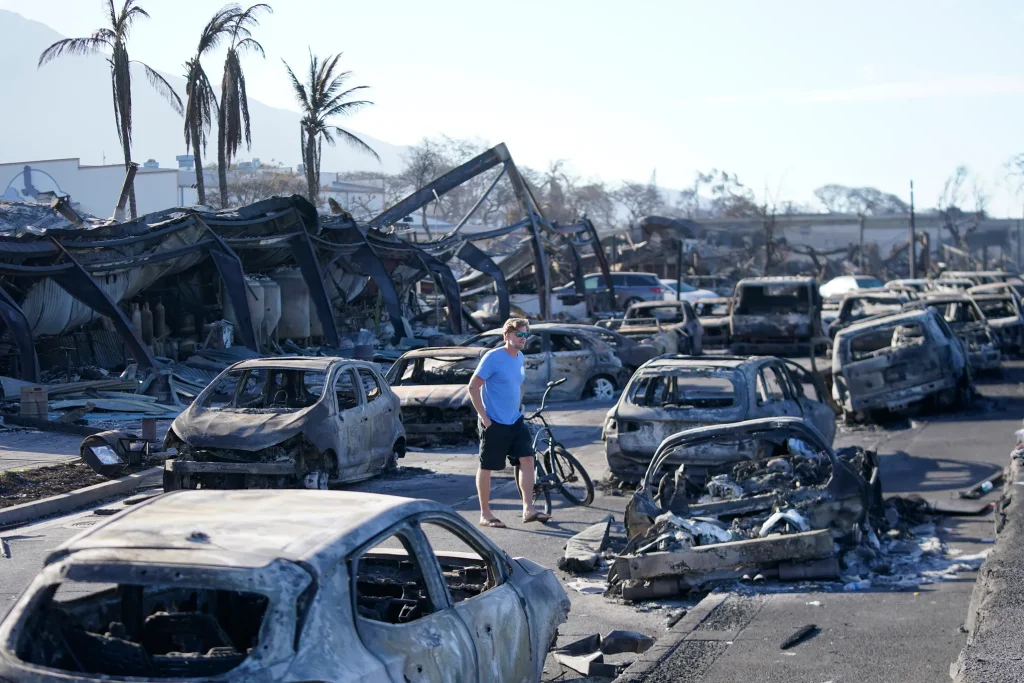
Lahaina, The Gulf Observer: Dogs trained to find bodies sniffed through piles of rubble and ash as stunned survivors of deadly wildfires that killed at least 80 people on the Hawaiian island of Maui took stock of their shattered lives and tried to imagine rebuilding from nothing.
The only items Summer and Gilles Gerling were able to retrieve from the detritus-filled lot where their home once stood in Lahaina were a piggy bank Summer’s father gave her as a child, their daughter’s jade bracelet and watches they gifted each other for their wedding. Their wedding rings were gone.
“Safety was the main concern. These are all material things,” Gilles Gerling said.
The fires nearly wiped out the historic town of 13,000 people and were still not fully contained Friday night on some parts of the island.
A new wildfire Friday evening triggered the evacuation of Kaanapali, a coastal community a few miles north of Lahaina, but crews were able to extinguish it, authorities said.
Maui County raised the number of confirmed deaths to 80 Friday night, and Gov. Josh Green warned that the toll would likely rise as search and rescue operations continue. Authorities set a curfew from 10 p.m. until 6 a.m. Saturday. Cadaver-sniffing dogs were deployed to search for the dead, Maui County Mayor Richard Bissen Jr. said.
An updated damage assessment released overnight by Maui County painted a stark picture of the Lahaina fire’s destructive power. More than 80% of the 2,719 structures exposed to the fire were damaged or destroyed — the vast majority of them residential. An estimated 4,500 people are in need of shelter, county officials said on Facebook early Saturday, citing figures from the Federal Emergency Management Agency and the Pacific Disaster Center.
“The recovery’s going to be extraordinarily complicated, but we do want people to get back to their homes and just do what they can to assess safely, because it’s pretty dangerous,” Green told Hawaii News Now.
The wildfires are the state’s deadliest natural disaster in decades, surpassing a 1960 tsunami that killed 61 people. An even deadlier tsunami in 1946, which killed more than 150 on the Big Island, prompted development of a territory-wide emergency system with sirens that are tested monthly.
Many fire survivors said they didn’t hear any sirens or receive a warning giving them enough time to prepare, realizing they were in danger only when they saw flames or heard explosions.
“There was no warning,” said Lynn Robinson, who lost her home.
The wildfire is already projected to be the second-costliest disaster in Hawaii history, behind only Hurricane Iniki in 1992, according to disaster and risk modeling firm Karen Clark & Company. The fire is the deadliest in the U.S. since the 2018 Camp Fire in California, which killed at least 85 people and destroyed the town of Paradise.
The danger on Maui was well known. Maui County’s hazard mitigation plan updated in 2020 identified Lahaina and other West Maui communities as having frequent wildfires and several buildings at risk. The report also noted West Maui had the island’s second-highest rate of households without a vehicle and the highest rate of non-English speakers.
“This may limit the population’s ability to receive, understand and take expedient action during hazard events,” the plan stated.
Maui’s firefighting efforts may have been hampered by limited staff and equipment.
Bobby Lee, president of the Hawaii Firefighters Association, said there are a maximum of 65 county firefighters working at any given time with responsibility for three islands: Maui, Molokai and Lanai.
The department has about 13 fire engines and two ladder trucks, but no off-road vehicles to thoroughly attack brush fires before they reach roads or populated areas, he said.
Maui water officials warned Kula and Lahaina residents not to drink running water, which may be contaminated even after boiling, and to only take short, lukewarm showers in well-ventilated rooms to avoid possible chemical vapor exposure.
Andrew Whelton, a Purdue University engineering professor whose team assisted with the Camp Fire and Colorado’s 2021 Marshall Fire, said showering in water potentially containing hazardous waste levels of benzene is not advisable and a do-not-use order would be appropriate until analysis is complete.
Lahaina resident Lana Vierra had fled Tuesday but was eager to return, despite knowing the home where she raised five children and treasured items including baby pictures and yearbooks were gone.
“To actually stand there on your burnt grounds and get your wheels turning on how to move forward — I think it will give families that peace,” she said.
Riley Curran said he fled his Front Street home after climbing up a neighboring building to get a better look. He doubts county officials could have done more given the speed of the onrushing flames.
“It’s not that people didn’t try to do anything,” Curran said. “The fire went from zero to 100.”
Curran said he had seen horrendous wildfires growing up in California.
But, he added, “I’ve never seen one eat an entire town in four hours.”