Tejas Again Plunges into Controversies
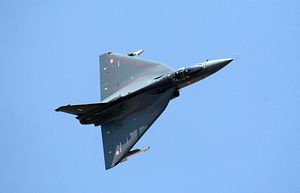

India’s Ministry of Defence (MoD) realised in the 1980s that its Soviet-era fighters, notably the MiG-21s, were nearing retirement, prompting the launch of the Light Combat Aircraft (LCA) programme in 1983. Officially named Tejas in 2003, meaning brilliance in Sanskrit, the fighter has struggled to live up to its name, plagued by failures, setbacks, and recurring issues that repeatedly pushed back deadlines. Despite its first flight in 2001 and induction into the IAF in 2016, the programme continues to face engine, structural, weight, and payload problems, causing major delays in fighter deliveries.
Accordingly, a deal worth 5 billion USD was signed between the MoD and HAL for 83 Tejas MK1 in 2021, followed by a 6 billion USD deal in 2025 for 97 more aircraft. Although the delivery of the first batch of Tejas Mk-1 was initially scheduled for March 2024, it remains almost two years behind schedule, with not a single aircraft delivered to date, with analysts viewing that full-fleet induction can extend beyond 2029. As of late, news has been floating that the deliveries of Tejas Mk-1 are now likely only by mid-2026 or even later, with five structurally completed aircraft present at HAL, according to the latest news, but not deemed fit for induction in the IAF due to pending certifications and incomplete avionics integration.
Whilst HAL has attributed the cause of missed deadlines to delayed supply schedule of the General Electric F404 engine, the sluggish progress on the Tejas Mk-1 by HAL has also earned the aspersions of the IAF Chief during his visit to the company in February 2025.
In thinly veiled remarks, ACM Singh expressed his scepticism towards HAL, stating that a new aircraft is not launched by merely changing one of its software or its looks, rather it is the weapons through which capability is determined. His concerns about Tejas are also shared by other IAF officers, expressing the aircraft’s limitations emerging from its lack of endurance and range as well as manoeuvrability and weapon integration.
These remarks are a recognition that Tejas Mk-1 is far from incorporating new weaponry, which actually make a difference in an aircraft. The successor to the Tejas Mk-1, the Tejas Mk-2, has also been plagued by delays. Its prototype, originally scheduled for rollout in August 2022, has now been deferred to 2027.
Adding to the troubles of the Tejas programme has been its number of crashes, the first of which happened in March 2024 in Jaisalmer during a training sortie, second during the Dubai Airshow in 2025, and the latest on 7 February 2026 near the runway at the frontline Nalia airbase in Gujarat. Speculations are that it could be an engine related problem as the accident occurred probably during landing. Nonetheless, the aircraft received major damage to its airframe. Following the latter, it is reported that the entire fleet of Tejas, roughly 40 produced till date of which three are written off, has been grounded due to flight safety concerns. Accidents are a normal affair in aviation business, but the glaring issue is the silence of the Tejas operator, which is the IAF, who has not issued any statement following the latest crash. However, on behalf of the operator, HAL is giving the clarifications by nullifying any crash and describing it as a minor technical incident on the ground, which is ludicrous and absurd. Questions are raised when the entire fleet remains grounded for safety reasons, a move that clearly points to problems far beyond what HAL claims. The operator itself is already perturbed by the poor quality of HAL’s work, a frustration underscored by ACM Singh’s marked frustration with the company’s unprofessionalism, saying he has “no confidence in HAL”.
The four-decades old Tejas programme, when compared with Pakistan JF-17, both 4.5 Generation fighters, reveals a stark disparity. Although the JF-17 took its maiden flight in September 2003, it is way ahead of the Tejas, most evident in the production of nearly 200 platforms to date. It has also garnered international prestige as it has more than 10 aspirant buyer states. Their eagerness stems from the platform’s several advantages including a low-price tag, network-enabled, precision-strike capable, multidomain combat platform, that brings operating autonomy with sanction-free availability, unhindered follow up spare support, and proven reliability with operational effectiveness. Contrarily, Tejas is nowhere close to the world aviation market.
Moreover, the Astra Mk-1 BVR is integrated on the Tejas with an effective range of approximately 100 km. On the other hand, the JF-17 operates the combat-proven PL-15 BVR with a range of more than 200 km. Additionally, the Indians claim the integration of an array of air-to-ground weaponry on Tejas, which is opposed to Pakistan’s claimed war-proven weapons on the JF-17 as they successfully destroyed two Indian S-400 batteries, one of the best air defence systems in the market, during Marka-e-Haq.
To conclude, the persistence of delays, technical shortcomings, and repeated setbacks underscores that the Tejas programme remains stuck in systemic inefficiencies. More than 40 years later, what was envisioned as a symbol of indigenous brilliance has instead become a cautionary tale of bureaucratic inertia and industrial underperformance, leaving India’s ambitions for a reliable homegrown fighter still unfulfilled.