The Expiration of the Last Nuclear Arms Control Treaty Between Washington and Moscow
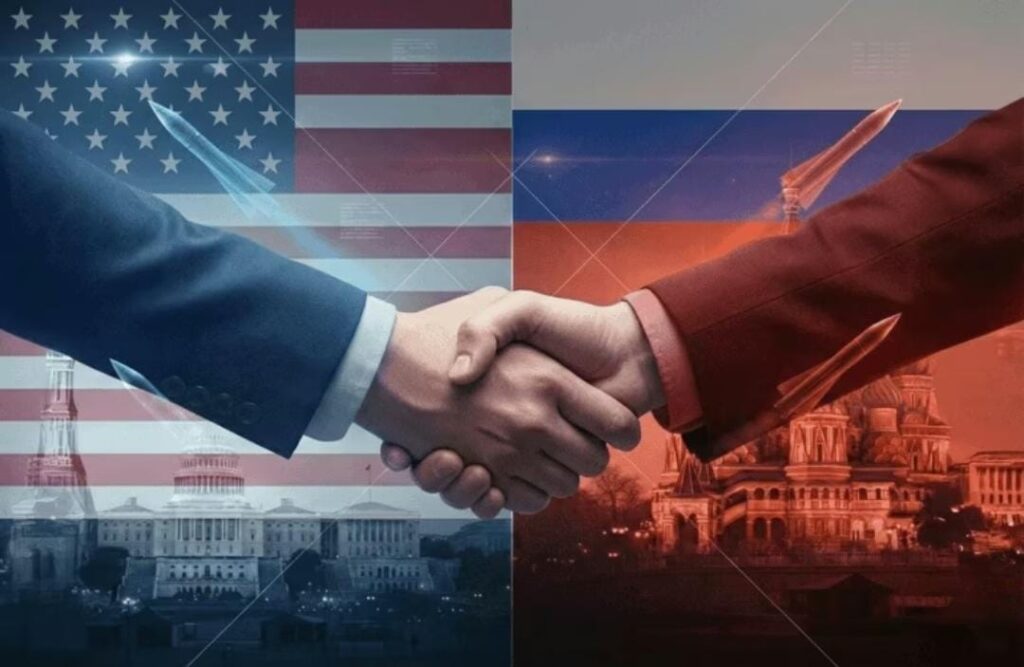

With the expiration of the New START Treaty, one of the final remaining agreements designed to reduce the risk of a catastrophic nuclear conflict, the international system has entered a new phase of strategic uncertainty. For the first time in decades, no legally binding framework governs the world’s two largest nuclear arsenals, raising profound concerns about the future of global strategic stability.
Both Russia and the United States have publicly expressed a shared understanding of the need to resume dialogue on nuclear arms control. However, these declarations come amid growing divergence over the nature, scope, and structure of any future agreement. Washington has called for a reconfiguration of the arms control architecture to reflect rapid geopolitical shifts and the growing number of nuclear-armed states, while Moscow has signaled conditional openness to negotiations under a broader, multilateral framework.
Kremlin spokesperson Dmitry Peskov stated on Friday that Moscow and Washington agree on the importance of handling nuclear weapons responsibly, noting that this issue was discussed during meetings held in Abu Dhabi following the expiration of New START. The treaty had imposed strict limits on the deployment of strategic nuclear weapons by both sides.
Under New START, each party was capped at 1,550 deployed strategic nuclear warheads, while the agreement also established extensive transparency mechanisms, including data exchanges, notifications, and on-site inspections of nuclear facilities. These measures formed the backbone of mutual confidence and predictability between the two nuclear superpowers.
The treaty’s expiration marks the effective end of decades of bilateral cooperation on arms control between Washington and Moscow—cooperation that played a pivotal role in ending the Cold War and reinforcing global strategic stability.
With New START no longer in force, the legal ceiling on deployed strategic warheads has disappeared, and verification mechanisms have ceased. This development brings the specter of renewed nuclear competition back into focus and places the international system in an era of unconstrained nuclear deterrence. United Nations officials and security experts have voiced increasing concern over the heightened risks of miscalculation and escalation.
In this context, Pope Leo XIV on Wednesday urged the United States and Russia to renew the START framework, emphasizing that current global conditions require “every possible effort to prevent a new arms race.”
A detailed analytical report by The New York Times described the moment as unprecedented since the early 1970s, noting that the last major agreement imposing legal limits on the size and composition of the world’s largest nuclear arsenals has expired without a ready replacement.
Meanwhile, indirect accusations have surfaced between the two sides. Moscow claims it sought to extend the treaty but received no response from Washington, while reiterating its openness to negotiations and its readiness to confront a potential nuclear arms race if necessary.
Washington, for its part, argues that extending the treaty no longer serves U.S. interests or global security. Thomas DiNanno, U.S. Assistant Secretary of State for Arms Control, Deterrence, and Stability, stated that bilateral agreements are insufficient in light of current threats, adding that President Donald Trump seeks a new nuclear arms control treaty.
Russia has also expressed willingness to participate in multilateral disarmament talks, provided that Britain and France—both NATO allies of the United States—are included. This condition highlights the fundamental divergence between the two powers over the future structure of nuclear arms control, at a time when international fears of a renewed arms race are intensifying.
According to the New York Times analysis, the demise of New START had been anticipated for years. However, the war in Ukraine and the sharp deterioration in U.S.–Russian relations prevented serious negotiations toward a replacement agreement or even a temporary extension.
From Arms Control to Risk Management
Despite official rhetoric emphasizing “responsible behavior,” the reality points to a transition from institutionalized arms control to a looser model of risk management without binding rules. The absence of numerical limits and verification mechanisms does not necessarily imply an immediate arms race, but it does open the door to:
- Undeclared expansion of nuclear arsenals
- Qualitative modernization of warheads and delivery systems
- A decline in strategic trust rooted in transparency
The core danger lies not in the absolute number of warheads, but in the erosion of mutual awareness regarding intentions and actual capabilities.
Political Rhetoric Versus Strategic Reality
The disparity in public positions underscores a widening gap between political messaging and strategic realities:
Moscow signals conditional readiness to negotiate, tying talks to a multilateral framework that includes Britain and France—an effort to recalibrate strategic balance with NATO.
Washington argues that bilateral agreements are obsolete, yet has not presented a comprehensive, workable alternative, particularly given the complexity of incorporating other nuclear powers such as China.
This divergence reflects not a technical disagreement, but a deeper conflict over the future nuclear order: whether it remains fundamentally bipolar or evolves into a multipolar nuclear system lacking clear rules.
The Missing International Dimension
Despite UN warnings and moral appeals from religious and international figures, the broader international community remains largely sidelined, for two primary reasons:
The absence of enforceable mechanisms outside the framework of major nuclear powers
The international system’s preoccupation with overlapping crises—from Ukraine to the Middle East—which diminishes political momentum for disarmament initiatives
In this sense, the end of New START represents not merely the failure of a single treaty, but a broader failure to modernize collective security structures for an era defined by multiple crises and power centers.
Scenarios for the Next Phase
Based on current indicators, three main scenarios appear plausible:
A prolonged legal vacuum accompanied by informal restraint—most likely in the short term
A limited qualitative arms race focused on modernization rather than numerical expansion
The launch of new negotiations within complex multilateral frameworks, making any comprehensive agreement a long and arduous process
Analytical Conclusion
The expiration of the New START Treaty does not signal an imminent nuclear war. It does, however, clearly indicate the erosion of the legal and normative foundations that have governed nuclear deterrence since the end of the Cold War. In the absence of a realistic and enforceable alternative, the world is entering an era of nuclear deterrence that is less predictable and more vulnerable to strategic miscalculation—arguably the most dangerous outcome of all.