PM Chính Calls for Decisive Measures to Achieve 2026 Economic Growth Targets
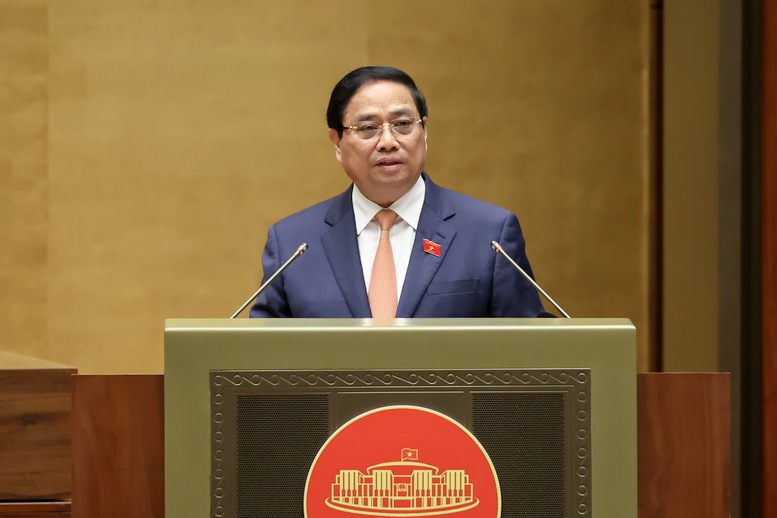
Hanoi, The Gulf Observer: Prime Minister Phạm Minh Chính has issued an official dispatch calling for tougher and more decisive implementation of key tasks to achieve Việtnam’s economic growth targets for 2026, as the country enters a pivotal new development phase.
The year 2026 marks the first year of the 2026–30 five-year socio-economic development plan and the beginning of a new growth cycle, alongside the implementation of the Resolution of the 14th National Party Congress.
In the dispatch, the Prime Minister directed ministries, agencies, localities and State-owned enterprises to effectively carry out the socio-economic development plan and State budget estimates set out in Government Resolution No.01/NQ-CP. They were instructed to closely monitor international and domestic developments, strengthen analysis and forecasting, and adopt flexible, timely and effective policy responses.
The Ministry of Finance (MoF) was assigned to lead the formulation of the Government’s action programme to implement the Resolution of the 14th National Party Congress, which must be submitted before February 5.
On fiscal and monetary policy, the MoF will continue pursuing a targeted and effective expansionary fiscal policy in close coordination with monetary and other macroeconomic policies. Measures include strengthening fiscal discipline, ensuring full and timely revenue collection, broadening the tax base and preventing tax losses, particularly in e-commerce, food services and retail.
State budget revenue in 2026 is targeted to increase by at least 10 per cent compared with the 2025 estimate. Tax and fee reductions, along with land rental support, will be extended to assist people and businesses, especially small and medium-sized enterprises (SMEs). Public debt and deficit space will be used effectively within safe limits to mobilise resources for investment, including government bond issuance for key national projects and priority areas such as science and technology, innovation and digital transformation.
Efforts will also be intensified to develop the stock market and corporate bond market in a stable, safe and transparent manner, turning them into effective channels for medium- and long-term capital mobilisation in support of the country’s double-digit growth target.
The State Bank of Việt Nam (SBV) was instructed to manage monetary policy proactively, flexibly and effectively in coordination with fiscal policy to promote growth, stabilise the macroeconomy, control inflation and maintain major economic balances. Interest rates and exchange rates will be managed in line with macroeconomic conditions, while the foreign exchange market will be closely supervised to maintain the stability of the Vietnamese đồng.
Credit institutions are required to ensure safe and effective credit growth, directing capital towards production, business, priority sectors and key growth drivers. Credit programmes for social housing, infrastructure, digital technology and high-quality rice production and consumption linkages will continue, while credit to potentially risky sectors will be strictly controlled. The SBV is also tasked with completing study and assessment dossiers on a proposed national gold trading exchange for submission to the Government within January.
State-owned groups and enterprises were urged to reinforce their leading role, improve governance and business efficiency, and strive for output or revenue growth of at least 10 per cent in 2026.
The MoF and relevant agencies must urgently consolidate budget estimates and finalise capital plans for 2026 for national target programmes, submitting them for allocation by February 2026. Disbursement of public investment capital is to be accelerated from the start of the year, with a target of 100 per cent disbursement of the assigned plan. Bottlenecks related to site clearance and construction materials must be resolved promptly, and capital reallocated from slow- to fast-disbursing projects.
The Government will step up efforts to attract large-scale, high-tech foreign direct investment. A Politburo resolution on foreign-invested economic development is to be finalised, while on-site investment promotion will be enhanced to attract multinational corporations and strategic investors in semiconductors, artificial intelligence and digital technology.
A resolution addressing stalled and prolonged projects is to be completed and issued before January 30 to unlock resources and boost growth momentum. Legal frameworks to resolve common issues in build-transfer projects will also be studied and proposed within the month. In addition, a national one-stop investment portal with shared databases linking central and local authorities is scheduled for completion in February.
The Ministry of Construction was tasked with reviewing and upgrading existing and ongoing expressway projects to meet full expressway standards, completing related technical infrastructure and reporting to the Prime Minister by February 15. Key transport projects will be advanced, including preparations for the next phases of the Lào Cai–Hà Nội–Hải Phòng railway and Long Thành International Airport, the segment design for the North–South high-speed railway, as well as regional connectivity roads and major seaports.
The National Housing Fund will be utilised to accelerate social housing development, particularly rental housing, with a target of completing more than 110,000 social housing units in 2026 and achieving the one-million-unit goal by 2028.
The Ministry of Agriculture and Environment was directed to promote agricultural restructuring linked to science, technology, innovation and digital transformation, focusing on integrated, multi-value commodity production in agriculture, forestry and fisheries while ensuring national food security.
The Ministry of Industry and Trade was instructed to implement demand-stimulation measures, particularly during Tết, combat smuggling, trade fraud and counterfeit goods, and improve service quality to support tourism. An action programme on consumer protection must be submitted to the Government before February 15, alongside strengthened trade promotion, export market diversification and brand-building for high-quality Vietnamese products.
Meanwhile, the Ministry of Justice was tasked with drafting a resolution on simplifying administrative procedures and business conditions for submission within January. To generate breakthroughs in new growth drivers, the Ministry of Science and Technology was urged to urgently roll out state-funded projects on science, technology, innovation and digital transformation.
The Ministry of Education and Training was assigned to propose breakthrough mechanisms to develop high-quality higher education institutions and strategic technology research programmes, while accelerating the construction of boarding schools to ensure education access in border communes.
The MoF, together with authorities in HCM City and Đà Nẵng, was directed to ensure the synchronised and effective operation of the International Financial Centre, including finalising special governance policies, piloting a digital asset trading platform and attracting global investment.
The Ministry of Public Security was instructed to draft and submit a decree on breakthrough mechanisms to promote innovation and data use at the National Data Centre within January.
The Prime Minister stressed that all ministries, agencies and localities must focus on decisive and effective implementation of breakthrough resolutions issued by the Politburo to maintain strong growth momentum in the new development phase.