Hanoi Party Committee Adopts 100-Year Master Plan to Transform Capital into Global City
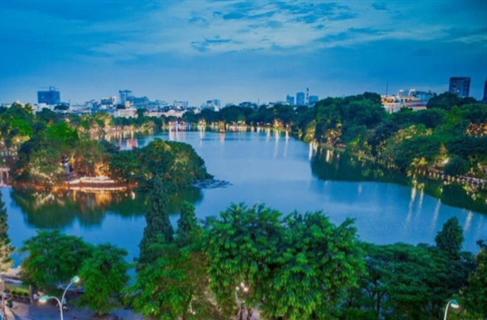
Hanoi, The Gulf Observer: The 18th-tenure Hanoi Party Committee convened its fifth conference on March 27, approving a series of strategic decisions aimed at shaping the capital’s long-term development and positioning it as a global city in the coming decades.
A key highlight of the conference was the adoption of a comprehensive master plan with a 100-year vision, under which Hanoi is expected to evolve into a globally recognised city beyond 2065, known for its high quality of life and overall well-being.
Presenting the plan, Permanent Vice Chairman of the municipal People’s Committee Duong Duc Tuan stated that the planning scope covers the entire administrative area of Hanoi, comprising 126 communes and wards. The plan also extends to the broader Capital Region, including the provinces of Phu Tho, Thai Nguyen, Bac Ninh, Hung Yen, and Ninh Binh, while promoting strong regional linkages across the Red River Delta, northern mountainous and midland areas, and national economic corridors.
Under the vision, Hanoi will serve as the core of a multi-centred urban cluster, driving development across the Capital Region. The city, spanning approximately 3,360 square kilometres, is projected to see its population reach 14–15 million by 2035, 15–16 million by 2045, and 17–19 million by 2065, with long-term planning aimed at maintaining sustainable urban density below 20 million residents.
By 2035, Hanoi aims to become a “civilised, modern and happy” capital, preserving its rich cultural heritage while emerging as a leading hub for economic activity, education, healthcare, and innovation in the Asia-Pacific region. By 2045, the city is expected to stand on par with capitals of developed nations in terms of knowledge and technology, ultimately achieving global city status after 2065.
The master plan outlines an open, “multi-layered, multi-polar, and multi-centred” spatial structure, with the Red River envisioned as the central ecological and cultural axis, integrated closely with regional and international economic networks.
In parallel, Vice Chairman Nguyen Xuan Luu presented Hanoi’s socio-economic development plan for 2026–2030, targeting rapid yet sustainable growth through a new economic model. By 2030, the capital aims to reinforce its role as Vietnam’s political and administrative centre, while becoming a leading hub for innovation, digital transformation, green transition, and the circular economy.
Key economic targets include an average annual GRDP growth rate of 11 percent, per capita GRDP of US$12,000, and a digital economy contributing 40 percent of total GRDP by 2030. The city also plans to achieve an urbanisation rate of 65–70 percent, with public transport expected to meet at least 30 percent of travel demand.
Closing the conference, Secretary of the municipal Party Committee Nguyen Duy Ngoc emphasized that Hanoi is entering a new phase of development marked by both significant challenges and historic opportunities.
He stressed that the vision for the capital must go beyond rhetoric and be translated into concrete actions across all levels of governance, calling for stronger determination, greater efficiency, and unified implementation to ensure that policies deliver tangible results.