The Turkic world should not hesitate to deepen its relations with China!
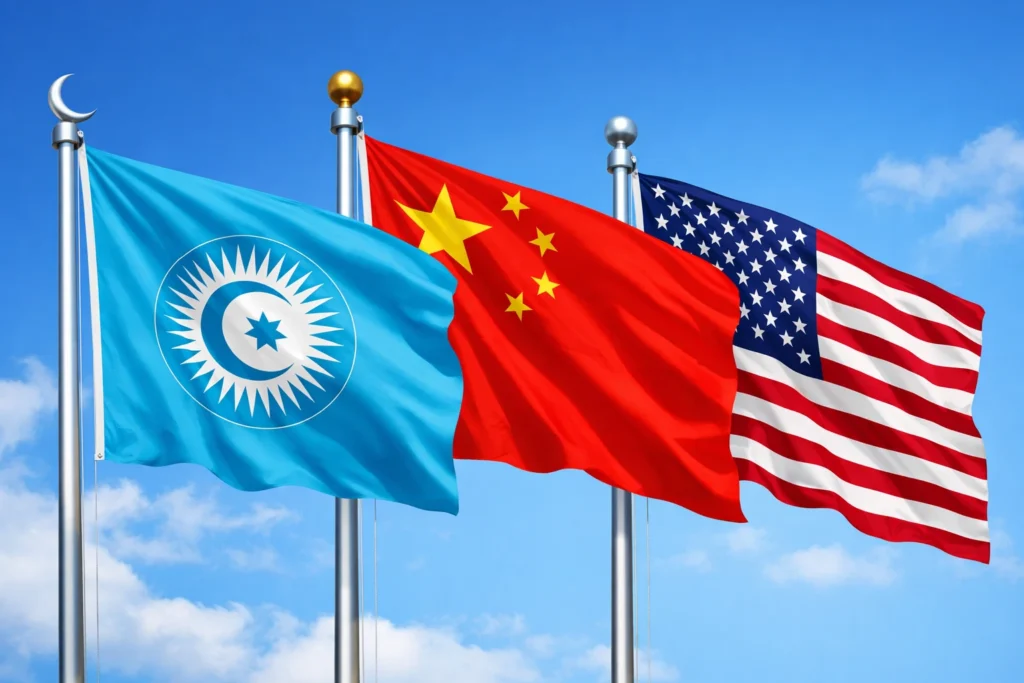
The Turkic world is historically interconnected but geopolitically fragmented. While Türkiye remains integrated into the Western security system, expanding ties with China reflects not an axis shift but a strategy of risk diversification and strategic autonomy. The objective is to act as a balancing power between blocs.
The Turkic world today presents a landscape that is historically interconnected yet geopolitically divergent. Although Azerbaijan, Kazakhstan, Kyrgyzstan, Uzbekistan, Türkiye, and Turkmenistan share a common historical memory, linguistic affinity, and cultural continuity, they are positioned along different axes in terms of security architecture and foreign policy orientation. Türkiye, as a member of NATO, is integrated into the Western security system, while several Central Asian Turkic republics participate in China- and Russia-centered platforms within the framework of the Shanghai Cooperation Organization. Turkmenistan, for its part, maintains its long-standing policy of neutrality.
This configuration evokes the bipolar order that emerged after 1945. During the Soviet era, Türkiye aligned with the West, whereas the Turkic communities of Central Asia remained within a Moscow-centered system. Shared memory was effectively frozen, and direct interaction was severed. Today, we observe the reintensification of global competition—this time along a U.S.–China axis. The critical question, therefore, is whether history will repeat itself: Will the Turkic world once again fragment into opposing blocs?
Drawing on extensive engagement with state programs and strategic platforms spanning the United States, the Gulf region, Russia, and Central Asia, I contend that Turkish decision-makers must avoid interpreting the international system through a single-axis framework.
In Ankara, the expansion of relations with China should not be framed as an “axis shift,” but rather as an effort to enhance strategic resilience and bargaining capacity. Türkiye’s institutional integration with the West is profound: its military doctrine, defense standards, intelligence networks, and educational infrastructure are largely aligned with Western systems. This integration is not merely technical; it is cognitive and normative. A sudden reorientation is therefore neither realistic nor structurally feasible.
However, the global order is undergoing transformation. China is emerging not only as a manufacturing hub but also as a new economic center through its infrastructure investments, financial instruments, digital technologies, and expansive trade networks. This transformation generates a new set of strategic questions for Türkiye: Is diversification of economic channels a necessity? Does excessive dependence on Western financial systems create vulnerability during crises? How can access to technology and integration into global value chains be diversified?
Based on observable policy trends, Turkish decision-makers appear to pursue three primary strategic objectives in their China policy.
First, mitigating economic vulnerabilities. Establishing alternative financial and trade networks reduces single-source dependency. This is not a shift in alignment, but rather a strategy of risk distribution.
Second, narrowing the technological gap. It is untenable to remain indifferent to China’s rapid technological ascent. Yet the critical issue lies in securing technology transfer without falling into long-term dependency traps.
Third, enhancing geopolitical bargaining power. In international relations, optionality translates into leverage. A balanced relationship with China may expand Türkiye’s maneuvering space in negotiations with Western actors.
Nevertheless, this evolving order must not be interpreted unilaterally. The Western system itself is undergoing transformation. The gap between democratic rhetoric and geopolitical practice is widening; sanctions are increasingly employed as instruments of foreign policy; and the concept of alliance is being redefined. For countries such as Türkiye, this environment necessitates a comprehensive cost-benefit analysis.
At the same time, the Chinese model should not be romanticized. Strong state control mechanisms, credit-based diplomacy, and the risk of dependency in strategic sectors must be carefully calculated. Reducing reliance on one center only to become dependent on another would not constitute strategic prudence.
The central issue, therefore, is not “West or China?” but rather the capacity for strategic autonomy. In times of crisis, which system offers greater flexibility? Which partnership structure generates fewer structural dependencies? To what extent can Türkiye increase self-sufficiency in defense, finance, and technology?
A similar threshold confronts the broader Turkic world. Shared identity does not automatically generate a unified geopolitical vision. As security alignments, economic dependencies, and regional threat perceptions diverge, states will inevitably position themselves according to national interests. However, if a coordinated strategic framework can be developed, the Turkic world may transcend its role as a passive geopolitical space within global competition.
My assessment is unequivocal: Türkiye’s objective should not be to switch sides, but to function as a gravitational center between competing blocs. While its bureaucratic and security architecture may remain integrated with the West, its economic and technological engagements can evolve in a multidirectional manner. This is not a contradiction; it is a deliberate balancing strategy.
The contours of the emerging world order remain unsettled. Yet one fact is clear: the era of passive alignment has ended. Türkiye will either dissolve within a bloc or transform into a balancing actor capable of maneuvering between power centers. I consider the latter trajectory feasible—provided that policy choices are guided not by emotional reflexes, but by sober strategic calculation.
In conclusion, the expansion of relations with China constitutes not merely a preference, but a structural necessity for both Türkiye and the wider Turkic world. Recognizing this necessity while simultaneously constructing resilience mechanisms that do not rely exclusively on Western resources will be essential for sustaining long-term strategic autonomy.