Vietnam, Laos Vow to Boost Trade to $10 Billion by 2030
Vientiane, The Gulf Observer: Vietnamese Prime Minister Lê Minh Hưng and his Lao counterpart Saleumxay Kommasith have reaffirmed their commitment to strengthening bilateral economic, trade and investment cooperation, setting a target of increasing two-way trade to $10 billion by 2030.
The two prime ministers made the remarks while attending the Việt Nam-Laos Investment Promotion Conference in Vientiane on Thursday, held as part of the Vietnamese leader’s official visit to Laos.
The conference brought together government officials, representatives of ministries, sectors and local administrations, as well as a large number of business leaders and investors from both countries. Participants reviewed bilateral investment cooperation, explored new business opportunities and discussed measures to address obstacles facing enterprises.
Discussions focused on expanding cooperation in minerals, rubber, energy, railways, roads, seaports and other priority sectors, alongside efforts to accelerate strategic infrastructure projects connecting the two economies.
According to figures presented at the conference, bilateral trade reached nearly $3 billion in 2025, marking a year-on-year increase of 32.7 per cent and the highest level recorded to date. However, trade during the first eight months of 2026 stood at approximately $1.65 billion, highlighting the need for further measures to sustain growth and achieve the ambitious 2030 target.
Laos remains Vietnam’s largest destination for overseas investment, hosting more than 300 Vietnamese-invested projects with total registered capital exceeding $7 billion. During the first nine months of 2026, Vietnamese investors received licences for 24 new projects in Laos, with total investment reaching $670 million, approximately 1.7 times the amount recorded during the corresponding period of 2025.
Both countries are also advancing major connectivity initiatives, including the Hanoi-Vientiane Expressway, the Vientiane-Vũng Áng Railway, Vũng Áng Port, energy infrastructure and electricity cooperation. Vietnam is accelerating construction and implementation efforts to complete the Vinh-Thanh Thủy Expressway ahead of schedule.
Vietnamese-invested projects in Laos have generated employment and increased incomes for hundreds of thousands of Lao workers, while contributing an average of around $300 million annually to the Lao state budget.
The two leaders welcomed the successful organisation of the conference as Vietnam and Laos prepare to mark the 65th anniversary of diplomatic relations in 2027 and the 50th anniversary of the signing of the Treaty of Amity and Cooperation in the same year.
They described the event as an important opportunity to translate high-level agreements into practical outcomes and strengthen economic cooperation during the 2026-2030 period.
While appreciating the progress achieved, both sides acknowledged persistent challenges, including delays in project implementation, investment procedures, land-related issues, payment difficulties and inadequate infrastructure connectivity. They stressed the need for coordinated action to address these concerns and improve the overall business environment.
Addressing the conference, Prime Minister Hưng outlined Vietnam’s development priorities, saying the country was determined to renew its growth model by placing greater emphasis on science and technology, innovation, digital transformation, human-resource development, productivity and competitiveness.
Vietnam aims to achieve double-digit economic growth during 2026-2030 and become a developed, high-income country by 2045, he said.
The Vietnamese prime minister highlighted the country’s efforts to implement major policy initiatives covering scientific and technological advancement, international integration, legal reform, private-sector development, the state economy, foreign investment, energy security, education, culture and healthcare.
Despite global economic uncertainty, Vietnam’s macroeconomic situation has remained broadly stable, with inflation under control and major economic balances maintained. According to figures presented at the conference, the country’s gross domestic product grew by more than 9.01 per cent during the first nine months of 2026.
Vietnam’s total import-export turnover reached $888 billion, up 30.4 per cent year-on-year. Registered foreign direct investment amounted to $50.36 billion, an increase of 76.4 per cent, while disbursed FDI reached $21.07 billion, up 12.1 per cent. Total social investment capital stood at VNĐ3.11 quadrillion, representing a 15.1 per cent increase.
Hưng also noted that Vietnam officially joined the group of upper-middle-income countries on July 1, 2026.
He emphasised that the leadership of both countries had consistently agreed that economic, trade and investment cooperation must become a strong pillar of the relationship, reflecting the longstanding ties of “great friendship, special solidarity, comprehensive cooperation and strategic cohesion” between Vietnam and Laos.
The prime minister praised the business communities of both countries for overcoming difficulties, maintaining production and expanding commercial activities. He also commended relevant ministries, sectors and localities for implementing high-level directives and working to resolve long-standing obstacles affecting major strategic projects.
Looking ahead, Hưng called for stronger determination and more effective action to create new breakthroughs in bilateral economic cooperation amid an increasingly complex and unpredictable global and regional environment.
He outlined five key priorities for advancing the partnership.
First, he stressed the need to translate strategic cohesion into practical economic cooperation, particularly through stronger institutional and policy coordination, transport infrastructure, logistics, energy, science and technology, and digital transformation.
He called for accelerated investment in the Hanoi-Vientiane Expressway, effective operation of Vũng Áng Port and the preparation of a suitable implementation plan for the Vientiane-Vũng Áng Railway. He also emphasised closer electricity trading and power-grid connectivity as important foundations for achieving the $10 billion bilateral trade target.
Second, Hưng urged both governments to improve their investment and business environments. Vietnam, he said, was ready to share its experience in institutional reform and simplifying administrative procedures while supporting Laos in maintaining macroeconomic stability to attract investment.
Third, he called for more effective use of existing bilateral cooperation mechanisms, particularly the Vietnam-Laos Intergovernmental Committee, to promptly identify and resolve emerging difficulties.
Fourth, the two sides should accelerate project implementation, with investors mobilising the necessary resources to ensure that projects, especially major strategic initiatives, are completed on schedule and meet quality standards.
Fifth, Hưng encouraged the expansion of investment into emerging and high-potential sectors, including high-tech agriculture, mineral processing, renewable energy, logistics, finance and banking, digital transformation and tourism.
He called on major Vietnamese state-owned enterprises and private-sector companies to increase their investments in Laos, while welcoming Lao businesses seeking investment opportunities in Vietnam.
“The great friendship, special solidarity, comprehensive cooperation and strategic cohesion between Vietnam and Laos, and between Laos and Vietnam, are an invaluable asset of the Vietnamese and Lao Parties, States and people,” Hưng said, stressing the responsibility of the current generation to transform this political foundation into tangible development opportunities for both countries.
He expressed confidence that the commitment of political leaders, citizens and business communities would elevate bilateral relations to new heights, contributing to prosperity, well-being and happiness in both nations.
For his part, Prime Minister Saleumxay Kommasith welcomed Hưng’s visit and expressed agreement with his assessment of bilateral relations, particularly in economic, trade and investment cooperation.
Saleumxay said the investment promotion conference would contribute significantly to strengthening economic ties and helping both countries address existing shortcomings while working towards targets established by their leaders.
He said Laos had taken note of proposals submitted by Vietnamese businesses aimed at improving the investment climate, strengthening investment management and promotion, and facilitating the implementation of Vietnamese-funded projects.
The Lao prime minister encouraged enterprises from both countries, including state-owned and private businesses, to deepen cooperation through equity partnerships, mutual support and the sharing of technological expertise.
He particularly urged Vietnamese investors, including major corporations, to visit Laos more frequently and explore opportunities in sectors prioritised by the Lao government.
Saleumxay also called on investors to report difficulties and obstacles promptly, assuring them that the Lao side would consider their concerns and work jointly towards practical and lasting solutions.
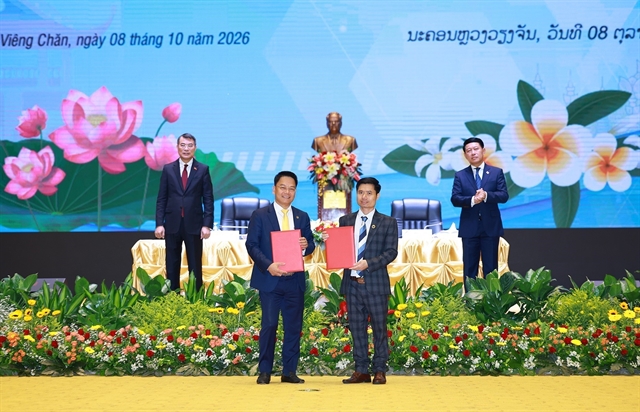
At the conclusion of the conference, the two prime ministers witnessed the presentation of 17 investment certificates and cooperation agreements for projects involving agencies and businesses from both countries.
Hưng expressed hope that the projects would deliver practical results by creating jobs, generating revenue and developing new economic value, while serving as additional bridges connecting the two economies, countries and peoples.