Tajikistan and China Inaugurate Joint Environmental Research Laboratory in Dushanbe
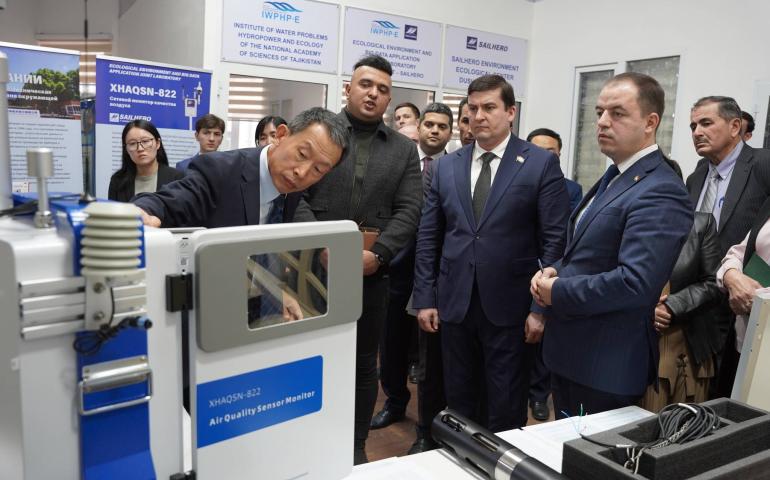
Dushanbe, The Gulf Observer: A joint Tajik-Chinese environmental research laboratory was officially inaugurated on December 10 in Dushanbe. Established within the Institute of Water Problems, Hydropower, and Ecology at the National Academy of Sciences of Tajikistan, the new facility is dedicated to environmental monitoring, water and air quality analysis, and assessing the sustainable use of natural resources.
Enhanced Cooperation and Research Opportunities
According to the National Academy of Sciences, the laboratory offers unprecedented opportunities for collaborative research between Tajik and Chinese scientists. It aims to reinforce scientific cooperation through data exchange, the application of cutting-edge technologies, and international-level partnership in ecological research.
The state-of-the-art equipment—introduced in Tajikistan for the first time—includes a multiparameter water quality analyzer, the portable P-MP1000 water quality meter, and the XHAQSN-822 air quality network monitor.
Strengthening Ecology and Scientific Capacity
The new facility provides a vital platform for experts from both countries to deepen collaboration in ecology, environmental protection, and energy. The advanced equipment has been installed with the support of the Ministry of Transport of the People’s Republic of China, the Ministry of Ecology and Environment of China, and Hebei Sailhero Environmental Protection.
“We hope this laboratory will be an important step in strengthening scientific ties and will foster new research in ecology and natural resource management,” the Academy of Sciences of Tajikistan stated.
Boosting Scientific Infrastructure
The initiative forms part of broader efforts to enhance Tajikistan’s scientific infrastructure. Recently, the Chemical, Biological, Radiation, and Nuclear Safety Agency of the National Academy of Sciences established a new radiation mapping laboratory equipped with advanced software to develop high-precision radiation maps. These tools support radiation monitoring, public safety, and efficient responses to potential radiation threats.