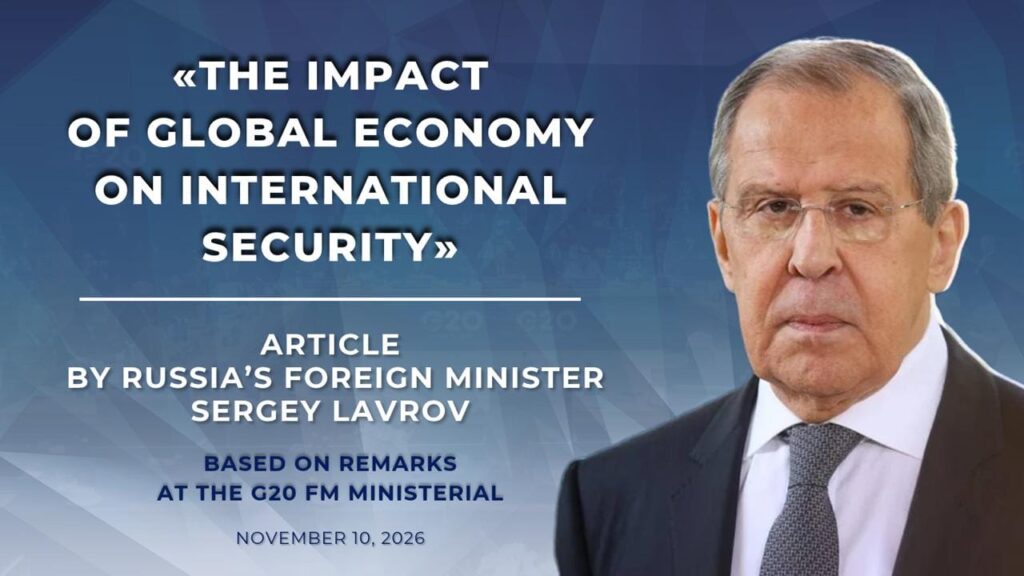
Article by Foreign Minister of the Russian Federation Sergey Lavrov, The Impact of Global Economy on International Security
Key points:
Geopolitical Context
In an ideal world, the global economy and international security should complement each other and jointly provide a foundation for peaceful coexistence and shared prosperity. Instead, the economy is increasingly becoming an arena of confrontation, with trade wars being unleashed to suppress geopolitical competitors in the wake of hot wars.
The objective process of the emergence of a multipolar world order is being met with outright hostility in the West. Protectionist barriers, and even outright blockades, in the way of the dissemination of advanced technologies are multiplying.
The European Union, which is turning itself into a military bloc has harked back to the days of slavery and piracy and taken to openly seizing foreign vessels and stealing their cargoes. To justify this plunder, it has invented the term “shadow fleet,” which has no basis in international law.
All these actions by the West are in direct violation of international law. They create uncertainty and additional costs, and undermine global economic connectivity and long-term resilience. In effect, they are dismantling the very globalisation model that the West itself created and promoted for decades as the ideal system of global economic governance, a kind of “economic end of history.”
Global energy and food security
- A stable global energy system is an essential prerequisite for sustained economic growth and the adoption of innovative technologies. However, the normal functioning of energy markets is being undermined by a number of factors.
- Feeling emboldened by the EU’s unconditional support, the Kiev regime has come to believe that it can act with impunity carrying out terrorist attacks against critical infrastructure.
- US President Donald Trump’s calls on Ukraine to stop fuelling the energy crisis have been ignored. To this day, those who organised the acts of sabotage against the Nord Stream pipelines mentioned above have not been brought to justice.
- The aggression against Iran, which led to the closure of the Strait of Hormuz, was a serious destabilising factor that has dealt a severe blow to the energy sector.
- Food security is another important component of global security. This year, G20 trade ministers condemned the weaponisation of food supplies. What is needed now is to translate words into concrete action.
Russia in the global economy: A constructive contribution despite challenges
- The illegitimate sanctions have inflicted losses running into trillions on Europe, fuelled inflation in the United States, and reduced living standards in many countries (hence the surge in protest sentiment across the European Union).
- Russia will continue to contribute to normalising global fuel and energy markets. We are among the leading exporters of hydrocarbons to Asia, Africa, and Latin America.
- We are convinced that the future lies in the democratisation of international economic relations and the restructuring of the global economy on a genuinely multipolar basis. Global markets and supply chains must be open, competitive, and inclusive, while trade and investment cooperation must be based on equality and predictability.
- For its part, Russia and its partners and like-minded countries, primarily within BRICS, the SCO, the EAEU, and the CIS, will continue working to advance a constructive agenda aimed at building a fairer and more prosperous world for all countries without exception.