US Military Experts Present Book Examining Azerbaijan’s Victory in 44-Day Patriotic War
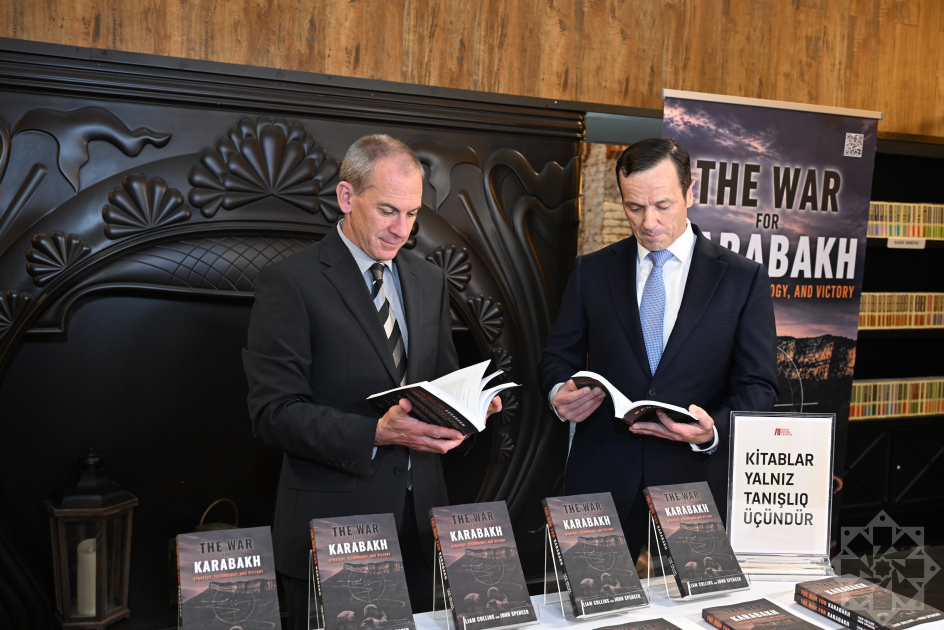
Baku, The Gulf Observer: A new book examining the historical background of the Garabagh conflict and the strategic, technological and military factors behind Azerbaijan’s victory in the 44-day Patriotic War was presented in Baku on November 3.
The presentation ceremony of “The War for Karabakh: Strategy, Technology, and Victory,” co-authored by retired US Army Colonel Liam Collins and Major John Spencer, was jointly organised by the Center of Analysis of International Relations and Multiculturalism and the Baku Book Center.
During the event, the American authors shared details of the publication process, their key research areas and major findings, noting that the book had taken nearly two years to complete.
Liam Collins highlighted the importance of strengthening military capabilities, implementing reforms in the armed forces and enhancing combat readiness in Azerbaijan’s victory in the Second Garabagh War. He observed that an army’s effectiveness depends not only on the number of weapon systems available but also on their quality and effective deployment.
John Spencer emphasised that Azerbaijan’s military operations during the 44-day war involved much more than the use of unmanned aerial vehicles (UAVs). He pointed to the importance of complex ground operations, troop coordination and strategies designed to misdirect opposing forces.
The publication is among the first comprehensive foreign military studies to systematically examine Azerbaijan’s victory in the 44-day Patriotic War. The participation of military research specialists from the United States Military Academy at West Point further strengthens its academic and analytical value.
The book traces the conflict from its historical roots and the First Garabagh War through Azerbaijan’s victory in 2020 and subsequent military-political developments. It examines Azerbaijan’s preparations for large-scale warfare, its Grand Strategy, the “Iron Fist” operation and the principal stages of the 44-day war.
Separate chapters analyse military operations in Hadrut, Amirvarli, Fuzuli, Zangilan and Gubadli, the battles for Shusha, and Azerbaijan’s anti-terrorist measures in 2023.
The authors also critically examine the widely held perception that Azerbaijan’s victory was achieved solely through the use of UAVs. Instead, the study identifies the effective integration and deployment of modern combat systems as a major factor behind the country’s military success.
The research draws on interviews with approximately 100 military and civilian experts, alongside field visits to locations where key battles took place.
Particular attention is given to the strategy of Azerbaijan’s Commander-in-Chief, President Ilham Aliyev, including his domestic and international communication efforts and initiatives to counter disinformation.
Before completing the book, the authors had also conducted extensive research and published articles examining the battles for Hadrut and Shusha during the 44-day war.
Collins is Director of the Madison Policy Forum, a Senior Fellow with New America’s Future Security Program and a Distinguished Military Fellow at the Middle East Institute. A retired US Army Special Forces colonel, he has undertaken several combat and operational deployments and previously served as executive officer to the US Senior Defense Advisor to Ukraine from 2016 to 2018, contributing to defence reform efforts.
Spencer serves as Chair of Urban Warfare Studies at the Modern War Institute at West Point and Co-Director of the Urban Warfare Project. A retired US Army officer with more than 25 years of active-duty service, including two combat deployments to Iraq, he is recognised internationally for his expertise in urban warfare.