When Words Prevented War

There are moments in the life of nations which, though brief in duration, cast shadows long enough to shape both present anxieties and future reckonings. History is not merely a chronicle of bygone days; it is a vigilant sentinel, reminding statesmen and peoples alike that decisions taken in hours of peril may determine the destiny of generations. One such moment arrived in the cold and uneasy February of 1987, when intelligence reports reached Islamabad that India, under the cover of its vast military exercises known as Operation Brasstacks, had positioned formidable forces near Pakistan’s borders. The atmosphere grew heavy with apprehension, and the Sub Continent stood poised on the brink of a miscalculation whose consequences could have been irreversible.
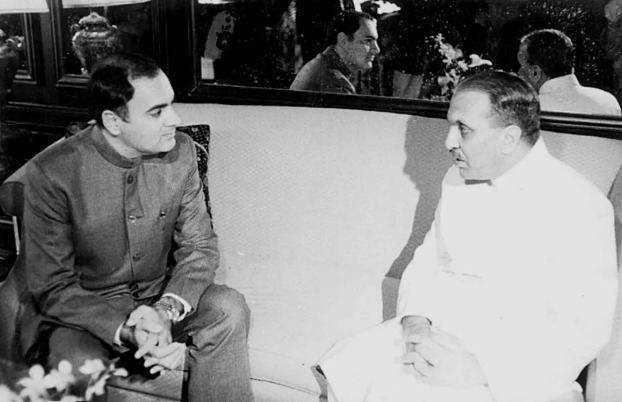
At that delicate juncture, the President of Pakistan, General Muhammad Zia-ul-Haq, undertook a step so unexpected that it has since entered diplomatic lore as one of the most striking examples of cricket diplomacy. Without the trappings of a pre-arranged summit, he arrived unannounced in New Delhi on 21 February 1987, ostensibly to watch the India–Pakistan Test match at Sawai Mansingh Stadium in Jaipur. It was a gesture outwardly modest, yet inwardly calculated. He was received by the Indian Prime Minister, Rajiv Gandhi, and that evening the two leaders met privately at Hyderabad House for nearly forty minutes of candid discussion.
The cricket match, played between 21 and 25 February and eventually ending in a rain-interrupted draw, seemed almost incidental to the gravity of the hour. What transpired in the quiet of that Delhi evening has since been recounted in journalistic and diplomatic circles. According to Behramnam, a special adviser to Rajiv Gandhi, quoted at the time in India Today, General Zia delivered a warning of remarkable bluntness. Addressing the Indian Prime Minister directly, he is reported to have said: “Mr Rajiv, you want to attack Pakistan, do it. But keep in mind that this world will forget Halaku Khan and Changez Khan and will remember only Ziaul Haq and Rajiv Gandhi, because this will not be a conventional war but a nuclear war. In this situation, Pakistan might be completely destroyed, but Muslims will still be there in the world; but with the destruction of India, Hinduism will vanish from the face of this earth.” Behramnam later described Rajiv Gandhi as visibly shaken by the stern delivery of these words. Yet, with the composure of a seasoned soldier-statesman, Zia is said to have immediately resumed a cordial demeanour, smiling and shaking hands warmly with others present, as though the gravity of the exchange had been but a passing remark.
Whether one applauds or questions his methods, the effect was unmistakable. The spectre of imminent conflict receded. The troops did not advance. The subcontinent stepped back from a precipice whose depths none could truly fathom. It was a demonstration that deterrence, when articulated with clarity and backed by resolve, can serve the cause of peace more effectively than prolonged rhetoric.
Today, once again, murmurs circulate in certain quarters that plots are being hatched against Pakistan. It is suggested that after other regional upheavals, Pakistan may be marked for pressure or provocation; that India and Israel, perturbed by Pakistan’s nuclear capability, might contemplate designs under the patronage of powerful allies. Those who indulge in such propaganda, or who imagine that Pakistan can be treated as other vulnerable states have been treated, dwell in a fool’s paradise. Pakistan cannot be compared to countries that have been isolated or overwhelmed through calculated stratagems. Its strategic calculus, its societal fabric, and its collective memory are of a different order.
In any hour of imposed aggression, the entire nation and the Pakistani armed forces would stand like a leaden wall. Political, linguistic, and provincial differences—so often magnified in times of peace—would dissolve before the imperative of sovereignty. This is a nation whose sons have lain before tanks, whose people have embraced sacrifice with a conviction that transcends material calculation. Pakistan is, by conviction and policy, a peace-loving country. Yet if war is thrust upon it, it will not measure its response by the comfort of others. Should any attempt be made to encircle or strangle it, the consequences would be of such magnitude that even the memory of Hiroshima and Nagasaki would pale before the dread of repetition.
The leadership of Pakistan’s armed forces combines professional training with spiritual conviction. A commander who is both a Hafiz of the Holy Qur’an and a seasoned soldier understands not only the science of warfare but the moral weight it carries. In his veins runs the inheritance of those who clashed at Khyber, who burned their boats upon distant shores rather than retreat, and who at decisive battles of history left adversaries stunned by their resolve. Such a nation and such forces are not to be taken lightly.
In 1987, General Zia spoke pointedly of the only Hindu-majority state in the world, underscoring the catastrophic implications of nuclear war. The warning was not an incitement but a deterrent—a stark reminder that certain thresholds, once crossed, admit no return. If ever again hostile eyes are cast upon Pakistan with malice, those who do so must recognise that deterrence is reciprocal. A Muslim does not fear martyrdom; he regards it as an honour should it be decreed. Yet the aspiration of Pakistan is not destruction but dignity. The world has witnessed how others are terrified at the sight of death on this occasion and have been seen running away screaming. Pakistan, by contrast, sees itself as iron—no morsel to be chewed and discarded, but a force that will break the teeth of aggression.
History’s verdict is seldom delivered in the language of passion; it is rendered in consequences. The surprise journey to Jaipur was more than a diplomatic curiosity. It was an assertion that peace is best preserved when sovereignty is unmistakably defended. Those who contemplate testing that resolve would do well to remember that nations, like men, reveal their true character not in comfort but in crisis.