A Tiny Proton’s Big Leap Could Transform the Future of Clean Energy
Picture Credit: DICP
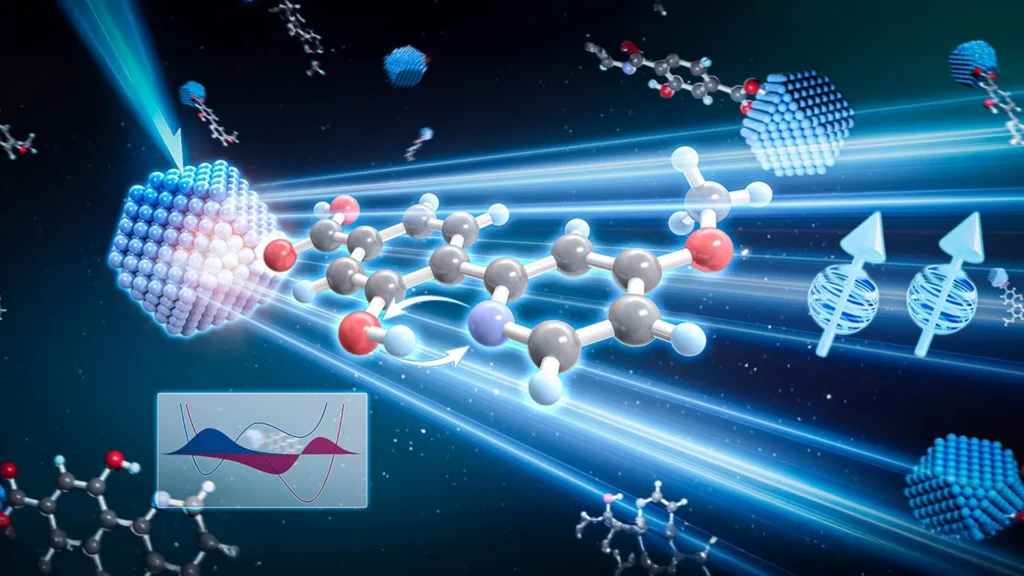
Scientific breakthroughs often emerge from discoveries that appear insignificant at first glance. The latest research from the Dalian Institute of Chemical Physics, published in Nature Materials, may be one such milestone. Scientists have identified a previously unknown quantum mechanism—proton shuttle-assisted triplet energy transfer (PS-TET)—that could significantly improve how energy is transferred in advanced materials, with far-reaching implications for solar energy, lasers, photocatalysis, and next-generation electronic devices.
A New Chapter in Quantum Energy Transfer
For decades, researchers have understood that electrons and protons often work together in natural processes such as photosynthesis, cellular respiration, and nitrogen fixation. Earlier discoveries involving proton-coupled electron transfer (PCET) and proton-coupled singlet energy transfer (PCEnT) have already inspired innovations in energy conversion technologies.
The newly discovered PS-TET mechanism extends this understanding into triplet energy transfer, a process that has remained comparatively unexplored despite its importance in modern materials science. Unlike previous mechanisms, the proton temporarily shifts position, synchronizing the movement of charge before returning to its original location. Remarkably, this fleeting motion dramatically increases both the speed and efficiency of energy transfer.
Quantum Tunnelling Moves from Theory to Application
One of the most striking aspects of the discovery is that the proton appears to move through quantum tunnelling rather than conventional heat-driven processes. Even at room temperature, the transfer rate remained largely unaffected by temperature changes, indicating that quantum mechanical effects can be harnessed under practical operating conditions rather than only in highly controlled laboratory environments.
This finding strengthens the growing view that quantum physics is no longer confined to theoretical discussions or specialized computing systems. Instead, quantum behaviour is increasingly becoming a practical engineering tool capable of improving everyday technologies.
Potential to Redefine Renewable Energy
Perhaps the greatest significance of the discovery lies in renewable energy. Solar cells frequently lose a considerable portion of absorbed sunlight because energy transfer inside the material is not perfectly efficient. If researchers can successfully integrate the PS-TET mechanism into commercial photovoltaic technologies, future solar panels could convert sunlight into electricity more effectively while reducing energy losses.
Although practical applications remain years away, the study provides scientists with an entirely new pathway to engineer materials that direct energy exactly where it is needed, potentially leading to higher-performance clean energy systems.
Beyond Solar Panels
The implications extend well beyond renewable energy. Efficient control of triplet states plays an important role in:
- High-performance lasers
- Organic light-emitting devices (OLEDs)
- Environmental and photoredox catalysis
- Advanced quantum materials
- Next-generation optoelectronic devices
In some technologies, increasing triplet energy transfer is beneficial, while in others suppressing it leads to better performance. The newly identified proton shuttle mechanism offers researchers a potential “control switch” to either enhance or limit triplet formation depending on the application.
Challenges Before Commercialisation
Despite the excitement, the research remains at the fundamental science stage. The experiments were conducted using zinc selenide quantum dots and specially designed molecular systems under laboratory conditions. Considerable engineering challenges remain before the mechanism can be incorporated into commercially viable devices.
Scientists must determine whether the process can be reproduced using scalable materials, manufactured economically, and integrated into industrial production without sacrificing stability or performance.
Why This Matters
History shows that many revolutionary technologies begin with discoveries that initially appear purely academic. The transistor, semiconductor laser, and lithium-ion battery all originated from fundamental scientific research before transforming global industries.
The discovery of proton shuttle-assisted triplet energy transfer belongs to that same category of foundational science. While it will not immediately produce more efficient solar panels or faster electronic devices, it expands the scientific toolkit available for designing future energy systems.
In an era defined by climate change, rising electricity demand, and the global transition toward cleaner technologies, even small improvements in energy efficiency can generate enormous economic and environmental benefits. If future research successfully translates this quantum phenomenon into commercial applications, today’s laboratory discovery could become tomorrow’s cornerstone of sustainable technology.