UN Peacekeeping Chiefs Workshop opens in Abu Dhabi with participation from 23 countries
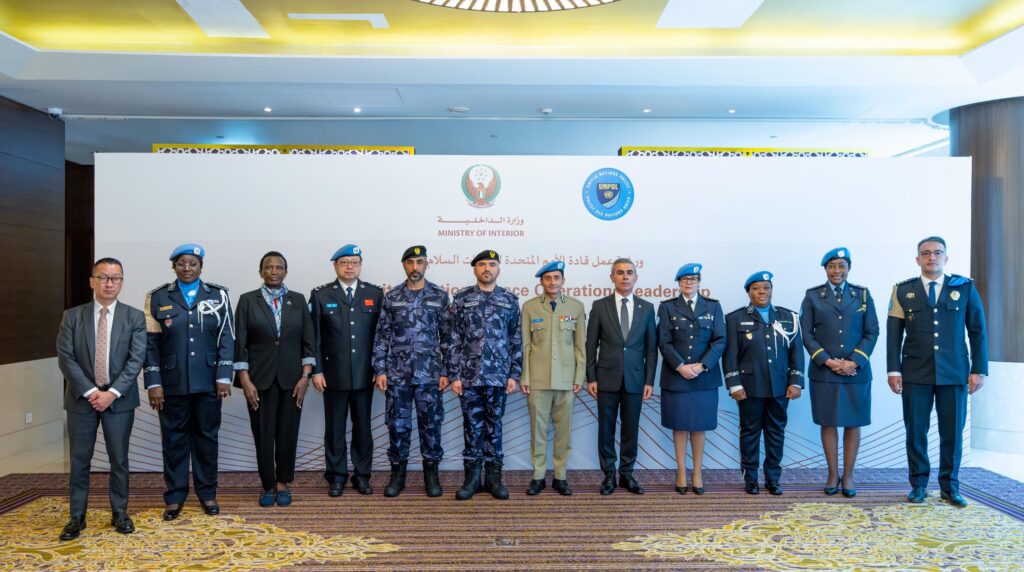
Abu Dhabi, The Gulf Observer: The UN Peacekeeping Chiefs Workshop opened in Abu Dhabi on Monday, bringing together police chiefs, military representatives and senior officials from 23 countries to discuss ways to enhance the effectiveness of United Nations peacekeeping operations.
Hosted by the UAE Ministry of Interior from August 31 to September 4, the workshop is being held as part of the ongoing cooperation between the United Arab Emirates and the United Nations. It brings together chiefs of police components and military representatives from UN peacekeeping missions worldwide, along with representatives of the UN and the UAE Ministry of Interior.
The workshop reflects the UAE’s commitment to supporting international efforts to strengthen peacekeeping operations and enhance their ability to respond effectively to evolving security and humanitarian challenges.
The discussions focus on a range of issues, including challenges facing UN Police, outcomes of the UN Chiefs of Police Summit, peacekeeping performance, knowledge management and guidance, permanent police capabilities, operational challenges, and responsive and gender-sensitive policing.
The workshop also provides an opportunity for police component chiefs from various UN missions to exchange experiences and best practices. Discussions address performance assessment standards for police units and individual officers, emergency planning, reporting, budgeting and ammunition management.
Participants are also discussing ways to strengthen coordination between police and military components within UN peacekeeping missions.
Colonel Saeed Al Dhaheri, Police Attaché at the UAE Permanent Mission to the UN in New York, welcomed the participants and highlighted the workshop’s importance in strengthening cooperation between the UAE and the United Nations and supporting international peace and security.
Al Dhaheri said the UAE’s hosting of the workshop demonstrates its firm commitment to supporting UN peacekeeping efforts and provides an important platform for exchanging expertise and best practices, developing performance assessment frameworks and improving the efficiency and effectiveness of peacekeeping operations.
He noted that the participation of military leaders alongside police chiefs represents an important step towards closer coordination between the two components, reflecting a shared understanding that sustainable peace requires genuine cooperation among all stakeholders involved in peacekeeping operations.
Lieutenant General Faisal, UN Police Adviser, said the UAE’s hosting of the workshop demonstrates its steadfast commitment to supporting the UN system and expanding its contribution to international peace operations.
He stressed the need for the continuous development of policing and security approaches in response to the evolving nature of conflicts, including a shift towards more flexible and innovative models based on technology and data, while maintaining a strong focus on efficiency, preparedness and rapid response.
He said developing qualified police capabilities capable of operating in complex environments, coupled with stronger police-military coordination, is essential to improving the effectiveness of peace operations and ensuring a lasting impact on the ground.
Lieutenant General Faisal further underscored that effective leadership, coordination among different components and the ability to adapt to rapidly changing conflict environments are key to strengthening peacekeeping performance.
He stressed that aligning priorities and enhancing police-military coordination are vital for enabling UN missions to fulfil their mandates, protect civilians and promote stability and the rule of law in host countries.
Lieutenant General Cheryl Pearce, Acting Military Adviser to the United Nations, said peacekeeping operations are being conducted in an increasingly complex geopolitical and operational environment, characterised by more complicated conflicts, transnational threats, the proliferation of drones, and growing information and technological challenges.
She said the future of peacekeeping requires missions to become more adaptable, mobile and responsive, with technology playing a greater role in improving situational awareness, supporting decision-making and enhancing operational effectiveness, while preserving the fundamentally political nature of peacekeeping operations.
Pearce added that the development of peacekeeping missions requires identifying their most critical tasks, ensuring the availability of the capabilities necessary to accomplish them, and strengthening coordination among the various entities and teams involved.
She emphasised that the safety and security of peacekeepers must remain a primary consideration in planning and implementing missions, supported by appropriate training and capabilities, enhanced situational awareness, rapid medical assistance when required, and the systematic incorporation of lessons learned from previous incidents.