Kazakhstan, China Relations Reach Unprecedented Level: President Tokayev
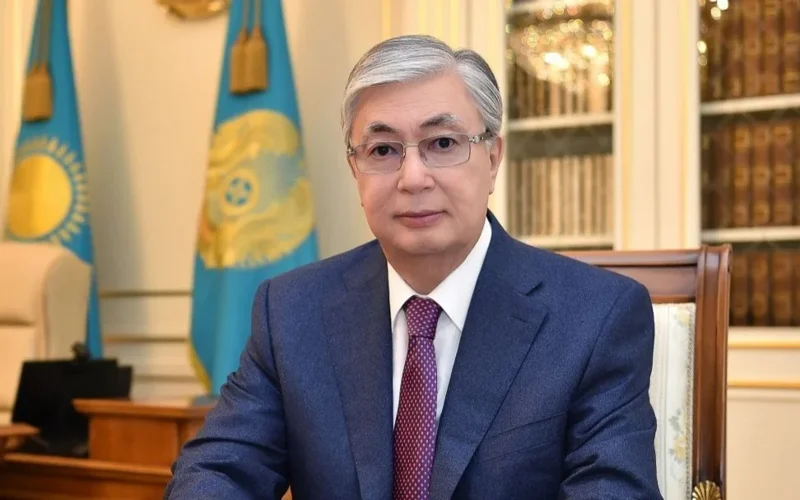
Bishkek, The Gulf Observer: Relations between Kazakhstan and China have reached an unprecedentedly high level, with Astana committed to further strengthening its comprehensive strategic partnership with Beijing, President of Kazakhstan Kassym-Jomart Tokayev said.
In an exclusive written interview with Xinhua News Agency, Tokayev said Kazakhstan was ready to consistently deepen its “eternal comprehensive strategic partnership” with China by expanding existing areas of cooperation and opening new avenues for collaboration.
The President highlighted the two countries’ long shared border and centuries-old history of good-neighborly relations, describing bilateral ties as serving the fundamental interests of both peoples and contributing to peace and stability across Eurasia.
Tokayev expressed gratitude to Chinese President Xi Jinping for his support and emphasized that sustained political dialogue had become a cornerstone of the Kazakhstan-China strategic partnership.
He noted that cooperation between the two countries now covers a wide range of sectors, including trade, investment, energy, transport, industrial cooperation, agriculture, digitalization, healthcare, science, education and culture.
According to Tokayev, bilateral trade continues to reach record levels, with China remaining Kazakhstan’s largest foreign trade partner.
The Kazakh President identified transport and logistics as among the most strategic areas of bilateral cooperation, stressing Kazakhstan’s role as a natural bridge between East and West.
He said Kazakhstan and China were working to transform this geographic advantage into modern transport and logistics infrastructure of Eurasian scale through the development of the Belt and Road Initiative and the Trans-Caspian International Transport Route, also known as the Middle Corridor.
The construction of new railway lines, expansion of dry ports and logistics terminals, and modernization of border infrastructure are contributing to a new configuration of transport connectivity between Asia and Europe, Tokayev said.
He described the Middle Corridor as a priority area of Kazakhstan-China cooperation and a crucial link between China and Europe. He stressed the importance of making the route more competitive through the introduction of smart customs, digital document management, synchronization of information systems and automation of border procedures.
Tokayev also underscored the growing importance of technological cooperation, particularly in artificial intelligence, digital technologies, robotics, new energy and high-tech manufacturing.
He noted that Kazakhstan had embarked on an accelerated digital transformation agenda and declared 2026 the Year of Digitalization and Artificial Intelligence.
During his recent visit to Shanghai for the World Artificial Intelligence Conference, Tokayev said he held meetings with executives of leading Chinese technology companies and identified opportunities for joint projects in the digital economy, intelligent manufacturing, e-commerce, scientific research and human-resource development.
The President also stressed the importance of ensuring equitable access to artificial intelligence technologies, knowledge and computing resources, saying Kazakhstan’s approach was aligned with China’s position.
He noted that Kazakhstan became one of the 29 founding members of the World Artificial Intelligence Cooperation Organization (WAICO) in Shanghai in July, describing the move as an important step toward developing an open international framework for cooperation in artificial intelligence.
On international affairs, Tokayev said Kazakhstan and China maintained similar positions on strengthening the central role of the United Nations, upholding international law, promoting mediation and multilateralism, and resolving conflicts through peaceful means.
He reaffirmed Kazakhstan’s adherence to the One-China policy and said Astana would continue coordinating with Beijing within the United Nations, the Shanghai Cooperation Organization (SCO) and the Conference on Interaction and Confidence Building Measures in Asia (CICA), while supporting cooperation under the Central Asia-China format.
Tokayev also highlighted the SCO’s 25th anniversary in 2026, describing the organization’s “Shanghai Spirit” — based on mutual trust, equality, dialogue, respect for cultural diversity and common development — as a model for international cooperation.
Looking ahead, the President noted that 2027 would mark the 35th anniversary of diplomatic relations between Kazakhstan and China. He emphasized that people-to-people contacts had also expanded significantly alongside political and economic ties.
The Kazakhstan-China Cross-Year of Culture in 2026 has further strengthened cultural exchanges, while educational cooperation continues to grow, with tens of thousands of Kazakh students studying in China and an increasing number of Chinese students attending universities in Kazakhstan.
Tokayev also highlighted the establishment of branch campuses of leading Chinese universities and Luban Workshops in Kazakhstan, as well as expanding academic mobility and inter-university cooperation.
The introduction of a mutual visa-free regime has provided additional momentum to tourism between the two countries. According to Tokayev, the number of Chinese tourists visiting Kazakhstan reached 962,000 in 2025, representing a 47 percent increase compared with 2024.
The President expressed confidence that growing cultural, educational, tourism and people-to-people exchanges would further deepen mutual understanding between the peoples of Kazakhstan and China.
He said Kazakhstan was keen to showcase its diverse cultural and natural heritage to Chinese visitors, while Kazakhstanis were increasingly discovering China as a country with an ancient civilization and a remarkable record of modern development.