Azerbaijan, Cambodia Pledge to Strengthen Bilateral Cooperation in Trade, Investment and Education
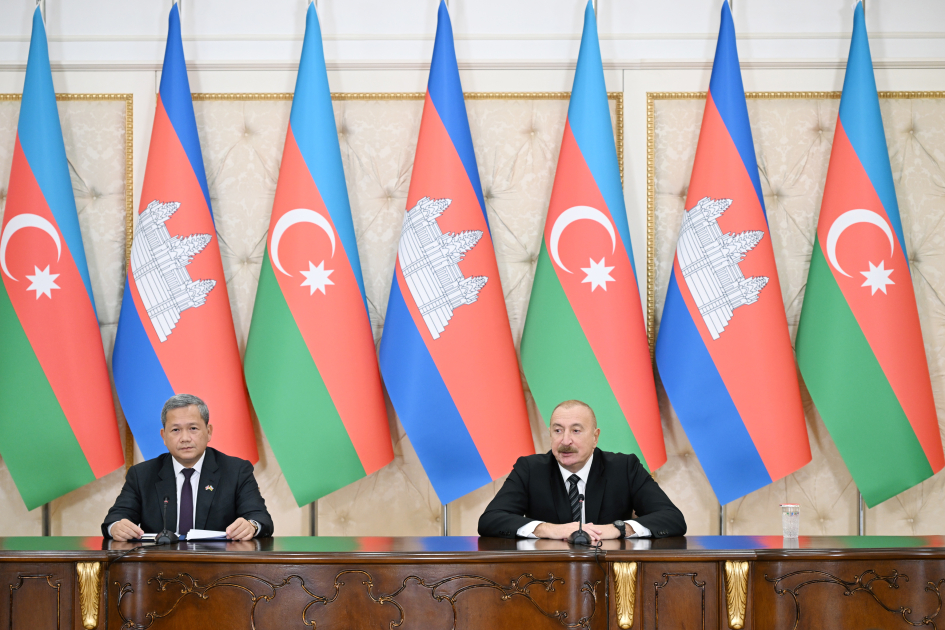
Baku, The Gulf Observer: President of Azerbaijan Ilham Aliyev and Prime Minister of Cambodia Hun Manet have reaffirmed their commitment to strengthening bilateral relations, with a focus on expanding trade, investment, education, transportation, digital transformation and cooperation in international forums.
The two leaders made the remarks while delivering press statements in Baku on October 12, following their meeting during the Cambodian prime minister’s official visit to Azerbaijan ahead of the upcoming Summit of the Conference on Interaction and Confidence Building Measures in Asia (CICA).
President Aliyev welcomed Hun Manet and expressed confidence that the visit would open new avenues for cooperation between the two countries. He recalled his meeting with Hun Manet’s father, former Cambodian Prime Minister and current Senate President Hun Sen, in Azerbaijan 12 years ago, describing the current engagement as a continuation of the two countries’ friendly relations.
Aliyev noted that Azerbaijan and Cambodia actively cooperate within international organizations, including the United Nations, the Non-Aligned Movement and CICA, and support each other on issues of mutual interest.
Emphasizing the potential for stronger economic ties, the Azerbaijani president said the two countries had agreed to establish a joint working group to identify practical opportunities for expanding trade and investment.
He acknowledged that bilateral trade remained modest but expressed optimism that the Cambodian prime minister’s visit and the business forum involving companies from both countries would help increase commercial engagement.
The two sides also discussed establishing joint manufacturing facilities in various industrial sectors, promoting tourism, expanding educational exchanges and strengthening people-to-people contacts. Aliyev highlighted the historical tradition of Cambodian students studying in Azerbaijan during the Soviet era and called for renewed opportunities for students from both countries.
Transportation and digital transformation were also identified as priority areas. Aliyev further expressed Azerbaijan’s readiness to share its experience with Cambodia in public service delivery through the ASAN service system, which has attracted interest from several partner countries.
The Azerbaijani president also highlighted parliamentary cooperation, noting that both countries maintain parliamentary friendship groups. He welcomed Cambodia’s support for Azerbaijan’s observer status in the ASEAN Inter-Parliamentary Assembly, describing Southeast Asia as an important region in Azerbaijan’s foreign policy priorities.
Addressing shared security concerns, Aliyev underscored the importance of cooperation in mine clearance, noting that both countries have suffered from landmine contamination. He stressed the value of exchanging expertise, technical knowledge and training to address the challenge.
On regional security, Aliyev emphasized that peace and stability should be grounded in international law, sovereignty and territorial integrity. He also outlined Azerbaijan’s ongoing reconstruction and development efforts in territories regained after years of occupation, including the implementation of the Great Return Programme.
For his part, Prime Minister Hun Manet thanked Azerbaijan for its hospitality and invitation to participate in the CICA Summit. He said the discussions had covered a broad range of areas in which both countries could strengthen cooperation.
Hun Manet noted that three agreements signed during the visit would provide a framework for further engagement in trade, education and other potential areas of mutual interest.
Recalling the more than three decades of diplomatic relations between the two countries, he referred to Hun Sen’s 2014 visit to Azerbaijan, which established a roadmap for bilateral cooperation.
The Cambodian prime minister expressed confidence that his visit would help translate existing commitments into practical initiatives, particularly in trade and investment. He confirmed that both sides had discussed a framework agreement to establish a joint trade working group tasked with identifying and implementing concrete measures to expand commercial ties.
He added that cooperation in defence, security and education had also featured prominently in the discussions.
At the multilateral level, Hun Manet reaffirmed Cambodia’s commitment to strengthening cooperation with Azerbaijan through international platforms. He recalled Cambodia’s support for Azerbaijan’s efforts to obtain observer status in ASEAN and develop relations with the regional organization.
The prime minister stressed that stronger bilateral engagement could contribute to broader cooperation between regions amid an increasingly complex international environment.
Highlighting the role of the private sector, Hun Manet said he would meet Azerbaijani business representatives and expressed his intention to invite an Azerbaijani business delegation to Cambodia to explore investment opportunities.
He also disclosed that the two countries had discussed arranging a meeting between their civil aviation authorities and signing an air services agreement to facilitate improved air connectivity.
Hun Manet thanked Azerbaijan for its longstanding support for Cambodia, particularly through educational scholarships, and expressed hope that cooperation would expand into additional sectors.
At the conclusion of his remarks, the Cambodian prime minister conveyed an invitation from King Norodom Sihamoni to President Aliyev to visit Cambodia, expressing confidence that such a visit would provide further opportunities to advance bilateral relations.
The statements underscored the shared determination of Azerbaijan and Cambodia to strengthen political dialogue, expand economic engagement and translate existing agreements into tangible outcomes across multiple areas of cooperation.