President Emomali Rahmon Inaugurates Six New Facilities in Shahrinav District
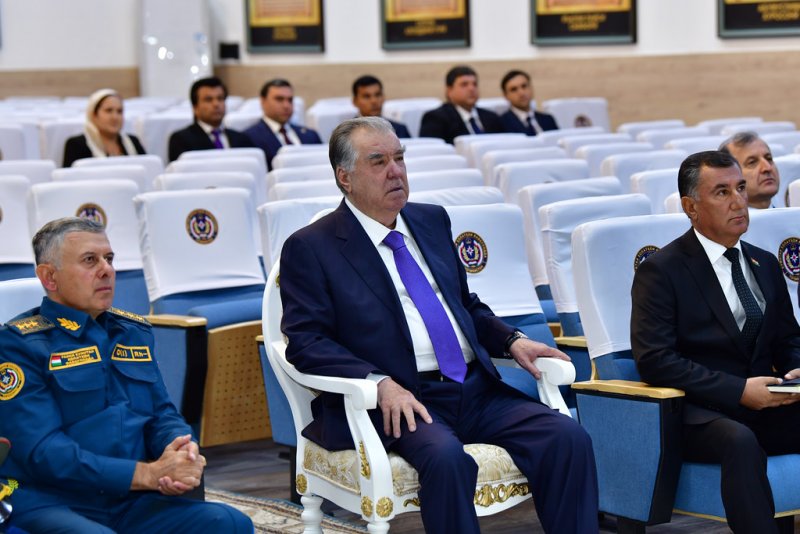
Dushanbe, The Gulf Observer: President of Tajikistan Emomali Rahmon on Tuesday remotely inaugurated six facilities of various purposes during a working visit to Shahrinav District, marking further progress in the country’s efforts to expand social infrastructure, strengthen industrial production and improve living standards in rural communities.
The inauguration ceremony included a new educational institution, a cultural palace, a medical and diagnostic centre, a plastic profile manufacturing plant, a brick production enterprise and a covered sports facility.
The new School No. 58, located in the Javononi village of Chusti rural community in Shahrinav District, has been constructed to accommodate 720 students studying in two shifts. The institution has 12 spacious classrooms equipped with the necessary educational facilities and employs 20 teachers.
The president also remotely inaugurated the Shahrinav District Palace of Culture, built as part of development initiatives undertaken to commemorate the 35th anniversary of Tajikistan’s State Independence.
The cultural complex features 12 rooms and a main auditorium with seating for 400 people. It provides facilities for artists to rehearse and prepare performances, as well as for hosting cultural, educational and commemorative events. The new building is expected to serve as an important cultural centre for local residents and the district’s artistic community.
Another facility inaugurated during the visit was the Tabib-2013 diagnostic and treatment centre, designed to accommodate up to 30 patients at a time.
The medical centre has been equipped with facilities intended to improve access to diagnostic and treatment services. It includes a reception area, rehabilitation and fitness halls, and consultation rooms for specialists in internal medicine, gynaecology, neurology, surgery and other medical fields.
The centre’s opening has created 30 permanent jobs for specialists, contributing to local employment and the improvement of healthcare services for the population.
In the industrial sector, Rahmon remotely inaugurated a plastic profile manufacturing plant operated by Fayzi Osiyo Limited Liability Company.
The facility currently employs 20 specialists and produces 10 types of plastic profiles, along with various types of doors and windows. Its products are manufactured to meet domestic market demand and the requirements of the construction sector, with supplies primarily intended for Shahrinav District and other cities and districts across the country.
The president also officially launched the operations of Shahrinav Brick Limited Liability Company, which has an annual production capacity of 90 million bricks.
The enterprise was established by local entrepreneur Imomali Shoev to support Tajikistan’s fourth strategic national objective — accelerated industrialization — and meet growing market demand. The facility has provided employment to 50 local residents.
The sixth facility inaugurated remotely was a covered sports ground and gymnasium located at School No. 11 in the Obodoni village of Shahrinav District.
Measuring 20 metres in width and 40 metres in length, the sports facility provides suitable conditions for physical exercise and sporting activities, including football. It is intended to serve residents of Obodon, Sharafi 1 and Sharafi 2 villages, offering young people and other community members improved opportunities to participate in sports.
Following his inspection of the newly constructed facilities, President Rahmon issued instructions and recommendations to the relevant officials to further expand development initiatives, establish educational institutions and industrial enterprises, improve living conditions in rural areas, create additional employment opportunities and foster patriotic values among the younger generation.
The inauguration ceremonies form part of broader development efforts undertaken in Shahrinav District to mark the 35th anniversary of Tajikistan’s State Independence.
According to the report, the district had initially planned to construct 297 facilities in connection with the anniversary. By the time of the celebrations, 318 facilities of various types had been completed and commissioned, including manufacturing enterprises and projects in education, healthcare and culture.
The achievement represents 108 per cent of the original target, reflecting the district’s progress in expanding infrastructure and supporting socioeconomic development.