Indonesia, Germany Step Up Cooperation in Renewable Energy, Education and Vocational Training
Jakarta, The Gulf Observer: Indonesia and Germany have agreed to strengthen bilateral cooperation in new and renewable energy, education and vocational training, building on their longstanding economic and development partnership.
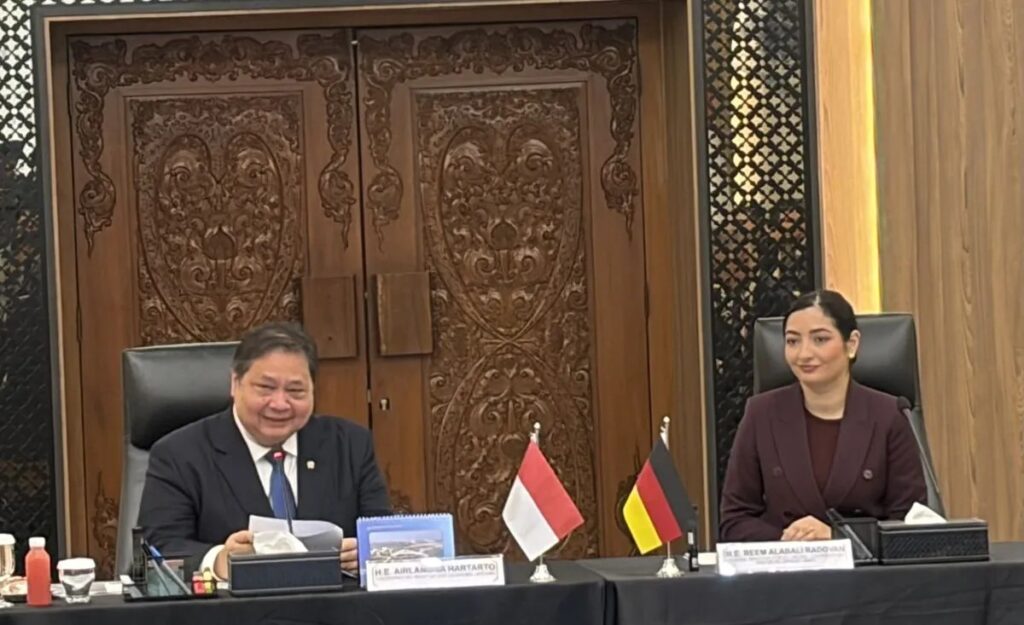
The agreement followed a meeting in Jakarta on Thursday between Indonesia’s Coordinating Minister for Economic Affairs Airlangga Hartarto and German Federal Minister for Economic Cooperation and Development Reem Alabali Radovan.
Hartarto welcomed the German delegation and highlighted several pipeline projects in the renewable energy sector, stressing the importance of accelerating cooperation to support Indonesia’s clean energy transition.
He said vocational education and training was another key area discussed during the meeting, noting that enhanced cooperation in this field could provide greater opportunities for young Indonesians to acquire skills and experience.
Hartarto emphasized that the strengthened partnership builds on the longstanding economic ties between Indonesia and Germany. He noted that more than 250 German companies currently operate in Indonesia, with cumulative German investment reaching approximately US$1.2 billion between 2021 and 2026.
On renewable energy, Hartarto said the cooperation was aligned with Indonesia’s commitment to mobilize US$21.4 billion in international financing under the Just Energy Transition Partnership (JETP) to support clean energy development and decarbonization.
He acknowledged that implementation had progressed more slowly than expected, with only around US$4 billion utilized so far, and called for efforts to accelerate the deployment of available financing and renewable energy projects.
Radovan described Indonesia as an important strategic partner for Germany, highlighting the longstanding relationship between the two countries based on mutual trust, particularly in the development sector.
She said Germany sought to deepen cooperation in both economic and development areas, including greater participation by German companies in Indonesia’s sustainable development, particularly renewable energy projects.
Radovan also reaffirmed Germany’s commitment to expanding vocational training cooperation. She said Indonesian students could benefit from opportunities to learn German and undertake vocational training both in Germany and Indonesia, including programs organized by German companies.
She added that key German institutions, including the German Embassy in Indonesia, the German Organization for International Cooperation (GIZ), the German Development and Investment Bank (KfW), and the German Chamber of Commerce, would contribute to efforts to strengthen economic and development cooperation.
Describing the meeting as productive, Radovan expressed optimism that Indonesia and Germany would further deepen their partnership and expand cooperation in areas of mutual interest.