Philippines Reports Improved PISA 2025 Performance, Marcos Highlights Education Reforms
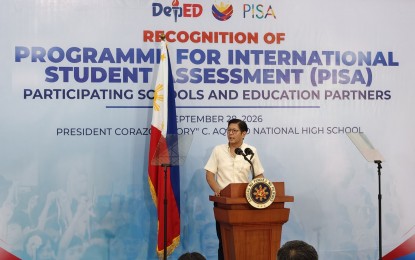
Manila, The Gulf Observer: President Ferdinand R. Marcos Jr. has said the Philippines’ improved performance in the 2025 Programme for International Student Assessment (PISA) reflects the impact of ongoing education reforms and sustained support for learners, teachers and schools.
Speaking at a thanksgiving gathering for PISA-participating schools and education partners at President Corazon C. Aquino National High School in Pasay City on Monday, Marcos highlighted the country’s improved results across all three assessment areas compared with the 2022 cycle.
The Philippines recorded a 20-point increase in Reading, a 17-point improvement in Science and a 16-point gain in Mathematics, marking its strongest performance since the country first participated in PISA in 2018.
Marcos said the results demonstrated the importance of effective teaching approaches that encourage students not only to identify correct answers but also to understand questions and concepts more deeply.
The PISA 2025 assessment involved 8,702 15-year-old learners from 208 schools across the Philippines.
The proportion of learners achieving at least Level 2, considered the baseline proficiency level, also increased to 31 percent in Reading, 31 percent in Science and 21 percent in Mathematics.
The President attributed the improvement to the combined efforts of teachers, parents, schools, local governments and other education stakeholders. He cited initiatives including the Academic Recovery and Accessible Learning (ARAL) programme, the revised K to 10 curriculum, school feeding initiatives and expanded support for teachers and school personnel.
He also highlighted the government’s hiring of 10,000 school counselor associates for the current school year as part of efforts to create safer and more supportive learning environments.
Despite the progress, Marcos acknowledged that the Philippines still faces significant challenges in improving educational outcomes and closing the gap with other countries in the region and globally.
He stressed the need to sustain efforts to provide learners and teachers with the resources and support required to improve performance.
According to the President, strengthening education requires a comprehensive approach involving the entire learning environment, including programmes that address learners’ nutritional and other needs so they are better prepared to learn in the classroom.
Marcos also urged teachers and parents to encourage children’s curiosity, while calling on students to ask questions, consider different perspectives and remain open to acquiring new knowledge.
The Programme for International Student Assessment is administered by the Organisation for Economic Cooperation and Development (OECD) and evaluates how 15-year-old students apply skills in Reading, Mathematics and Science.