President Tebboune at COP31: No Country Can Address the Climate Challenge Alone

Antalya, The Gulf Observer: President of the People’s Democratic Republic of Algeria, Abdelmadjid Tebboune, on Thursday called for tackling climate change in a spirit of cooperation, justice and fairness, while upholding the principle of common but differentiated responsibilities among the nations of the world.
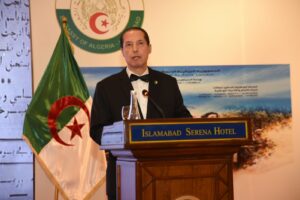
In a speech addressed to participants at the Conference of the Parties to the United Nations Framework Convention on Climate Change (COP31), held in the Turkish city of Antalya, and read on his behalf by Prime Minister Sifi Ghrieb, President Tebboune stated that “no country can address the climate challenge alone.”
“There is no alternative but to move forward together in a spirit of cooperation, justice and equity toward climate action that fulfills our commitments and leaves no one behind,” the President stressed.
Tebboune at COP31 Highlights Gaps in Global Climate Action
President Tebboune noted that the first global stocktake, a decade after the adoption of the Paris Agreement, underscored that the collective effort to tackle climate change “remains insufficient” to meet the agreed goal, and that “the funding gap is just as critical as the emissions reduction gap.”
He emphasized that “energy transition can only be sustainable if it is just, based on the principle of common but differentiated responsibilities, and respectful of countries’ development pathways in line with their circumstances while safeguarding their sovereignty.”
Balancing Development and Climate Commitments
Describing the challenges facing his country, President Tebboune said that “Algeria, which experiences climate change as a present reality that directly endangers its water and food security, faces a complex challenge: the need to meet our people’s aspirations for development and employment, and the importance of contributing to the global effort to cut emissions despite our minimal share in them.”
He reiterated that Algeria’s approach to the issue is “clear and unambiguous,” resting on the premise that “development and climate action are not contradictory, as long as the transition is smooth and gradual and receives the necessary support stipulated in the Paris Agreement.”
The President affirmed that Algeria “has placed the fight against climate change at the heart of its public policies, within an institutional and planning framework that continues to be reinforced.”
Algeria’s National Climate Projects
Outlining several national projects aligned with this approach, President Tebboune pointed to the initial phase of a state-funded programme targeting 15,000 MW of renewable energy by 2035, alongside the adoption of a national hydrogen strategy.
He added that particular attention is being given to energy efficiency and the development of mass transit, as well as to curbing gas flaring and methane emissions.
The President further stated that Algeria is continuing to strengthen its water security through seawater desalination and treated wastewater reuse projects. The country has also relaunched the Green Dam project, an initiative that combines the fight against desertification with rural development, and is completing a national climate change adaptation plan.
Algeria’s Nationally Determined Contribution
President Tebboune emphasized that Algeria has submitted its Nationally Determined Contribution (NDC), which includes an unconditional target of reducing emissions by 14 percent by 2035, fully financed from national resources, with the possibility of raising the target to 31 percent depending on international support.
His address at COP31 reaffirmed Algeria’s position that a fair and well-supported global transition is essential to meeting the goals of the Paris Agreement while respecting the development needs of countries across the Global South.