Vietnam, Denmark Seek to Elevate Green Strategic Partnership
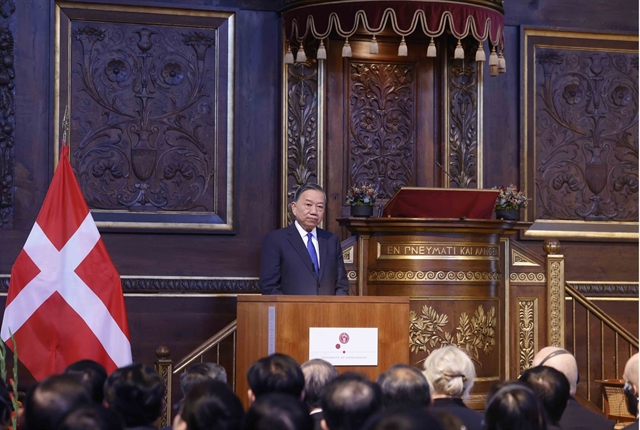
Copenhagen, The Gulf Observer: Vietnam and Denmark have reaffirmed their commitment to strengthening bilateral relations, with Vietnamese General Secretary of the Communist Party of Vietnam Central Committee and President To Lam proposing to upgrade their Green Strategic Partnership to a more comprehensive and strategic framework.
Addressing a policy speech at the University of Copenhagen on Monday during his state visit to Denmark, To Lam said the two countries had developed deep mutual trust over decades of friendship, creating opportunities for a new phase of cooperation in sustainable development, science, technology and economic growth.
The speech, titled “From Fairy Tales to a Horizon of Vietnam–Denmark Cooperation in a New Era,” was attended by Speaker of the Danish Parliament Henrik Frandsen, senior officials from both countries, academics, scientists, students and friends of Vietnam.
55 Years of Friendship and Cooperation
To Lam highlighted the historical foundations of Vietnam-Denmark relations, recalling that Denmark was among the first Western European countries to establish diplomatic relations with Vietnam in 1971, during the Vietnam War.
He expressed gratitude for the Danish people’s support during Vietnam’s struggle for national independence and subsequent reconstruction, describing the longstanding friendship as a foundation for deeper cooperation.
Over the past 55 years, bilateral relations have expanded from development assistance into mutually beneficial partnerships encompassing trade, investment, education, healthcare and people-to-people exchanges. More than 150 Danish companies are now operating in Vietnam, undertaking projects across various sectors.
Building on the Comprehensive Partnership established in 2013 and the Green Strategic Partnership launched in 2023, To Lam called for a broader framework that would combine Denmark’s strengths in science, technology and green transition with Vietnam’s development potential and commitment to sustainable growth.
He said the two countries shared fundamental values, including respect for sovereignty and territorial integrity, adherence to international law, support for multilateralism and a commitment to resolving differences through dialogue.
The Vietnamese leader also envisioned the two countries serving as strategic bridges between Southeast Asia and Northern Europe, strengthening connections between the Association of Southeast Asian Nations (ASEAN) and the European Union (EU).
Green Transition and Renewable Energy at the Core
Emphasising the importance of economic cooperation, To Lam called on both countries to move beyond traditional assistance towards joint value creation, particularly in science and technology, renewable energy, climate action and the just energy transition.
He stressed that Vietnam’s pursuit of rapid economic growth would not come at the expense of environmental protection or technological advancement.
Highlighting Denmark’s global experience in green transition and wind energy, he pointed to opportunities for cooperation in offshore wind power, marine economic development and renewable energy infrastructure.
Vietnam, with a coastline exceeding 3,200 kilometres and substantial offshore wind energy potential, could benefit from Denmark’s expertise in maritime planning and clean energy development, he said.
Combining the two countries’ strengths could help establish new renewable energy industries, support international efforts to combat climate change and create opportunities for Denmark to contribute to the development of the ASEAN Power Grid.
To Lam also called for stronger cooperation in building secure supply chains, maintaining free trade and advancing research and innovation to support sustainable economic development.
Education, Research and People-to-People Exchanges
The Vietnamese leader underscored the importance of education, scientific research and people-to-people exchanges as long-term foundations for bilateral relations.
He noted that Vietnam needed highly qualified human resources, while Denmark offered a strong scientific and educational environment, exemplified by the University of Copenhagen.
To Lam proposed establishing joint research groups, introducing co-supervision arrangements for doctoral students and sharing research infrastructure to encourage long-term academic collaboration.
He also invited the University of Copenhagen to consider establishing a campus in Vietnam, pledging that his country would provide the most favourable possible conditions regarding taxation and land to support the initiative and attract students from Vietnam and across Southeast Asia.
He further highlighted the Vietnamese community in Denmark, particularly scientists, experts, entrepreneurs and students, as an important bridge for strengthening bilateral relations and expanding cooperation among younger generations.
Joint Commitment to Peace and International Cooperation
Addressing regional and global challenges, To Lam called for closer coordination between Vietnam and Denmark at the United Nations and other multilateral forums, alongside stronger ASEAN-Denmark and ASEAN-EU relations.
He said both countries supported international law, multilateral cooperation and the peaceful settlement of disputes through dialogue.
Referring to Danish physicist Niels Bohr and his advocacy for international cooperation and peace, To Lam highlighted the importance of responsible approaches to scientific and technological progress, particularly amid the rapid development of artificial intelligence and other emerging technologies.
He expressed Vietnam’s readiness to work with Denmark to promote dialogue on technological safety, responsibility and the interests of communities.
As maritime nations, he also expressed hope that Denmark would support efforts to ensure security, safety and freedom of navigation in accordance with international law, particularly the 1982 United Nations Convention on the Law of the Sea (UNCLOS).
Concluding his remarks, To Lam said the trust built over 55 years of friendship provided a strong foundation for expanding cooperation and addressing shared challenges. He encouraged students and young people to take an active role in shaping the next chapter of Vietnam-Denmark relations.
Green Transition to Drive Vietnam’s New Growth Model
During a question-and-answer session following his address, To Lam described the green transition as more than an environmental commitment, calling it a central driver of Vietnam’s future economic growth and development model.
He said the country aimed to achieve average double-digit economic growth in the coming period while shifting away from extensive growth based on natural resources and labour towards productivity, innovation and clean technology.
The transition, he explained, would create opportunities in renewable energy, energy storage, the circular economy, green materials and low-emission agriculture.
He identified potential areas for collaboration with international universities, including energy-transition modelling, next-generation renewable energy, sustainable agriculture and advanced skills development.
Responding to questions about sustaining economic growth and avoiding the middle-income trap, To Lam outlined three key shifts: moving from low-cost labour towards productivity and innovation; transitioning from extensive growth to green, digital and inclusive development; and achieving a better balance between exports and domestic consumption.
He emphasised the need for institutional reforms, stronger investment in human capital and greater reliance on science and technology to sustain economic progress.
Education and training would remain national priorities, with Vietnam working to improve educational quality, align curricula with labour market needs and develop expertise in strategic technology sectors.
He added that the country would expand digital skills through reskilling and lifelong learning, attract and retain domestic and international talent through competitive incentives and supportive working environments, and promote a green, inclusive and resilient economy through renewable energy and the circular economy.