Indonesia Steps Up Efforts to Finalize EU Trade Pact, Strengthen Strategic Economic Partnership
Jakarta, The Gulf Observer: Indonesia is intensifying diplomatic efforts to accelerate the signing of the Indonesia-European Union Comprehensive Economic Partnership Agreement (IEU-CEPA), describing the landmark trade pact as a strategic bridge to deepen economic cooperation between Southeast Asia’s largest economy and the 27-member European Union.
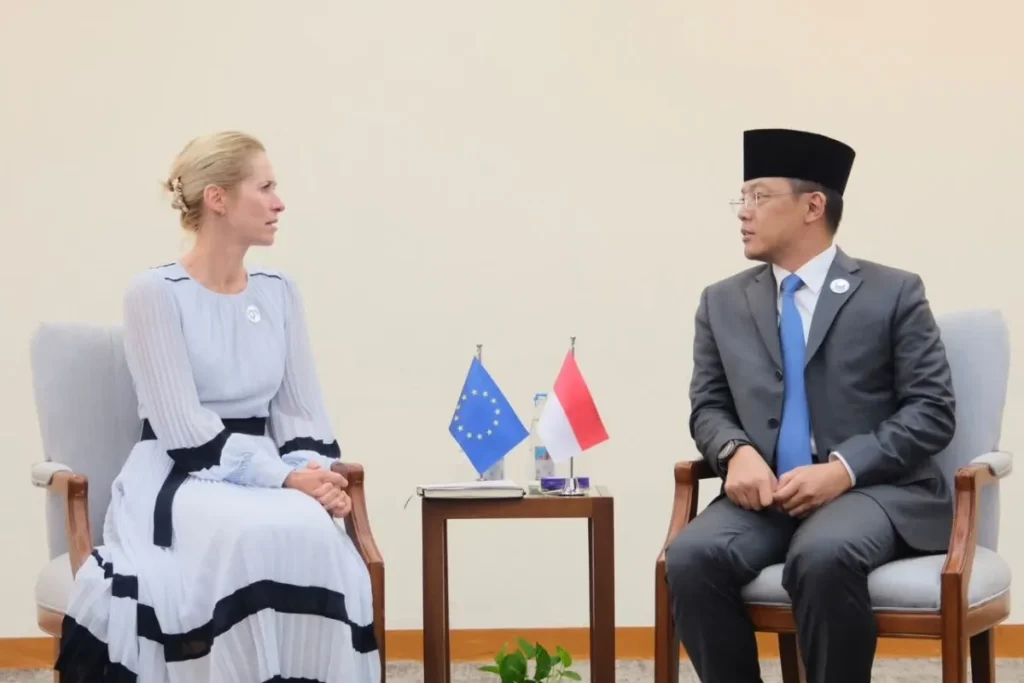
Indonesian Foreign Minister Sugiono reaffirmed the importance of the agreement during a bilateral meeting with European Union High Representative for Foreign Affairs and Security Policy Kaja Kallas on the sidelines of the ASEAN Foreign Ministers’ Meeting and Post-Ministerial Conferences (AMM/PMC) in Manila.
“The signing of the IEU-CEPA is highly strategic for strengthening trade, investment, and economic partnership between Indonesia and the EU,” Sugiono said in a statement issued by Indonesia’s Ministry of Foreign Affairs.
The renewed diplomatic push follows the conclusion of substantive negotiations in 2025, with both sides aiming to complete the ratification process in the second half of 2026. The agreement is expected to enter into force in early 2027.
Earlier this month, the European Commission submitted proposals for the signing and conclusion of the IEU-CEPA and the accompanying Investment Protection Agreement (IPA) to the Council of the European Union, marking a significant step toward final approval.
According to Coordinating Minister for Economic Affairs Airlangga Hartarto, the agreements must first receive the Council’s approval before being forwarded to the European Parliament for final consent. Indonesia is simultaneously advancing its domestic ratification process.
Under the IEU-CEPA and IPA, the European Union will eliminate import duties on 98.5 percent of tariff lines, streamline export procedures, and create expanded investment opportunities in key sectors, including electric vehicles, electronics, and pharmaceuticals.
For Indonesia, the agreements are expected to broaden access to European markets, enhance the competitiveness of domestic products, attract high-quality foreign investment, and strengthen the country’s integration into global value chains.
Indonesia, EU Highlight Energy Transition Cooperation
Beyond trade, the bilateral meeting also underscored a shared commitment to accelerating the global energy transition. Foreign Minister Sugiono highlighted Indonesia’s vast renewable energy potential and called for stronger collaboration with the European Union in renewable energy development and sustainable investment.
“Indonesia has great potential in developing renewable energy. Cooperation with the EU is crucial to realizing this potential,” Sugiono said.
The two sides also exchanged views on regional and global developments, reaffirming their commitment to multilateralism and emphasizing that dialogue and diplomacy remain essential for resolving conflicts and achieving lasting peace.