Cancer and Stem Cells: The Double-Edged Science Reshaping Oncology
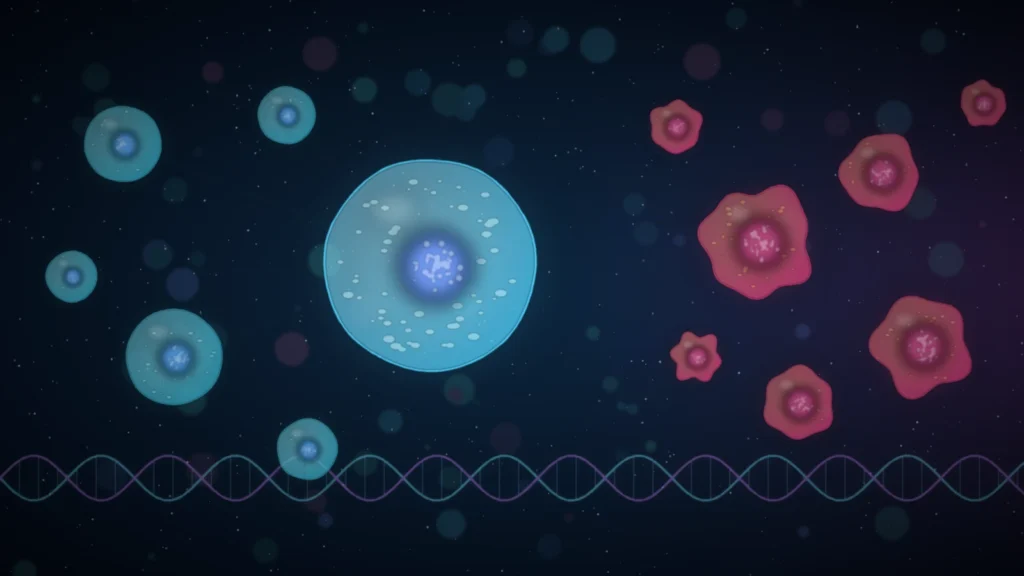
Stem cells sit on both sides of the cancer story: they may be where many tumours begin, and they are also among medicine’s most powerful tools for curing them. Understanding this double role is now central to modern oncology.
Cancer remains one of humanity’s heaviest burdens. The World Health Organization’s cancer agency estimated roughly 20 million new cases and about 9.7 million deaths worldwide in 2022, and projects a sharp rise by 2050 as populations grow and age. Much of that increase will fall on low- and middle-income countries, including across South Asia and the Middle East.
For decades, treatment focused on shrinking tumours as fast as possible. Yet many patients whose tumours melt away under chemotherapy relapse months or years later. One of the most compelling explanations for that frustrating pattern leads straight to the stem cell.
What stem cells are
Stem cells are the body’s master cells: they can renew themselves and give rise to specialised cells such as blood, skin or gut lining. Two properties define them — self-renewal and differentiation.
Scientists broadly recognise three kinds:
- Embryonic stem cells, taken from early embryos, can become almost any cell type in the body.
- Adult (tissue) stem cells, found in bone marrow, skin, intestine and other organs, repair and replace tissue throughout life.
- Induced pluripotent stem cells (iPSCs), first produced by Shinya Yamanaka’s team in 2006, are ordinary adult cells reprogrammed back to an embryo-like state. The discovery earned a Nobel Prize in 2012.
The intestine offers a vivid example of their work. Its lining is replaced roughly every few days, driven by a small pool of stem cells at the base of tiny pits called crypts. That constant, lifelong division is essential for health — and it is exactly the kind of activity that, when it goes wrong, can seed a cancer.
The cancer stem cell hypothesis
The cancer stem cell (CSC) model holds that many tumours are not uniform masses but hierarchies, driven by a small subpopulation of cells with stem-like powers. These cells can regenerate the entire tumour, while most other cancer cells cannot.
The idea gained firm experimental footing in 1997, when John Dick and Dominique Bonnet in Toronto showed that only a rare fraction of human leukaemia cells could transfer acute myeloid leukaemia into mice. In 2003, researchers led by Muhammad Al-Hajj identified similar tumour-initiating cells in breast cancer. Comparable populations have since been reported in brain, colon, pancreatic and other cancers.
Where do these cells come from? Two routes are proposed. Normal stem cells, which live long and divide often, may accumulate mutations until they turn malignant. Alternatively, more mature cells may regain stem-like traits after genetic damage — a process sometimes linked to the epithelial-to-mesenchymal transition.
The model is not settled. In some cancers, such as certain melanomas, many cells appear capable of driving growth, and cells can shift in and out of a stem-like state. Most researchers now see “stemness” as a flexible condition rather than a fixed identity — which makes the target harder to pin down, but no less important.
Why cancer stem cells defeat treatment
If the CSC model is right, conventional therapy often hits the wrong target: it kills the bulk of the tumour but spares the cells that rebuild it. That helps explain three of oncology’s hardest problems.
- Relapse. Chemotherapy and radiation work best on rapidly dividing cells. Cancer stem cells often divide slowly or lie dormant, letting them survive treatment and regrow the disease later.
- Drug resistance. These cells tend to carry molecular pumps that expel drugs, stronger DNA-repair machinery and defences against oxidative stress. Each adds a layer of protection.
- Metastasis. Stem-like cells appear especially able to leave a tumour, travel through the bloodstream and establish new colonies in distant organs — the process responsible for most cancer deaths.
An analogy is often used: treating only the tumour bulk is like mowing a lawn of weeds. The field looks clear, but the roots remain. A lasting cure may require reaching the roots as well.
Stem cells as a cure
The same biology that makes stem cells dangerous in cancer makes them lifesaving in treatment. Haematopoietic (blood-forming) stem cell transplantation is the oldest and most proven stem cell therapy in medicine.
The approach was pioneered by E. Donnall Thomas, whose work on bone marrow transplants earned a Nobel Prize in 1990. Today, transplants are a standard option for leukaemias, lymphomas, multiple myeloma and some other blood disorders.
There are two main forms:
- Autologous transplants use the patient’s own stem cells, collected before high-dose chemotherapy and returned afterwards to rebuild the blood and immune system.
- Allogeneic transplants use cells from a matched donor — a sibling, an unrelated volunteer or umbilical cord blood. Beyond rebuilding the marrow, the donor’s immune cells can attack remaining cancer, the “graft-versus-leukaemia” effect.
The benefits carry real risks. Allogeneic patients can develop graft-versus-host disease, in which donor cells attack healthy tissue, and they face serious infection risk while immunity recovers. Finding a matched donor also remains difficult for many ethnic groups underrepresented in international registries, including South Asian populations.
The research frontier
Today’s research pursues both sides at once: killing cancer stem cells, and engineering stem and immune cells to fight cancer more precisely.
Targeting cancer stem cells. Scientists are testing drugs aimed at the signalling pathways CSCs depend on, such as Wnt, Notch and Hedgehog. Hedgehog inhibitors like vismodegib are already approved for advanced basal cell skin cancer. Other strategies aim at surface markers such as CD44 or CD133, or try to push stem-like cells into maturing so that they lose their regenerative power — an approach already successful in acute promyelocytic leukaemia, where retinoic acid forces malignant cells to differentiate.
Cell therapies. CAR-T therapy reprograms a patient’s own T cells to recognise cancer. Since the first US approval in 2017, CAR-T products have transformed outcomes for some patients with otherwise untreatable leukaemias, lymphomas and myeloma. Researchers are now building “off-the-shelf” immune cells from iPSCs, which could make such therapies cheaper and more widely available.
Organoids and precision medicine. Stem cells can grow miniature three-dimensional versions of organs, called organoids. Grown from a patient’s own tumour, they allow doctors to test which drugs work before giving them — a step toward truly personalised treatment.
Gene editing. Tools such as CRISPR allow scientists to switch off genes that make immune cells vulnerable or to study exactly which mutations turn a normal stem cell malignant.
Ethics, risks and access
The promise of stem cell medicine has also created real dangers, most urgently a global market in unproven treatments. Clinics in many countries advertise stem cell “cures” for cancer and other diseases without clinical evidence, often at high cost to desperate families. Medical regulators have repeatedly warned that such products can cause infections, tumours and other serious harm.
There are scientific risks too. Because pluripotent cells can multiply without limit, therapies derived from them must be carefully checked to ensure they do not themselves form tumours. Research using embryonic stem cells continues to raise ethical and religious questions, which iPSC technology has partly — though not fully — eased.
Access is the deepest challenge. CAR-T therapy can cost several hundred thousand US dollars per patient in Western markets, and transplant centres remain scarce across much of Asia and Africa. For countries such as Pakistan and others in the region, expanding donor registries, training specialists and investing in local manufacturing will decide whether these advances reach ordinary patients or remain the privilege of a few.
Conclusion
Stem cells are both a root of cancer and a route to its cure, and the future of oncology depends on mastering both roles. The cancer stem cell model has changed how scientists think about relapse and resistance, shifting the goal from shrinking tumours to eliminating the cells that sustain them.
At the same time, transplants, CAR-T therapies, organoids and gene editing show how stem cell science can be turned against the disease. The coming decade will test whether these tools can be made safer, cheaper and fairer.
For policymakers, the lesson is clear: investment in research, regulation of unproven clinics, and equitable access must advance together. The science is moving quickly; the challenge now is to ensure that its benefits reach every patient who needs them, not only those in the world’s wealthiest health systems.