President Emomali Rahmon Calls for Stronger Cultural and Intellectual Cooperation Among Persian-Speaking Peoples
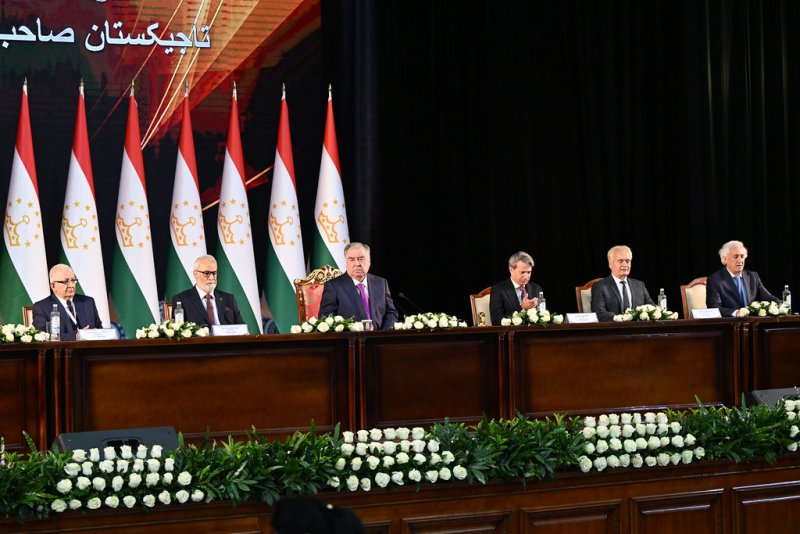
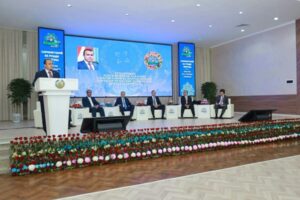
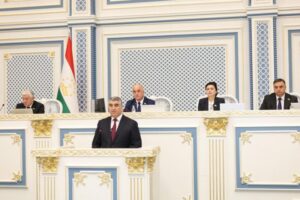
Dushanbe, The Gulf Observer: A scientific forum of the International Association of Tajiks and Persian-Speaking Peoples “Payvand”, titled “Independent Tajikistan — A Link between Aryan Civilisation and the Modern World,” was held at the Vahdat Palace in Dushanbe under the chairmanship of President of Tajikistan and Leader of the Nation Emomali Rahmon.
More than 230 guests from 27 countries, alongside Tajik scholars and researchers, participated in the forum, which was held as part of events marking the 35th anniversary of Tajikistan’s state independence.
Opening the forum, President of the National Academy of Sciences of Tajikistan Khushvahtzoda Qobiljon Khushvaht delivered remarks before inviting President Rahmon to address the gathering.
President Rahmon congratulated participants on the 35th anniversary of Tajikistan’s independence and welcomed scholars, scientists, cultural figures and active members of the Payvand Association to independent Tajikistan, describing the country as a home of hope for Tajiks and Persian-speaking peoples around the world.
The President described the Payvand Association as a unique institution of Tajikistan’s independence era that has developed into a broad platform for interaction among Tajiks and Persian-speaking communities worldwide.
He said the participation of international guests in the country’s independence celebrations demonstrated their respect for the Persian language and culture, history, civilisation and shared spiritual values of Persian-speaking peoples.
Against the backdrop of growing global competition involving identities, languages, values and interests, President Rahmon stressed the importance of strengthening spiritual and cultural unity among Persian-speaking peoples.
Recalling the objectives set at the association’s founding congress in 1993, he said its fundamental purpose was to restore historical relations and expand scientific and cultural ties among Persian-speaking peoples.
President Rahmon praised the contribution of Tajiks living abroad and Persian-speaking communities to promoting independent Tajikistan, its achievements and its international standing.
He highlighted the valuable contribution made by members of the Payvand Council and Executive Committee to the organisation of major scientific and cultural events commemorating prominent figures and milestones in Persian and Tajik civilisation and literature, including Abu Abdullah Rudaki, Mir Sayyid Ali Hamadani, Barbad Marvazi, Abulqasim Ferdowsi, Hafez Shirazi, Kamal Khujandi, Abdurrahman Jami and Omar Khayyam.
The President also commended their contribution to events marking the 1,100th anniversary of the Samanid state, international conferences devoted to the Avesta and world civilisation, the contribution of Tajiks and Persian-speaking peoples to world civilisation, the 2,700th anniversary of Kulob and the Year of Aryan Civilisation.
President Rahmon urged members of the association not merely to regard themselves as heirs to a great civilisation, but to enrich that heritage with new forms and content consistent with contemporary realities and modern scientific achievements.
He stressed that Aryan civilisation represents an important historical and cultural foundation and said its preservation in the national and intellectual consciousness would have a significant bearing on the future.
During the forum, President Rahmon also spoke about making the immortal Shahnameh of Abulqasim Ferdowsi widely available to the people of Tajikistan and proposed the construction in Dushanbe of a Palace of Aryan Civilisation and an International Navruz Centre.
He said the Palace of Aryan Civilisation could serve as a living cultural, scientific and educational centre, presenting the history of the Aryan peoples as a civilisation that contributed to the development of the ancient world.
The proposed International Navruz Centre, he added, could become a unique global cultural institution where Navruz would be presented not merely as a one-day or seasonal celebration, but as an enduring philosophy of life, peace and renewal.
According to President Rahmon, the centre would represent Tajikistan’s contribution to preserving humanity’s cultural heritage, promoting dialogue among civilisations and strengthening the country’s role as a centre of Navruz civilisation.
The President emphasised that in the coming decades Tajiks should be recognised not only as a nation with a proud historical legacy, but also as a forward-looking and constructive society capable of generating knowledge, developing technology, promoting contemporary culture and advancing effective diplomacy.
He said the Payvand Association could become a coordinating centre for the intellectual, economic and cultural potential of Tajiks around the world.
President Rahmon also highlighted efforts undertaken during the independence period to revive national and ancient traditions, including Navruz, Sada, Mehrgon and Tirgon.
He cited the publication and nationwide distribution of Bobojon Ghafurov’s seminal work “The Tajiks” and Ferdowsi’s “Shahnameh”, along with the “Stars of Literature” series, as important initiatives aimed at strengthening national consciousness, historical pride and the people’s connection with their ancestral heritage.
The President described language as the foundation of a nation’s spiritual existence and identified its preservation, promotion and future development as a central responsibility of the Payvand Association.
“We must not only cherish our language, but transform it into a powerful language of science, technology, modern innovation, economics and diplomacy,” President Rahmon said.
Referring to the historical contribution of Aryan peoples, President Rahmon highlighted Cyrus the Great, founder of the first empire in history and associated with an early declaration of human rights, as an example of justice and tolerance.
He said Tajikistan considered it its mission to convey to future generations and societies a message of peace, dialogue among civilisations, mutual understanding, tolerance and shared responsibility.
President Rahmon also welcomed the adoption by the United Nations General Assembly of a resolution proclaiming the “Decade of Strengthening Peace for Future Generations”, an initiative put forward by Tajikistan.
He called for the forum to convey a clear message that Tajiks are a people of peace and peacebuilding, moderation and tolerance, culture, construction and development.
The President proposed that the forum serve as the starting point for a new development programme for the Payvand Association for the coming years, incorporating cooperation in language, history, culture, science, economics, youth affairs, innovation, digitalisation and cultural diplomacy.
He further proposed that issues of peace and security, water and climate, and sustainable development be integrated into the association’s future activities alongside the preservation of historical and spiritual heritage.
Concluding his address, President Rahmon said that in the coming decades Tajikistan should aspire to become not only a country of stability, peace and development, but also a centre for constructive ideas, living culture, international initiatives and closer integration among Persian-speaking peoples.
Following the President’s address, several participants spoke at the forum and praised the association’s contribution to strengthening unity among Tajik and Persian-speaking peoples. They also commended President Rahmon’s role as chairman of the association in reviving national values and Aryan civilisation and promoting the scientific and cultural achievements of their ancestors.
Among the speakers were Alireza Qiyamati, a professor at Mashhad University and a prominent scholar and researcher of the Shahnameh, and Dr. Mohieddin Mahdi, a former member of the National Assembly of the Islamic Republic of Afghanistan and a researcher specialising in history, linguistics, literature and Afghanistan’s political history.
The speakers described Tajikistan’s political, economic, scientific and cultural progress as the result of the dedicated efforts of the Tajik people under the leadership of President Emomali Rahmon.