Morocco Reaffirms Africa as Foreign Policy Priority, Calls for Stronger Russia-Africa Cooperation
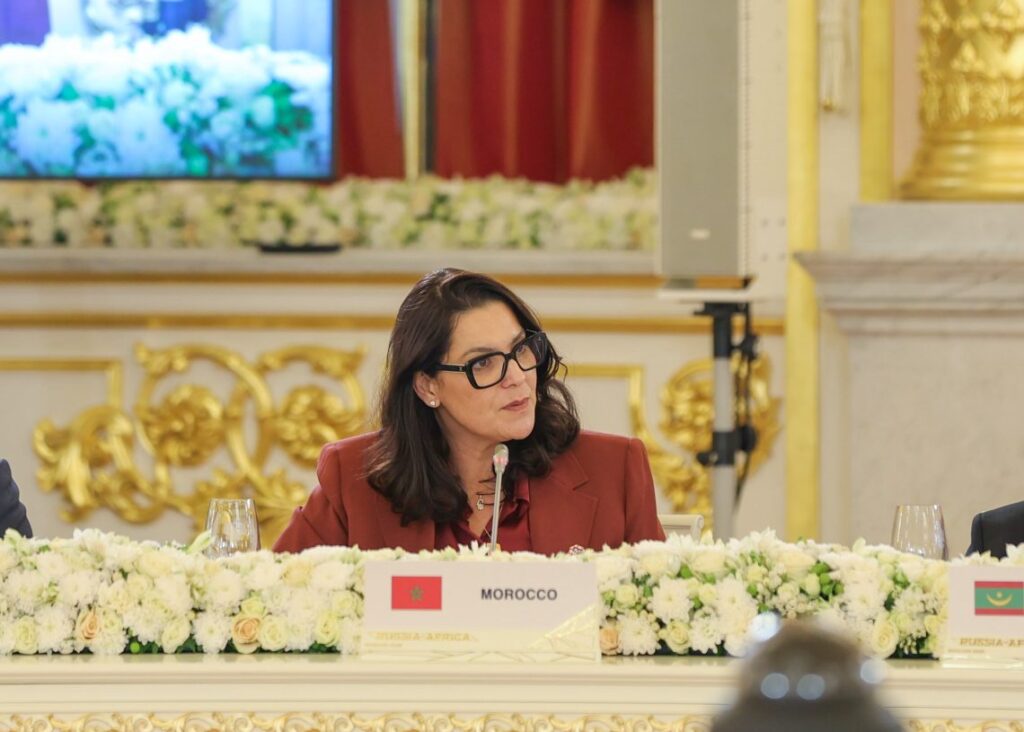
Rabat, The Gulf Observer: Moroccan Head of Government Fatima Ezzahra El Mansouri has reaffirmed that Africa remains a central priority of Morocco’s foreign policy, calling for stronger Russia-Africa cooperation focused on practical projects and the continent’s development needs.
El Mansouri made the remarks while representing King Mohammed VI at the third Russia-Africa Summit, held in Moscow on October 28–29, where she emphasised the importance of translating existing agreements into concrete initiatives that deliver tangible benefits for African countries.
Her participation marked her first official foreign visit since assuming office following Morocco’s September 2026 parliamentary elections, becoming the country’s first woman head of government.
Addressing the summit’s plenary session, El Mansouri said Morocco supports enhanced cooperation between Russia and African nations, stressing that international partnerships should complement existing initiatives, respect mutual interests and respond to the priorities of African countries.
She highlighted King Mohammed VI’s continued commitment to placing Africa at the centre of Morocco’s foreign policy, citing several royal initiatives designed to strengthen regional integration, improve infrastructure and promote economic development.
These include the Atlantic African States Initiative, the royal initiative to facilitate landlocked Sahel countries’ access to the Atlantic Ocean, and the Nigeria-Morocco Atlantic African Gas Pipeline project.
According to El Mansouri, these initiatives seek to strengthen connectivity among African countries, expand access to international trade routes and energy infrastructure, and create new opportunities for sustainable economic growth.
Morocco Calls for Results-Oriented Russia-Africa Partnership
El Mansouri stressed that Africa needs cooperation with all its international partners, adding that such partnerships can generate significant added value when they complement one another and produce measurable results.
She observed that Russia-Africa relations were entering a new phase, shifting from planning and political commitments towards practical implementation.
Referring to the previous Russia-Africa summits held in Sochi in 2019 and St. Petersburg in 2023, she said those meetings had established important foundations for cooperation, while the current gathering should focus on delivering concrete outcomes.
The Moroccan head of government identified food security, energy security, industrial development and technology transfer as key areas requiring greater attention in future cooperation.
She reaffirmed Morocco’s commitment to the Russia-Africa partnership and expressed the country’s readiness to contribute its experience to developing new avenues of collaboration.
Highlighting Africa’s growing international significance, El Mansouri pointed to the continent’s natural resources, youthful population, strategic geographical position and rich historical and cultural diversity.
“Africa is not the only one that needs the rest of the world; the rest of the world increasingly needs Africa,” she said.
She also noted that trade between Russia and African countries exceeded $27.7 billion in 2025, stressing that the summit should build on this progress while addressing the continent’s evolving development requirements.
Morocco-Russia Trade Reaches $630 Million
Highlighting bilateral relations, El Mansouri said Morocco and Russia enjoyed longstanding ties that had continued to develop since the establishment of their strategic partnership in 2002.
Relations were further strengthened following King Mohammed VI’s visit to Moscow in 2016, when both countries elevated their relationship to a reinforced strategic partnership.
Bilateral trade reached $630 million in 2025, while Moroccan exports to Russia registered an increase of 18 per cent, she said.
Educational cooperation also remains an important component of bilateral relations, with more than 7,000 Moroccan students enrolled in Russian educational institutions during the 2024–2025 academic year.
Despite the complex geopolitical environment, El Mansouri expressed satisfaction with the continued substantial level of economic and other exchanges between the two countries.
She identified energy, science and technology as promising areas for expanding cooperation and encouraged both sides to explore additional opportunities in these fields.
As part of efforts to strengthen institutional engagement, the foreign ministries of Morocco and Russia recently established a joint working committee, which held its inaugural meeting in September 2026.
El Mansouri expressed Morocco’s hope that the third Russia-Africa Summit would open new avenues for practical cooperation, reinforce political dialogue and contribute to a partnership that supports Africa’s economic transformation and sustainable development.