President Emomali Rahmon Addresses Sughd Region Leaders on Tajikistan’s 35th Independence Anniversary
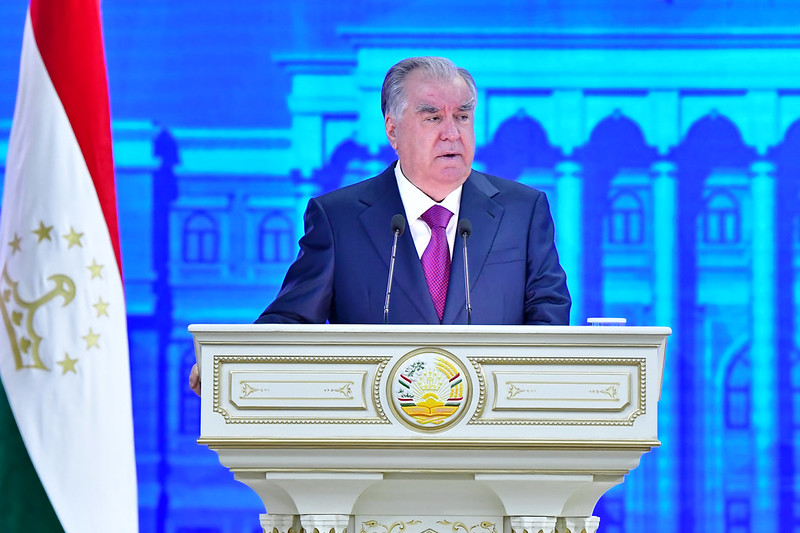
Dear compatriots,
Distinguished attendees,
Our meeting is taking place at a time when, just a few days ago, the honorable people of our country, including the proud residents of Sughd Region, celebrated the sacred and great national occasion—the 35th anniversary of the State Independence of Tajikistan—with significant achievements and pride in the glorious path traversed by our state and nation over these years.
On this important and historic occasion, I sincerely congratulate all the hardworking and patriotic people of Sughd Region.
I wish every family in the region, as well as all of you, dear attendees, good health, peace, stability, prosperity and well-being.
State independence is the greatest historical achievement and the most sacred national value for the Tajik people.
Thanks to independence, national statehood in Tajikistan was revived, and our country established its rightful place in the international arena.
This great historic achievement enabled the Tajik people to independently choose their path of future development and take firm steps towards a bright and prosperous future for our homeland.
During the years of independence, the foundations of modern Tajik statehood were established, creating favorable conditions for economic and social development, strengthening peace and stability and national unity, reviving national values, enhancing Tajikistan’s international standing and substantially improving the living standards of the people.
Sughd Region, which possesses enormous industrial and agricultural potential and broad economic opportunities, has achieved considerable progress during this period and made a significant contribution to implementing the country’s strategic objectives and developing the national economy.
Today, we also commissioned a number of new industrial and social facilities. These projects are the result of the dedicated work of the people of the region and the valuable contribution of entrepreneurs and philanthropists to development and construction efforts.
It is encouraging that, in preparation for the 35th anniversary of State Independence, 15,400 social and industrial facilities have been constructed or renovated in the cities and districts of Sughd Region.
Over the past three days, as part of our working visit to the cities and districts of the region, 43 newly constructed industrial and social facilities have been commissioned. These include major industrial enterprises in the cities of Istiklol and Guliston, dozens of educational and medical institutions, and service facilities equipped with modern amenities and technologies. Thousands of new jobs have been created at these facilities.
More than 1,000 jobs have been created at the Adrasmon ore-processing plant in Guliston, while 320 new jobs have been created at the second phase of the Tajikistan-China Mining and Industrial Company’s metallurgical plant in Istiklol and at the company’s lime production facility.
These achievements demonstrate the people’s support for the state’s constructive and development-oriented policies, as well as the active participation of the residents of Sughd Region in the development and progress of our beloved homeland.
Over the years of independence, the Government has implemented numerous measures to ensure the comprehensive development of the region and improve living conditions for its population.
During this period alone, more than 40 billion somoni from the state budget was allocated to implement the region’s social and economic development programmes.
More than 100 state investment projects worth 11 billion somoni have been implemented in the region, while another 24 projects are currently under implementation.
In addition, 117 billion somoni in foreign investment, including 28 billion somoni in foreign direct investment, has been attracted to the economy of Sughd Region.
During the period of independence, more than 22,000 hectares of land were allocated for household subsidiary farms, while more than 6,900 hectares were designated as household plots.
The gross regional product of Sughd Region amounted to 49 billion somoni in 2025, representing a significant contribution by the region to strengthening the country’s economic potential and ensuring further national development.
During the independence period, credit institutions provided more than 70 billion somoni in loans to entrepreneurs and residents of the region.
As a result, favorable conditions have been created for the development of key sectors of the economy, including industry, agriculture and tourism.
The value of industrial production in the region increased from 1.8 billion somoni in 2000 to 40 billion somoni in 2025.
The number of industrial enterprises has now reached 1,324, which is 11 times higher than at the beginning of the independence period.
Over the past five years alone, 781 new industrial enterprises have been established and commissioned in the region, creating more than 8,000 new jobs.
Currently, a number of investment projects in mineral processing and light industry, with a total value exceeding 6 billion somoni, are being implemented in the region.
During the years of independence, a number of major modern enterprises have been established in the cities and districts of the region, while the mining industry has achieved unprecedented development.
As a result, the mining sector now accounts for 44 percent of the region’s total industrial production.
The light industry has also been developing rapidly in the region and now plays an important role in processing local raw materials and creating employment opportunities.
In 2025, the number of textile and garment enterprises in the region reached 169, an increase of 56 enterprises compared with five years earlier.
Despite the significant progress achieved in this sector, it is necessary to ensure the full processing of domestic raw materials, further increase the production of finished products and make full use of the export potential of domestic enterprises.
The production of construction materials also makes a significant contribution to the region’s economic development.
During the independence period, dozens of new production enterprises have been established using local raw materials, substantially improving the capacity to supply the domestic market with construction materials.
In particular, cement production was launched in 2010, and its output reached 1.4 million tonnes in 2025.
During our previous working visit, on July 9 this year, we laid the foundation stone for a cement plant in Istaravshan with an annual production capacity of 1.2 million tonnes.
An investment of 1.2 billion somoni has been attracted for the construction of this plant. More than 1,200 people will be employed during the construction phase, while more than 850 permanent jobs will be created once the plant becomes operational.
I would like to emphasize that, despite the achievements mentioned above, it is necessary to take additional measures to achieve the country’s strategic objectives, particularly the goal of accelerated industrialisation. This requires ensuring the efficient operation of existing enterprises and taking steps to restore enterprises that have ceased operations.
In this process, particular attention should be paid to producing competitive products with high added value, introducing advanced technologies, efficiently using natural resources and increasing labour productivity.
I am confident that entrepreneurs and investors, enterprise managers and the hardworking people of Sughd Region will continue to make a valuable contribution through constructive activities and development initiatives to achieving the state’s strategic objectives, strengthening the country’s productive capacity and advancing independent Tajikistan.
Distinguished attendees,
During the period of independence, a number of important strategic projects were implemented to develop the energy infrastructure of Sughd Region and further improve electricity supplies to the population and economic sectors.
As a result, the southern and northern electricity networks of the country were interconnected through a 500-kilovolt transmission line, creating a unified national power system and strengthening the country’s energy security.
The 264-kilometre, 500-kilovolt South-North electricity transmission project, together with the Dushanbe-500 and Sughd-500 substations, was implemented at a cost of 2.8 billion somoni.
This work was carried out at a time when the region faced the risk of being left without electricity altogether.
Over the past 15 years, 10 state investment projects worth 5.4 billion somoni have been implemented in the region’s energy sector.
These include the rehabilitation of the Qairoqqum Hydropower Plant, the construction of electricity transmission lines and projects aimed at reducing electricity losses, all of which have contributed to strengthening the region’s energy capacity.
As part of the modernization of the Qairoqqum Hydropower Plant, all six generating units were completely replaced, increasing its generation capacity from 126 to 174 megawatts.
The construction of the Qairoqqum-Asht and Qairoqqum-Sughd transmission lines has also helped improve electricity supplies in the region and created favorable conditions for expanding production and exporting electricity.
In addition, 74 small hydropower plants with a combined capacity of more than 8,900 kilowatts have been constructed in the cities and districts of the region.
The implementation of five additional projects is currently underway, including the expansion of the Sughd-500 substation, with a total value of 2.3 billion somoni. These projects will contribute to the further development of the region’s energy infrastructure.
Furthermore, one of the first major “green energy” projects in Sughd Region—the construction of a 250-megawatt solar power plant in Asht District—has been completed.
This important facility began operations two days ago, creating favorable conditions for further development of the energy sector and the wider use of renewable energy sources.
Given the opportunities that have been created, it is necessary to maintain constant attention to the efficient use of energy capacities, the introduction of modern technologies and the reduction of electricity losses.
Distinguished attendees,
Agriculture, as one of the key sectors of Sughd Region’s economy, plays an important role in ensuring the country’s food security, improving living standards and expanding exports.
It is worth noting that the hardworking people of the region have extensive experience in the efficient use of land and water resources and have achieved significant results in this area.
The presence of the Syr Darya and Zeravshan rivers, extensive irrigation networks and more than 300 sunny days a year provides farmers with opportunities to harvest two or three crops from the same land during a year.
Every year, nearly 35,000 hectares in the region are used for repeated planting, which is one of the factors contributing to increased agricultural production.
Thanks to the dedicated efforts of farmers and the consistent support of the state and the Government, the area of irrigated land in the region has increased by 36,000 hectares during the independence period. Over the past six years alone, 4,800 hectares of land, including 4,600 hectares of irrigated land, have been brought into agricultural circulation.
During this period, agricultural production increased 3.8 times, reaching 26 billion somoni in 2025.
Horticulture, as a profitable and promising branch of agriculture in the region, has developed considerably over the 35 years of independence. The area under orchards and vineyards has doubled, reaching 97,000 hectares.
Agricultural products from Sughd Region have also established a presence in foreign markets. In 2025 alone, agricultural exports exceeded 1.1 billion somoni.
Distinguished attendees,
During the independence period, the Government consistently implemented major infrastructure projects aimed at overcoming the country’s transport isolation and transforming Tajikistan into a transit country.
As a result, Tajikistan has developed a modern transport network that meets contemporary requirements, while the country’s domestic and international economic connections have expanded significantly.
The construction and rehabilitation of the Dushanbe-Chanak highway ensured year-round transport connectivity between Sughd Region, the capital and other cities and districts of the country, creating new opportunities for the region’s economic and social development.
To date, 13 state investment projects in the transport sector, worth more than 6.1 billion somoni, have been implemented in Sughd Region. Within these projects, 568 kilometres of internationally significant roads, 90 bridges and 11.7 kilometres of tunnels have been constructed and commissioned.
In addition, two days ago, the 23-kilometre Kurush-Bekobod and Khistevarz-Sohilob roads, with a combined cost of 140 million somoni, were commissioned.
To address challenges related to the movement of people and the transportation of goods and products, two days ago we laid the foundation stone for the reconstruction of the Khujand-Asht road. The road is 110 kilometres long, with a total project cost of 1.2 billion somoni.
It is also commendable that, in preparation for the 35th anniversary of State Independence, 5,500 kilometres of local roads have been repaired and reconstructed in the cities and districts of Sughd Region with the support of entrepreneurs and philanthropists.
Given the direct link between economic development, investment attraction, expansion of trade and improvement of living standards and the condition of transport infrastructure, the relevant authorities must continue to pay close attention to road maintenance, efficient use of transport infrastructure and improvement of its quality.
Distinguished attendees,
During the years of independence, 986 educational institutions accommodating 470,000 students have been constructed and commissioned in the cities and districts of Sughd Region at a total cost of 1.4 billion somoni.
The construction of new educational institutions, the establishment of additional classrooms and their equipping with modern facilities are contributing to improving the quality of education and preparing young specialists who meet the requirements of the modern era.
With the support of the Government, the number of preschool institutions and the participation of children in preschool education have steadily increased during this period.
Today, 315 preschool institutions operate in the region, providing education and care to 54,000 children, while more than 27,000 children receive education and developmental support at 724 child development centres.
Over the past 14 years alone, 4,300 young people from the cities and districts of Sughd Region have been admitted to higher professional education institutions across the country under the Presidential quota programme.
It is encouraging that students from educational institutions in Sughd Region participate actively every year in national and international competitions and olympiads and achieve significant results.
I am confident that the well-educated young people of Sughd Region, making use of the opportunities created by the state and Government, will make a valuable contribution to the advancement of science and technology, the development of the national economy and the strengthening of Tajik statehood.
During the period of independence, significant work has been carried out in Sughd Region to improve the quality of healthcare services, strengthen the material and technical capacity of healthcare institutions and train highly qualified specialists.
During this period, 417 healthcare facilities have been constructed and commissioned in the cities and districts of the region.
The regional healthcare budget increased from 183,000 somoni in 1991 to 1.322 billion somoni in 2026.
The heads and responsible officials of the sector must take additional measures to equip healthcare institutions with modern equipment, develop digital healthcare, enhance the professional skills of healthcare workers and further improve medical services for the population.
Distinguished attendees,
We regard our culture and rich historical heritage as among the most important factors in strengthening national identity, social unity and the education of a patriotic younger generation.
During the period of independence, 152 cultural facilities worth 854 million somoni have been constructed, renovated or reconstructed in Sughd Region.
Today, 763 cultural institutions operate in the cities and districts of the region, contributing to the development and promotion of national culture.
There are 1,361 registered historical and cultural monuments in Sughd Region, representing a valuable heritage of Tajik civilisation.
During the years of independence, a number of important historical and architectural monuments, including ancient Sarazm, ancient Panjakent, Khujand Fortress and Mug Fortress, have been restored and reconstructed.
The recognition and commemoration by UNESCO of the 5,500th anniversary of ancient Sarazm and the 700th anniversary of Kamol Khujandi represent important achievements during the period of independence. These milestones have contributed to presenting the ancient civilisation and rich cultural heritage of the Tajik people more prominently to the world.
The inclusion of the cities of Istaravshan and Panjakent in the World Crafts Cities network is a recognition at the international level of Tajikistan’s traditional crafts and cultural traditions.
The Khujand Fortress Historical and Cultural Complex, which was reconstructed during the independence period, has now become one of the country’s important cultural and tourism centres.
I emphasize that all available opportunities should continue to be mobilized to preserve and promote national values, revive historical and cultural heritage and develop traditional crafts.
Dear compatriots,
We have welcomed the 35th anniversary of our state independence with significant achievements, full confidence in the creative strength of our people and faith in Tajikistan’s bright future.
Throughout these years, the proud people of Sughd Region have made a significant contribution to implementing the constructive policies of the state and Government, developing the economy, strengthening national unity and developing our beloved homeland.
In the complex environment of today’s world, preserving the achievements of the independence period, strengthening national statehood, protecting the national interests of the country and ensuring security and stability require an even greater sense of responsibility from every conscientious citizen.
Young people, in particular, as the driving force of society, should strive to protect Tajikistan’s achievements and contribute to the further development of the state and nation with a strong sense of national identity, self-awareness and devotion to the homeland.
I express my gratitude to the honorable and hardworking people of Sughd Region for their valuable contribution to the development and prosperity of our beloved homeland.
I am fully confident that they will continue to make a valuable contribution to the country’s progress and the preservation of the achievements of the independence period through strong determination and dedicated efforts.
I believe that, relying on the sacred values of independence, peace and national unity, and through constructive labor, we will make our beloved homeland even more prosperous and developed.
Once again, I sincerely congratulate all the patriotic residents of Sughd Region and all of you, distinguished attendees, on the 35th anniversary of the independence and freedom of the Tajik state.
I wish every one of you happiness, prosperity, abundance, success and continued well-being.
May you always remain healthy, proud and prosperous, dear compatriots!