Ramaphosa Calls for Accelerated Early Childhood Development Reforms, Universal Access by 2030
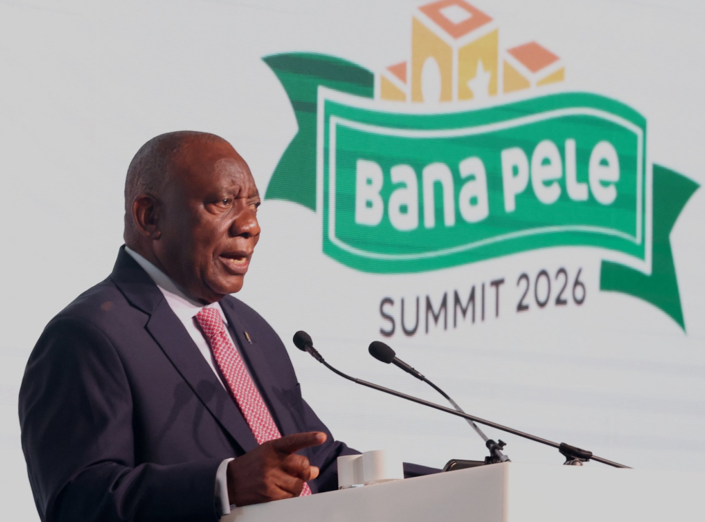
Johannesburg, The Gulf Observer: South African President Cyril Ramaphosa has called for accelerated reforms in early childhood development (ECD), urging government, businesses and communities to work together to ensure every child in the country has access to quality early learning by 2030.
Addressing the Bana Pele Leadership Summit 2026 at the Galleria Arena and Conference Centre in Sandton on Monday, Ramaphosa stressed that investment in early childhood development was essential to preparing children for a rapidly changing world shaped by artificial intelligence, automation and technological advancement.
“A child cannot be prepared for the future unless that child is given a strong foundation in the present,” the president said, emphasising that technology could not replace the care, encouragement and human interaction children need to develop.
The two-day summit, organised by the Department of Basic Education under the theme “From Blueprint to Movement,” brings together government representatives, businesses, civil society organisations, communities and philanthropic institutions to strengthen cooperation towards universal access to quality early learning by 2030.
The gathering aims to translate the Bana Pele Shared Blueprint into coordinated action, addressing implementation progress, remaining challenges and partnerships needed to expand access to early childhood education.
Strengthening the foundations of learning
Ramaphosa said early childhood development was no longer simply about providing childcare but also about equipping children with foundational literacy, numeracy, critical-thinking and problem-solving skills necessary for formal education and future employment.
He noted that the transfer of responsibility for early childhood development from the Department of Social Development to the Department of Basic Education in 2022 recognised the importance of distinguishing childcare from structured early education.
“Sending a child to an early learning centre is not only about making sure they are safe and fed. It is about structured learning in early literacy and numeracy that prepares them for formal schooling,” he said.
The president warned that developmental gaps continued to affect children’s educational outcomes, leaving millions unable to read for meaning by Grade 4.
He said children entering the education system in the coming years would need to adapt to technological changes and occupations that did not yet exist. Consequently, early education must prepare them to think critically, solve problems, communicate effectively and respond to change.
Ramaphosa described the Bana Pele Shared Blueprint as a roadmap towards universal access by 2030, focusing on connecting support systems, improving data for planning, registering early learning facilities and programmes, and strengthening the professional skills of practitioners.
Although South Africa had been slow to establish a formalised early childhood development system, he called for faster implementation of the reforms.
Expanding access and reducing barriers
Despite progress, approximately one million children aged three to five remain unenrolled in early learning programmes, while fees continue to prevent many children from disadvantaged households from accessing quality education.
Ramaphosa said the government was committed to addressing these challenges through additional funding for the early childhood development conditional grant and an increase in the subsidy provided per child per day.
However, he noted that too few eligible facilities were receiving the subsidy, making it necessary to intensify the Bana Pele Mass Registration Drive launched last year.
South Africa now has more than 39,000 registered early learning programmes serving over 1.6 million children, according to the figures cited at the summit.
The government is also working to reduce administrative obstacles that have prevented facilities from registering. Revised norms and standards for early learning centres were gazetted earlier this year, while Cabinet approved the Children’s Amendment Bill for submission to Parliament.
The proposed changes aim to simplify regulations while ensuring that registration requirements safeguard children without unnecessarily excluding centres serving poor communities.
“Our approach must be developmental. Where a centre does not meet the required standards, our first response should be to determine what assistance it needs to become compliant,” Ramaphosa said.
He emphasised that protecting children’s health and safety must go hand in hand with helping facilities improve their standards.
In his 2026 State of the Nation Address, the president also committed to expanding mass registration, increasing subsidies for eligible children and making Grade R compulsory to strengthen the foundations of learning.
ECD investment as an economic priority
Ramaphosa highlighted the broader economic and social benefits of early childhood development, including poverty reduction, women’s economic participation, job creation, improved child health and the development of a stronger workforce.
Quality early learning, he said, enables children from disadvantaged backgrounds to enter formal schooling on a more equal footing with those from better-resourced communities.
It also allows parents and caregivers, particularly women, to seek employment, establish businesses or pursue training and education while their children receive appropriate care and early learning.
The president noted that early childhood development could generate employment opportunities for unemployed women and young people, particularly in poor and rural communities, by enabling them to train as practitioners and establish early learning centres.
He also highlighted the contribution of these centres to children’s health through nutritious meals, vaccination support and links to health and social services.
Calling for greater private-sector participation, Ramaphosa urged businesses to invest in constructing and upgrading centres, training practitioners, subsidising access for disadvantaged children and providing educational materials, digital resources and internet connectivity.
“I would like to see early childhood development become a central part of corporate social investment and broader economic development strategies,” he said, describing such investment as essential to the country’s future prosperity.
Technology to support early learning
While highlighting the importance of human interaction and foundational skills, Ramaphosa said technology could help expand access to learning when used to support practitioners rather than replace them.
He cited an early reading application offering phonics exercises, teaching materials and an online library containing more than 4,000 books.
“Technology cannot replace teachers or books. What it can do is multiply what one well-trained practitioner can deliver, reaching many more children at different levels with the same resource,” he said.
The president also acknowledged donors supporting the Early Childhood Care and Education Outcomes Fund, launched in December 2025, noting that donor contributions had matched the government’s funding.
With support from the United Nations Children’s Fund (UNICEF), curriculum support packs are now available in all of South Africa’s official languages. More than 70 non-governmental organisations are also assisting early learning centres with documentation and first-aid training.
A collective responsibility
Ramaphosa called on municipalities, traditional and faith leaders, businesses, philanthropists and community organisations to strengthen their involvement in early childhood development.
He urged municipalities to work with the Department of Cooperative Governance and the South African Local Government Association to support early learning centres and adopt a developmental approach to regulatory compliance.
Community leaders were also encouraged to visit centres, engage with practitioners and identify practical ways to provide assistance.
The president stressed that achieving universal access to quality early learning by 2030 would require sustained cooperation among government, the private sector and the communities served by these programmes.
He said expanding access to early childhood development would also help give effect to the constitutional right to basic education by establishing a stronger foundation for every child’s educational journey.
“Let us make sure that no child falls behind before they even reach school. Let us truly put our children first, Bana Pele,” Ramaphosa said.