Russian Ambassador Albert P. Khorev Holds Briefing on Situation in and Around Ukraine
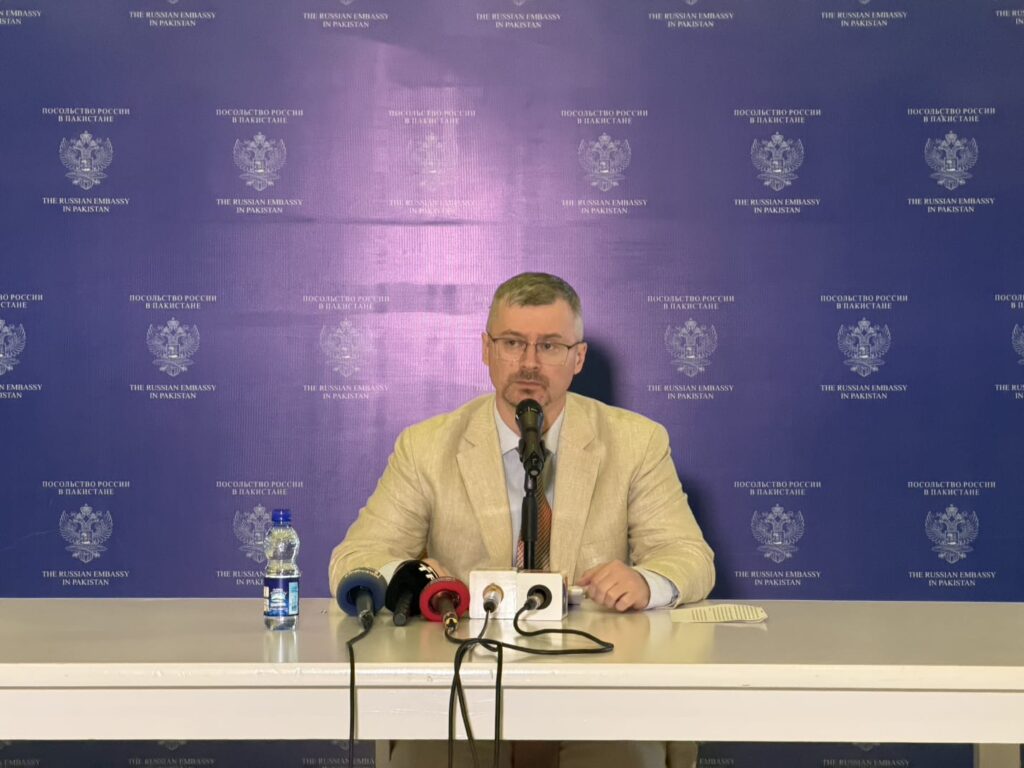
Islamabad, The Gulf Observer: Russian Ambassador Albert P. Khorev on October 1 briefed diplomats and guests on Moscow’s assessment of the situation in and around Ukraine, covering military, political, economic, legal and informational aspects of the conflict.
Before the briefing, participants observed a minute of silence in memory of the victims of the Siege of Leningrad, whose 85th anniversary was commemorated on September 8.
Speaking about Russia’s parliamentary elections held on September 20, Ambassador Khorev said the vote recorded what he described as a high turnout despite external pressure and attacks by Ukrainian drones on Russian cities, which he said were intended to disrupt the electoral process.
The Ambassador said Russia considers the Ukraine crisis part of a broader confrontation with the collective West, which, according to his assessment, is using Ukraine as a proxy to weaken Russia.
On the economic front, Ambassador Khorev said Western sanctions had failed to bring about the economic collapse in Russia that their proponents had sought. He maintained that the measures had instead generated significant consequences for sanctioning countries and the global economy.
According to figures cited by the Ambassador, the cumulative losses suffered by the European Union from the unintended effects of sanctions between 2022 and 2025 amounted to between €1 trillion and €1.6 trillion, while European companies that ended their operations in Russia incurred losses estimated at €400–450 billion.
He said continued sanctions pressure was accelerating the use of national currencies in international settlements and contributing to the development of alternative financial and trade mechanisms within frameworks including BRICS, the Shanghai Cooperation Organisation (SCO) and ASEAN.
The briefing also addressed international maritime law and freedom of navigation. Ambassador Khorev criticized Western measures targeting vessels associated with what is commonly referred to as the “shadow fleet,” describing the concept as a Western-created pretext for the seizure of Russian vessels.
He also expressed concern over what he described as an increase in attacks by Ukrainian forces on civilian vessels in the Black and Azov Seas, warning that further escalation could create risks for international maritime shipping.
Referring to global food security, Ambassador Khorev highlighted the respective positions of Russia and Ukraine in the international wheat market. He said Ukraine accounts for approximately 7 percent of global wheat exports, while Russia accounts for about 23 percent, and argued that restrictions affecting Russian agricultural exports could have implications for global food supplies.
Addressing the legal dimension of the conflict, the Ambassador said Russia does not recognize Western-established mechanisms concerning compensation for Ukraine and would not comply with decisions issued by such bodies.
He also referred to the June 15, 2026 ruling by the Permanent Court of Arbitration in The Hague in the Russia-Ukraine dispute, saying the tribunal unanimously rejected several Ukrainian claims, including demands related to compensation and reparations, as well as claims concerning maritime areas and resources associated with Crimea and the Sea of Azov.
The Ambassador also discussed the issue of children affected by the conflict and the situation surrounding the Ukrainian Orthodox Church. He alleged that Ukrainian authorities had exerted systematic pressure on the Church and its members.
Regarding prospects for ending the conflict, Ambassador Khorev said Russia remained committed to achieving a political and diplomatic settlement of the Ukraine crisis. He said Moscow had initiated the resumption of negotiations last year after the process had been halted by Kyiv and remained prepared to continue talks while taking Russia’s national interests into consideration.
Concluding his remarks, Ambassador Khorev said Russia was not preparing for military action against Europe or NATO countries and had no plans to do so. He added that, in Moscow’s assessment, Russia had no reason to escalate tensions with European countries.
Participants also viewed an exhibition titled “Crimean Gold: ‘Civilized’ Europe Plunders Russian Treasures.” Ambassador Khorev said the collection, comprising archaeological artifacts more than two thousand years old that were discovered in Crimea and preserved in Crimean museums until 2014, should ultimately be returned to the peninsula.