Sri Lankan Government Prioritises Education Reforms, Infrastructure Development: Prime Minister
Colombo, The Gulf Observer: Sri Lankan Prime Minister and Minister of Education, Higher Education and Vocational Education Dr. Harini Amarasuriya has reaffirmed the government’s commitment to building an education system that enables every child to benefit fully from quality education, despite prevailing economic constraints.
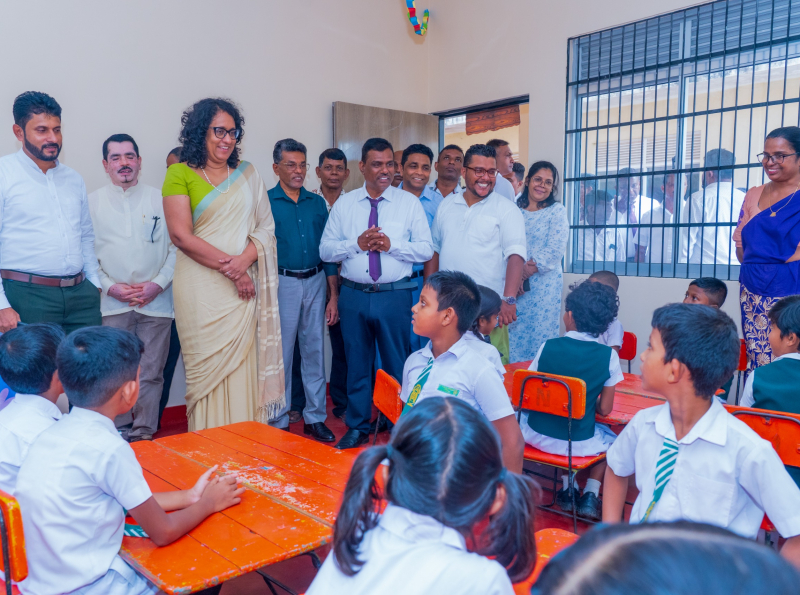
The Prime Minister made these remarks on October 24, 2026, while attending the handover ceremony of a newly constructed two-storey building at Vijitha Primary School in Polonnaruwa.
Constructed at a cost of approximately Rs. 55 million through government funding, the new building comprises eight primary classrooms. Following the formal handover, the Prime Minister interacted with students, inspected the newly equipped classrooms and reviewed academic and welfare issues affecting teaching and learning at the school.
Dr. Amarasuriya stated that the government had initiated efforts to strengthen the education sector by allocating substantial financial resources, notwithstanding the country’s economic challenges.
Emphasising the broader scope of the proposed education reforms, she said that reforming the education system involved more than revising curricula. It also required adequate infrastructure, comprehensive teacher training and the creation of a supportive school environment. The new curricula would therefore be introduced in phases, taking into account the preparedness of the school system.
The Prime Minister highlighted that the government aimed to establish a quality learning environment in which children could learn freely and happily, teachers could perform their duties effectively, and students’ safety would be ensured.
She added that particular attention would be given to improving primary education infrastructure, including classroom facilities, furniture and educational equipment.
Dr. Amarasuriya further stated that, as the country’s economic stability improved, the government expected to increase its focus on key sectors, particularly education and healthcare. She expressed the government’s intention to allocate more funds for implementing education reforms in the coming year than in the current year.
Highlighting institutional reforms, the Prime Minister said legal proceedings had commenced towards establishing an Education Council to promote professionalism and maintain quality standards across the education sector.
She also noted that revisions were underway to school curricula and teacher education programmes at National Colleges of Education to prepare teachers capable of meeting the demands of the new education system.
The Prime Minister stressed that transforming the country’s education system required addressing institutional shortcomings, infrastructure gaps and human resource shortages. She underscored that a fundamental responsibility of education was to nurture citizens equipped with knowledge, practical skills and positive values.
She also emphasised the importance of teachers’ dedication and the active support of parents and local communities in achieving these objectives. Calling for collective efforts to protect village schools, she stressed that every child should have access to quality education, regardless of their location.
The ceremony was attended by Deputy Minister of Housing, Construction and Water Supply T. B. Sarath, Polonnaruwa District Member of Parliament Padmasiri Bandara, the Chairman and members of the Lankapura Pradeshiya Sabha, education officials, including the Additional Provincial Director of Education of the North Central Province, as well as school principals, teachers, parents and students.