Vietnam and Japan Advance Innovation Cooperation Through Hòa Lạc Technology Hub
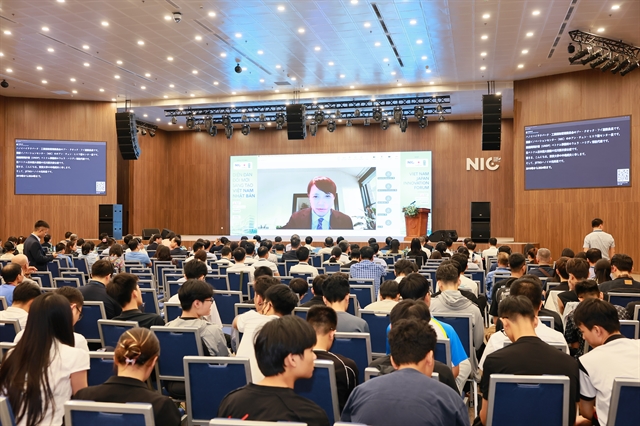
Hanoi, The Gulf Observer: Vietnam and Japan are strengthening cooperation in innovation and advanced technologies, with Hòa Lạc being positioned as a testing and co-creation hub where businesses, researchers and universities can jointly develop, validate and commercialise new technologies.
The initiative was highlighted at the Vietnam–Japan Innovation Forum 2026, held at the Vietnam National Innovation Centre (NIC) Hòa Lạc in Hà Nội on August 13.
NIC Deputy Director Hoàng Trung Hiếu said the centre would continue working closely with Japanese government agencies, research institutions, universities, companies and investors to connect resources and transform cooperation commitments into practical and sustainable outcomes.
“NIC is committed to continuing to accompany Japanese partners to connect resources, promote cooperation and create new value,” he said.
UNDP Resident Representative in Vietnam Ramla Khalidi said technology, knowledge and innovation would need to play a greater role in boosting productivity and creating value if Vietnam is to sustain rapid economic growth and strengthen competitiveness in an increasingly technology-driven global economy.
She stressed that the transition would require investment, skills, strong institutions and, above all, effective partnerships.
Japanese Deputy Ambassador Ishikawa Isamu highlighted the long-standing cooperation between Japan and Vietnam in Hòa Lạc, noting that bilateral collaboration in the area dates back nearly three decades to support provided by the Japan International Cooperation Agency for the master plan of the Hòa Lạc Hi-Tech Park.
He said Japan would continue implementing cooperation programmes to support Vietnam’s innovation development, with potential areas including science and technology, semiconductors and artificial intelligence.
Discussions at the forum focused on a “Connect–Test–Scale” model for future cooperation. Under the approach, technology needs and partners are first connected, innovative solutions are subsequently tested and validated in real-world environments, and successful technologies are then scaled up for wider application.
Hòa Lạc is expected to serve as a co-creation and testing environment where businesses, startups, universities and international partners can jointly develop technologies and translate research into practical applications.
The forum also highlighted Japan’s experience in developing long-term innovation ecosystems. The University of Tokyo’s ecosystem, for example, has supported the creation of more than 700 startups, alongside initial public offerings and mergers and acquisitions, through sustained cooperation among universities, businesses, investors and government institutions.
Vietnam and Japan possess complementary strengths that provide a strong foundation for expanded cooperation. Vietnam offers substantial software talent, manufacturing capabilities and a young workforce, while Japan contributes advanced technologies, industrial expertise, corporate networks, ecosystem-building experience and long-term investment capital.
These complementary capabilities create opportunities for cooperation in research and development, talent development, technology startups, advanced manufacturing and international market expansion.
Semiconductors are emerging as a key area of bilateral collaboration. The forum announced the establishment of a Vietnam–Japan Semiconductor Human Resources Working Group, involving the Japanese Embassy, Japan’s Ministry of Economy, Trade and Industry, NIC, Japanese semiconductor companies and four leading Vietnamese engineering universities.
The working group will assess gaps between the supply and demand for semiconductor professionals and seek to align industry requirements with the training and research capacities of Vietnamese universities. It is also expected to support joint training programmes and human-resource development initiatives between the two countries.
Meanwhile, NIC is developing the Vietnam–Japan Innovation Hub in Hòa Lạc as a platform for companies, universities and research institutions to conduct joint research, testing and training while establishing connections with potential investors.
The hub will be linked with Vietnam–Japan University, the Vietnam National Space Centre and technology companies operating in the Hòa Lạc Hi-Tech Park, creating opportunities for concrete research and development programmes and technology projects involving Vietnamese and Japanese partners.
The broader cooperation agenda encompasses strategic technologies such as semiconductors, cybersecurity, quantum technology and unmanned aerial vehicles.
Khalidi emphasized that an innovation hub should extend beyond physical infrastructure and focus on building strong human and institutional connections. She noted that cooperation among innovators, businesses and government agencies could help move ideas from laboratories to the marketplace.
She also underlined the importance of prototyping facilities that allow companies and researchers to test and refine technologies before commercialisation, reducing risks and improving their readiness for the market.
Unmanned aerial vehicle technologies, for instance, could be tested for applications ranging from disaster-risk reduction to more efficient agricultural production.
The forum called for closer collaboration among businesses, universities, research institutions and government agencies throughout the innovation cycle — from identifying market needs and developing solutions to testing, validating and ultimately commercialising technologies.
Under this framework, Hòa Lạc is being positioned as a strategic platform where technologies can be demonstrated, tested, validated and refined in cooperation with businesses and research partners before being introduced to wider markets.
The initiative is expected to contribute to deeper Vietnam–Japan innovation cooperation while strengthening the two countries’ capabilities in advanced technology, human-resource development and technology commercialisation.