Vietnam, Russia Agree to Deepen Comprehensive Strategic Partnership
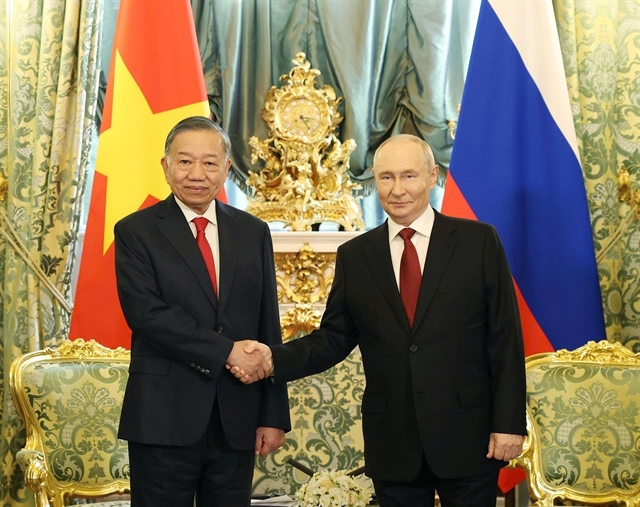
Moscow, The Gulf Observer: General Secretary of the Communist Party of Vietnam Central Committee and President To Lam held talks with Russian President Vladimir Putin at the Kremlin on Wednesday, following an official welcoming ceremony held in his honour with full state honours.
Welcoming To Lam and the high-level Vietnamese delegation on their state visit to Russia, President Putin said the visit carried special significance and represented a new milestone in the traditional friendship and Comprehensive Strategic Partnership between the two countries.
Putin noted that the visit, following a series of high-level exchanges and meetings in recent years, reflected the determination of the two countries’ leaderships to usher bilateral relations into a new phase of deeper, more substantive and effective cooperation. He reaffirmed that Vietnam remains a reliable partner and a priority in Russia’s policy towards the Asia-Pacific region.
President To Lam said the Party, State and people of Vietnam deeply value and remember the wholehearted support and effective cooperation extended by successive generations of Russian leaders and people to Vietnam during its struggle for national independence and reunification, as well as in its current national development and defence efforts.
He described Vietnam and Russia as reliable, natural and sustainable comprehensive strategic partners, noting that the two countries have consistently supported each other’s foreign policies based on independence, self-reliance, diversification and multilateralisation of external relations.
To Lam reaffirmed that Vietnam regards Russia as an important partner and a top priority in its foreign policy. He said enhancing the effectiveness of Vietnam-Russia cooperation was a major strategic orientation of the Vietnamese Party and State for the country’s next development phase.
The two leaders briefed each other on developments in their respective countries and held extensive discussions on bilateral relations as well as regional and international issues of mutual concern.
They reviewed progress achieved since To Lam’s official visit to Russia in May 2025 and assessed the implementation of agreements reached by the two countries’ leaderships.
Both leaders expressed satisfaction with the continued positive development of traditional friendship and the Comprehensive Strategic Partnership, noting that political trust had been further strengthened and high-level and other exchanges had continued regularly.
They highlighted encouraging progress in economic and trade cooperation, investment, energy and oil and gas, defence and security, science and technology, education and training, culture, tourism and people-to-people exchanges.
The two sides agreed on key directions for further deepening bilateral relations in the new period. They agreed to maintain regular and substantive exchanges at all levels, particularly at the highest level, while strengthening cooperation between their respective political parties and parliaments.
The leaders also agreed to take stronger measures to enable economic cooperation to play a pioneering role in strengthening bilateral relations. They stressed the importance of enhancing the role of the Vietnam-Russia Intergovernmental Committee for Economic-Trade and Scientific-Technological Cooperation and set the goal of increasing bilateral trade to US$15 billion at an early date.
The two sides agreed to encourage businesses to strengthen connectivity, expand investment, establish new production and supply chains and develop emerging areas of cooperation, including large-scale industry, food production and livestock farming, seafood processing, the marine economy, processing industries, domestic production of consumer goods, wood processing, shipbuilding, technical labour, education and services.
The leaders reaffirmed that energy and oil and gas would remain important pillars of the Vietnam-Russia Comprehensive Strategic Partnership. They also called for expanding cooperation into new energy areas, including nuclear power, wind power and gas-fired power generation.
The peaceful use of nuclear energy was identified as a strategically significant area with the potential to create a new landmark in bilateral relations. President Putin expressed Russia’s readiness to share experience and technology, support human-resource development and implement cooperation projects in line with Vietnam’s needs.
The two sides further agreed to strengthen strategic defence, security and military-technical cooperation, coordinate efforts to address non-traditional security challenges, combat transnational and high-tech crime and respond to emergency situations.
They also agreed that science and technology, innovation and digital transformation should become new drivers of the Comprehensive Strategic Partnership.
The leaders welcomed the Vietnam-Russia Year of Educational, Scientific and Technological Exchanges 2026 and agreed to strengthen cooperation among research institutes, universities, innovation centres and technology enterprises.
To Lam called on Russia to continue providing opportunities for Vietnamese officials and undergraduate and postgraduate students to study and conduct research in basic sciences and advanced technologies in which Russia has particular expertise. He also encouraged greater exchanges between young scientists from the two countries.
The two leaders underscored the importance of education, training and people-to-people exchanges in preserving and promoting the traditional friendship between Vietnam and Russia.
They agreed to strengthen high-quality human-resource training and expand cooperation among universities and research institutions, while promoting collaboration in culture, arts, sports and tourism and facilitating travel, study and employment between the two countries.
To Lam welcomed Putin’s consideration of visa exemption for Vietnamese citizens and expressed Vietnam’s readiness to coordinate in organising a “Russian Cultural Season in Vietnam” in 2027.
Putin praised the success of the 2025 Vietnamese Culture Festival at Red Square and the opening of a Russia-Vietnam heritage and cultural connectivity space at the S.A. Gerasimov All-Russian State University of Cinematography.
To Lam also requested Russian support in providing access to valuable archival materials and photographs related to Vietnam’s revolutionary history and President Ho Chi Minh as Vietnam works to establish the Museum of the Communist Party of Vietnam.
He thanked the Russian Government and local authorities for supporting the Vietnamese community in Russia and called for continued favourable conditions enabling Vietnamese citizens to live, study and work stably and contribute to Russia’s development while serving as a bridge of friendship between the two nations.
On regional and international issues, the two leaders stressed the importance of maintaining international peace, security and stability, promoting multilateralism and upholding the central role of the United Nations, the UN Charter and fundamental principles of international law.
To Lam expressed Vietnam’s support for stronger Russia-ASEAN relations in the interests of peace, stability, cooperation and development in the region and beyond.
The Vietnamese leader invited President Putin to pay a state visit to Vietnam and attend the APEC Economic Leaders’ Meeting in Phu Quoc in November 2027. Putin thanked To Lam for the invitation and affirmed Russia’s support for Vietnam and its readiness to coordinate in contributing to the success of the APEC meeting.
During the visit, President Putin also attended a ceremony at which the 2026 Lev Tolstoy International Peace Prize was presented to To Lam.
The award recognised the Vietnamese leader’s contributions to promoting peace, cooperation and understanding among peoples, advancing justice and respect for international law, and promoting Vietnam’s tradition of peace, humanitarianism and dialogue.
Accepting the recognition, To Lam said the award represented not only recognition of his personal contributions but also appreciation of the Vietnamese people’s tradition of peace and Vietnam’s foreign policy based on independence, self-reliance, peace, friendship, cooperation and development.
He reaffirmed that Vietnam would continue working with the international community to promote dialogue, strengthen mutual understanding and trust, and resolve differences and disputes through peaceful means in accordance with the UN Charter and international law, contributing to a world of peace, stability and sustainable development.