Mauritius Coastal Property Prices Surge as Foreign Demand Deepens Housing Affordability Concerns
Port Louis, The Gulf Observer: Coastal real estate prices in Mauritius have climbed to record levels amid a sustained influx of foreign buyers, intensifying competition for scarce coastal land and fuelling a growing debate over housing affordability for local citizens.
The surge in property prices has drawn renewed attention following recent remarks by Minister of Housing and Lands Shakeel Mohamed concerning the country’s coastal land reserves, commonly known as pas géométriques.
Real estate agents and industry experts say strong international demand, coupled with a severe shortage of coastal land, continues to drive prices higher. Industry representatives have noted that there is effectively no ceiling on prices for prime coastal properties, with sought-after estates often going to the highest bidder.
Property prices rose sharply after the government allowed foreign nationals to acquire single-family homes. Although that particular purchasing route has since been repealed, market prices have remained elevated.
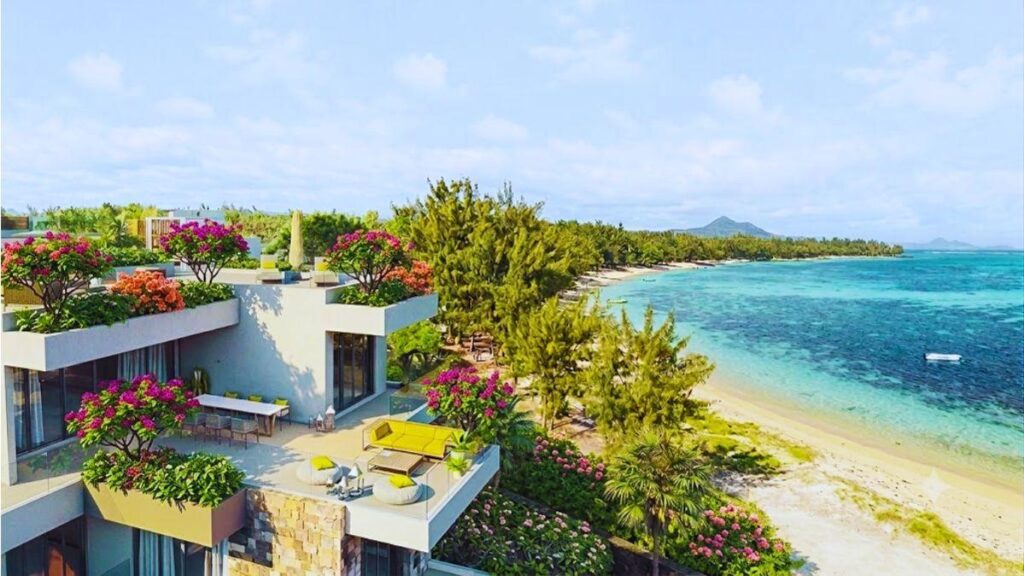
In response to strong demand from affluent international buyers, developers have increasingly shifted towards vertical construction, including ground-plus-two-storey (G+2) residential developments.
Industry sources acknowledge that many of these luxury properties remain beyond the financial reach of most Mauritians. Standard luxury villas are reportedly priced between USD 1.2 million and USD 8 million, equivalent to approximately MUR 56.55 million to MUR 380.8 million, while exceptional trophy beachfront estates can command more than USD 15 million.
Property prices per square metre range from around USD 3,500 for inland villas in Moka to more than USD 8,500 in prime coastal locations such as Belle-Mare. As a result, significant stretches of the coastline have effectively become the preserve of high-income buyers, with only a small segment of Mauritian households able to afford coastal properties.
Foreign nationals seeking Mauritian residency through real estate investment are generally required to make a minimum investment of USD 375,000 under schemes approved by the Economic Development Board (EDB).
These include the Property Development Scheme (PDS), which serves as the principal framework for new luxury developments; the older Integrated Resort Scheme (IRS), which provides resale opportunities in established resort complexes; and the Ground+2 (G+2) scheme, which allows foreigners to purchase apartments in qualifying multi-storey buildings.
Other investment avenues include the Smart City Scheme, covering mixed-use residential, commercial and educational developments in areas such as Moka and Cap Tamarin; the Senior Living Scheme for buyers aged 50 and above; and the Real Estate Scheme (RES), under which foreign purchases can begin at USD 350,000, although such purchases do not automatically provide residency.
Eligible investors can obtain a renewable 10-year residency permit covering the purchaser, their spouse and dependent children under the age of 24. The conveyancing process generally takes between eight and 16 weeks, while residency may be granted within four to eight weeks following registration. The framework also offers tax advantages, including the absence of capital gains tax on resale.
Successive Mauritian governments have sought to manage the impact of foreign investment and protect domestic affordability by segmenting the property market since 2002.
Under the existing framework, foreign capital is directed towards designated luxury development corridors, while non-scheme properties, including inherited land and historic estates, are generally unavailable for freehold purchase by foreign nationals.
While inland properties remain comparatively accessible to Mauritian buyers, the continued expansion of high-end coastal developments is placing additional pressure on the country’s limited land resources. The trend is consequently widening the divide between international demand for premium real estate and the ability of local residents to access property in some of Mauritius’ most sought-after coastal areas.